SpaceX 2Q26 earnings: Compound's read
SpaceX beat earnings in its first quarter since going public, but the stock still fell 10%
by Compound Team · August 5, 2026 · 8 min read
Earnings recap
SpaceX reported 2Q26 after close on Tuesday. It beat earnings across the board, yet the stock opened 10% lower today. See the SpaceX earnings model Compound built here.
To recap: SpaceX reported revenue of $7.8B (+92% YoY and a +15% beat) and Adjusted EBITDA of $3.5B (+191% YoY and a +71% beat). AI segment Adjusted EBITDA turned positive for the first time at $1.1B. The company ended the quarter with $100B of cash and marketable securities (mainly from financing - enough to fund roughly five quarters of capex at the current rate, assuming no future raises) and $47.5B of backlog (combining all segments).
The stock still moved lower at the open, for two likely reasons: 1/ capex of $18.4B (+550% YoY, +82% QoQ), with management signalling a similar level in each of the next two quarters, and 2/ the overhang from a lock-up expiring tomorrow, releasing 912m shares held by non-Musk insiders and taking the free float from roughly 5% to 12% of shares outstanding.
| % change | ||||||
|---|---|---|---|---|---|---|
| Q1'26 | Q2'26 Est | Q2'26 Act | QoQ | YoY | Beat / Miss | |
| Revenue | 4,694 | 6,827 | 7,814 | +66.5% | +91.9% | +14.5% |
| Adj. EBITDA | 1,127 | 2,066 | 3,538 | +213.9% | +191.4% | +71.2% |
| EPS ($) | n/a | (0.23) | (0.09) | n/a | n/a | n/a |
| Capex | 10,107 | n/a | 18,369 | +81.7% | +550.2% | n/a |
| Segment revenue | ||||||
| Space | 619 | n/a | 962 | +55.4% | +29.0% | n/a |
| Connectivity | 3,257 | n/a | 4,291 | +31.7% | +65.8% | n/a |
| AI | 818 | n/a | 2,561 | +213.1% | +247.5% | n/a |
| Segment adj. EBITDA | ||||||
| Space | (351) | n/a | (205) | n/a | n/a | n/a |
| Connectivity | 2,087 | n/a | 2,597 | +24.4% | +64.1% | n/a |
| AI | (609) | n/a | 1,146 | n/a | n/a | n/a |
Deep-dive into the segments
Space: Reported revenues of $962m (+29% YoY and +55% QoQ) on ten customer launches versus seven in 1Q26. Adjusted EBITDA a $205m loss. Total segment costs and expenses rose +$389m YoY, of which R&D accounted for $383m as Starship spend accelerated. The segment is being run for capability rather than for near-term earnings and management has been explicit about that.
Connectivity: Reported revenues of $4.3B (+66% YoY and +32% QoQ). Starlink reached 12.0m subscribers, double the level a year ago, with ARPU flat at $66. Enterprise and government revenue was the standout at $1.8B (+108% YoY) on American Airlines, Southwest, Virgin Atlantic, Iberia and Aer Lingus activations, new Starlink Mobile partnerships with SoftBank, NTT Docomo and Spark NZ and over $6B of multi-year Starshield awards. Adjusted EBITDA was $2.6B (+64% YoY).
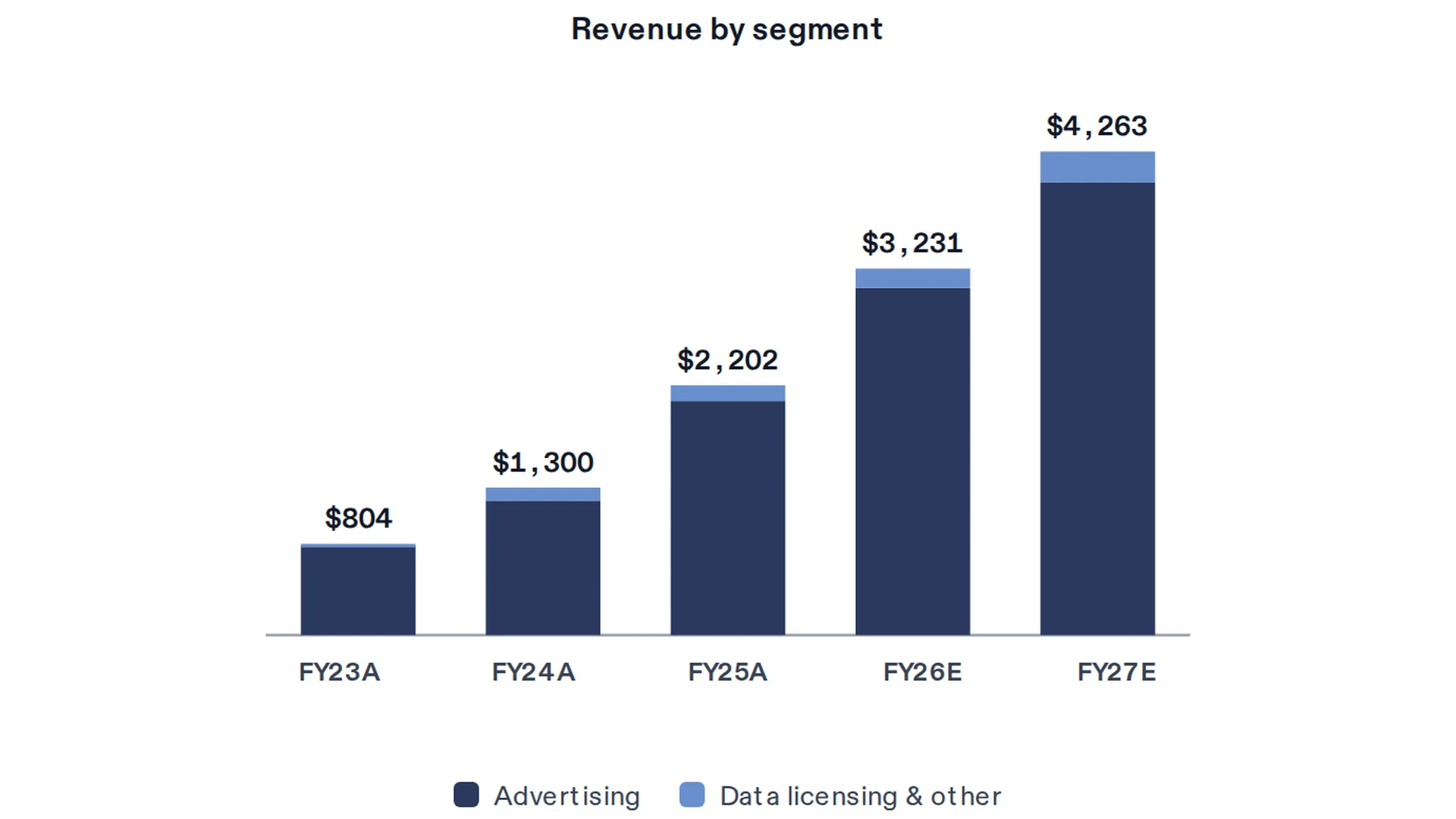
AI: Reported revenues of $2.6B (+247% YoY and +213% QoQ). AI solutions and infrastructure revenue was $2.2B (+$1.9B YoY and +362% QoQ). Of that, $1.6B was incremental revenue from new Cloud Services Agreements totalling $14.1B in contracted sales. Nameplate compute reached 1.4 GW, from 1.0 GW in 1Q26 and 0.4 GW a year ago. AI capex was $15.8B in the quarter, driving the majority of the company’s $18.4B total. Advertising did not perform as well - revenue was $367m, down 14% year on year. It grew 7% QoQ as the ad platform was rebuilt, but the YoY trend is still negative.
Seven KPIs we track, and what moved
1 / Customer launches: the mix tilted to government
Ten customer launches in 2Q26 against seven in 1Q26. On our estimates the split was four commercial and six government, from three and four in 1Q26. Government has now been the larger half for two quarters running, having been the smaller half in every quarter of 2025.
The revenue effect came through payload rather than count. Customer mass per launch rose from 6.4 to 8.7 metric tons, and blended revenue per customer launch rose from $47m to $65m. SpaceX does not disclose commercial and government pricing separately, so we cannot attribute that directly to the mix, though the release credits “a higher number of large customer launches and a favorable customer shift”. The government tilt also shows up in work that sits outside this chart: over $6B of multi-year Starshield awards signed in the quarter, and $314m of Launch & Development revenue recognised cost-to-cost.
We carry 11 and 12 customer launches for 3Q26E and 4Q26E, with commercial recovering to six then seven. This extrapolates trends similar to 3Q25 and 4Q25 and assumes 1Q26 was an outlier.
2 / Cost per kg: mass moved it, not cost
$3.8k/kg in 2Q26 against $6.2k/kg in 1Q26. Almost all of that is the denominator: customer mass to orbit went from 45 to 87 metric tons while cost of revenue was roughly flat, $329m against $281m. 1Q26 was the outlier rather than 2Q26. At 87 tons the quarter sits inside the 74 to 88 ton range of 2025, so we read it as the closer of the two to normal.
We hold $3.7k and $3.6k/kg for 3Q26E and 4Q26E on customer mass of 88 and 96 tons, which is the 2025 average carried forward on a broadly flat cost of revenue.
Those are Falcon economics. Starship carried no customer payloads in 2Q26 and none in our forecast, so nothing in this chart reflects it. That is worth spelling out because Starship is the vehicle meant to move this line: management says it will cut the cost to orbit by 99% or more against the historical average. None of that is in our numbers, so read this metric as the cost of the fleet flying today rather than a view on where cost per kg ends up.
3 / Starlink subscribers: 1.7m added, level with 4Q25
12.0m subscribers at quarter end, up 1.7m in the quarter, level with 4Q25 and double the 6.0m of a year ago. Adds stepped back to 1.4m in 1Q26 before returning to 1.7m.
We carry net adds of 1.8m and 2.1m for 3Q26E and 4Q26E, taking the base to 15.9m. The driver we would point to is capacity rather than any single customer: management called out higher R&D on the next-generation V3 satellites, which it expects to deliver meaningful increases in broadband capacity and data density, and capacity is what has gated self-serve growth in the markets where Starlink is already live.
4 / Starlink ARPU: flat sequentially, lower year on year
Blended ARPU was $66 a month, unchanged from 1Q26 and down from $85 a year ago. The year-on-year move is mix rather than price, as international markets and lower tiers become a larger share of a base that doubled. The sequential figure held flat alongside 1.7m net adds.
We carry $65 and $64 for 3Q26E and 4Q26E. That continues the roughly $1 a quarter drift of the last three quarters as mix keeps shifting, and assumes no change in list pricing.
5 / Consumer AI: the smallest line in the segment
Paying X Premium and SuperGrok subscribers were roughly 7.6m on our estimate, from a disclosed 6.3m at 1Q26 and 4.9m at the end of 2025. Subscription ARPU is near $18 a month. At roughly $380m of quarterly revenue this is the smallest piece of the AI segment, against $2.2B from AI solutions and infrastructure.
We carry 8.8m and 10.0m subscribers for 3Q26E and 4Q26E, extrapolating the last four quarters, with ARPU at $19.30 and $19.86 respectively. We attribute the increase to tier mix, with Grok 4.5 pulling users up into the higher-priced tiers.
6 / Compute: 1.4 GW today, 2 GW targeted by year end, 10 GW by end-2027
Nameplate compute reached 1.4 GW, up from 0.4 GW a year ago and 1.0 GW last quarter. This is the fastest-growing line in the company and the one absorbing the capex.
Management has put two markers down: over 2 GW by the end of 2026, and for end-2027 Musk said “closer to 10 GW of compute than 5 GW.”
The line on the right axis is what a contracted watt currently earns: $19/W a year, on the capacity leased out under Cloud Services Agreements. It starts in 2Q26 because that is the first quarter any capacity was leased.
7 / Capex per watt: higher than a year ago on both cuts
AI capex divided by nameplate compute added was $39.57/W in 2Q26 and $38.62/W in 1Q26. On a cumulative basis, total spend over total capacity added, it is $32.98/W at 2Q26 against $25.45/W at the end of 2025. Both cuts sit above where they were a year ago.
Against a $19/W rental price, capex near $39/W implies roughly two years to recover the build on revenue alone. The comparison is loose: capex is per nameplate watt, revenue per contracted watt, and only half the fleet is saleable. So we can neither reconcile CFO Bret Johnsen’s sub-one-year payback nor rule it out. It could hold on compute hardware alone, or on cash collected under take-or-pay terms. A capex split between saleable and internal capacity would settle it.
We hold $40/W for 3Q26E and 4Q26E, on 400 MW added and $16B of AI capex each quarter. That assumes the Vera Rubin generation costs about what the current build costs, with no scale benefit yet.
What management committed to on the call
- $100B ARR by December 2026, pulled forward a year, against a $31B run-rate today.
- $6.7B of further cloud services signed in early 3Q26, ramping from October, counterparties unnamed.
- Over 2 GW of compute by end-2026, and “closer to 10 GW of compute than 5 GW” by end-2027.
- A 20 GW power and cooling pipeline, with perhaps 15 GW expected to land.
- Building exclusively on Nvidia Vera Rubin, expecting “a very significant percentage” of next year’s GPUs.
What analysts pressed on
Compute buildout
Adam Jonas, Morgan Stanley: Whether there is line of sight on the permitting, chips and turbines behind 10 GW by end-2027.
Elon Musk (CEO): Guided to “closer to 10 GW of compute than 5 GW” by the end of 2027, against a target of 20 GW of power and cooling projects with perhaps 15 GW expected to land, and expects to take “a very significant percentage” of Nvidia's GPUs next year.
John Hodulik, UBS: How much of the 2027 capacity is withheld to train Grok rather than leased to customers.
Elon Musk (CEO): Roughly 10% retained for Grok training, falling over time. That leaves a saleable share above what most published models assume.
Capital intensity
John Godyn, Citigroup: The capex outlook by segment, and where the company builds rather than buys, including Terafab.
Bret Johnsen (CFO): No figure given. Argued that compute capex carrying a sub-one-year payback behaves “almost like an item that you would put otherwise in COGS”, which implies the depreciation drag is temporary.
The $100B ARR bridge
Edison Yu, Deutsche Bank: What gave management the confidence to pull the $100B run-rate forward a year, and what makes up the bridge.
Elon Musk (CEO): “the $100 billion ARR in December is not a question mark. That's what we'd achieve if we basically did nothing.”
Bret Johnsen (CFO): All three segments contribute, with cloud services the largest single piece.
Enterprise durability
Eric Sheridan, Goldman Sachs: How the enterprise and government backlog converts into recognised revenue.
Gwynne Shotwell (President & COO): SpaceX has never lost an enterprise customer, and aviation is only around 10% penetrated.
Elon Musk (CEO): Expects enterprise revenue to exceed consumer revenue substantially.
Mobile ambition
Kutgun Maral, Evercore ISI: A genuine fourth US carrier implies well over $100B of mobile capex. How that is weighed against an MVNO or an acquisition.
Elon Musk (CEO): No capex figure. Sketched a cheaper route using femtocells mounted on existing Starlink dishes rather than new macro towers, with satellites flying next year and service at the end of next year.
Quotation marks are verbatim from the call. Everything else, including the questions, is our summary.
Where we come out
This was a strong quarter on the numbers, and the operating story is intact: Connectivity compounding, AI turning its first Adjusted EBITDA profit, and compute scaling faster than anything else in the business.
We are not publishing a valuation view on SpaceX for now. The near term looks unsettled for reasons that have little to do with the fundamentals. Tomorrow’s lock-up expiry roughly doubles the free float and further tranches follow.
Chart conventions: solid bars are reported, hatched bars in the shaded band are our estimates, and the dashed outline is management’s target. Cost per kg, the rental price and capex per watt are our derivations; the launch and ARPU splits are our estimates. † SpaceX never reported 3Q25 or 4Q25 separately, so daggered columns carry third-party estimates scaled to the disclosed FY25 total.
Sources: SpaceX 2Q26 earnings press release and Form 10-Q; SpaceX 2Q26 earnings call transcript, 4 August 2026; SpaceX IPO prospectus; the Compound SpaceX Quarterly Earnings Tracker, the model behind every chart and estimate here. Figures described as derived or estimated are our calculations rather than company disclosures.