| B | C | D | E | |
|---|---|---|---|---|
| 42 | DILIGENCE LOG | Items | Due by DD expiry | Due by closing |
| 43 | Seller | 291 | 18 | 11 |
| 44 | Buyer | 6 | 5 | 1 |
| 45 | Counsel | 6 | 4 | 2 |
| 46 | Lender | 2 | 1 | 1 |
| 47 | Consultant | 9 | 9 | 0 |
| 48 | Total | 52 | 372 | 15 |
| 49 | Of which closing conditions | 15 |
- 1Most open items sit with the seller: documents to deliver and questions to answer
- 2Due before the diligence period ends, while the buyer can still walk away
You are the associate on the buy side of Cedar Fork Commerce Park, a 248,400 square foot multi-tenant industrial and flex park on 19.6 acres in Lewisville, Texas. The broker asks $48.0M, a 6.00% cap rate on the seller’s in-place NOI of $2.88M, for a December 15, 2026 closing. The offering memorandum (OM) says the site has no environmental issues, lies entirely in flood Zone X and has a capital plan “in place”, and that its largest tenant is committed through June 2032.
Due diligence in real estate is how you test each of those statements, inside the due diligence period the purchase agreement sets, while you can still walk away or renegotiate. This page takes it one step at a time, each step run in Compound: the timeline, the diligence log, the findings by workstream, what goes back to the seller and what it does to the price. Figures in the text are rounded, in $M for the park and $k for single items. The tables show Compound’s exact figures.
Each suite ID is a building letter and a suite number, so C-200 is Building C, suite 200. The park has six buildings, A to F, holding 19 suites. Six suites come up on this page.
| Suite | Tenant | What diligence finds |
|---|---|---|
| A-100 | Lone Star Cabinetry | Largest tenant, can leave in 2028 |
| B-200 | Pecan Street Brewing Supply | Free rent past closing |
| C-100 | Brazos Fire Protection | Uses a storage yard zoning can take away |
| C-200 | Redbird HVAC Services | Unpaid TI and an offset claim |
| C-400 | Lakeview Auto Glass | No estoppel returned |
| F-300 | Prairie Dental Lab | No signed lease |
Cedar Fork Commerce Park, its tenants, its seller, its title company and its consultants are illustrative: a made-up property with a data room built to read like a real one. Everything Compound produced on this page is real: the diligence log, the checklist workbook, the findings memo and the title and survey objection letter come from one Compound run on that room, quoted unedited.
The due diligence period and the closing date
The first step fixes the dates every diligence item has to meet.
The OM targets a December 15, 2026 closing. The purchase and sale agreement (PSA) that will set the diligence period is not in the room yet, so Compound’s log assumes the period ends on November 20, 2026 and marks that date as an assumption until the PSA is signed. Most PSAs also require tenant estoppels dated within 30 to 45 days of closing, and the log uses 30 days.
Cedar Fork dates the diligence log has to manage
Report and estoppel dates, the diligence period, closing and the lease events that change the findings
Source: Cedar Fork OM, third-party reports, estoppel tracker, leases, A-100 First Amendment and zoning letter (illustrative). Diligence expiry is the log's assumption until the PSA is signed. Dates from Compound's Diligence Log and lease abstract.
The reports in the room are dated August and the estoppels September. By a December closing the estoppels will be 81 to 98 days old, too old for the 30 to 45 day window, so the timeline already sets one closing condition.
Takeaway: about four weeks remain until the assumed end of the diligence period, and eight until closing.
That is not long for a room of seven folders and six third-party reports. Which items are still open, and who has to close each one?
The diligence log: every open item with an owner and a due date
The second step turns the data room into one list of open items, each with an owner, a question and a date.
The room holds the OM and the seller’s financials, 17 leases and their amendments, the rent roll and T12, the tax notice, the third-party reports (PCA, Phase I, appraisal, survey, zoning letter, title commitment), 15 tenant estoppels and the insurance certificate. The usual first move is last deal’s checklist template with a column of checkmarks. It shows which documents arrived. It does not say what they contain, who has to act or by when.
Compound first read every document into a 61-row checklist, then wrote the 52 rows that need action into a Diligence Log. Each row cites its document, and each due date is a formula on the closing date or the assumed diligence expiry. These are ten of the rows, one or more from each workstream.
| B | D | E | F | G | I | L | O | |
|---|---|---|---|---|---|---|---|---|
| 11 | Log # | Workstream | Item | Status | Owner | Value at stake ($) | Question or request to the seller | Due date |
| 18 | L-07 | Title | 30-foot drainage and utility easement under the Building D truck court (B-II item 9) | Closing condition1 | Seller | Provide the recorded instrument and obtain the grantee's recordable consent to the paving and stalls, with restoration at its cost, or title affirmative coverage. | 2026-12-05 | |
| 19 | L-08 | Survey | Survey certification | Open | Seller | Have North Texas Land Surveying recertify to the buyer, its lender and Kessler Bluff Title Company with a current field date. | 2026-11-10 | |
| 24 | L-13 | Zoning | C-100 outdoor storage yard (legal nonconforming) | Open | Seller | Confirm the yard has been used continuously since 2015 and provide any City correspondence about it. | 2026-11-05 | |
| 26 | L-15 | Environmental | Building E underground fuel tank (REC) | Open | Consultant | 25,000 | Grant site access for a Phase II and provide any tank removal, registration or closure records. | 2026-11-05 |
| 28 | L-17 | Physical condition | Building C roof | Price item | Seller | 612,0002 | Replace the Building C roof before closing or credit $612,000; provide the leak and repair history. | 2026-11-10 |
| 33 | L-22 | Leases and estoppels | F-300 Prairie Dental Lab: no executed lease | Closing condition | Seller | 100,650 | Deliver the executed F-300 amendment and an F-300 estoppel, or confirm the tenant is month-to-month. | 2026-12-05 |
| 35 | L-24 | Leases and estoppels | C-200 unfunded TI and offset claim | Closing condition | Seller | 38,500 | Fund the $38,500 before closing and deliver a clean C-200 estoppel, or credit $38,500 at closing. | 2026-12-05 |
| 37 | L-26 | Leases and estoppels | Estoppel bring-down before closing | Closing condition | Seller | Re-issue or bring down all 17 estoppels, dated within the window in the inputs above, with the C-200 offset exception cleared. | 2026-12-103 | |
| 50 | L-39 | Insurance and flood | Flood zone | Open | Consultant | Provide any flood determination or elevation certificate on file. | 2026-11-10 | |
| 55 | L-44 | Closing deliverables | Purchase agreement terms | Open | Counsel | Agree the PSA, including the diligence period, title objection deadline, a 30 to 45 day estoppel window and the closing conditions in this log. | 2026-10-264 |
- 1L-07: the grantee could remove the paving and 14 of the 24 marketed trailer stalls
- 2L-17: not in the OM's $150,000 roof budget, and the leases do not let the owner recover it from tenants
- 3L-26: bring-downs must be dated on or after 11/15/2026 for a 12/15/2026 closing
- 4L-44: due first, because the PSA fixes the diligence period the other dates assume
Twenty-nine of the 52 rows sit with the seller, 37 are due before the diligence period ends, and 15 are conditions to closing. Each row also carries the question that closes it. The seller’s share rolls up into a list of 19 questions in the next-to-last step.
Takeaway: the log replaces a list of received documents with a list of decisions, each owned and dated.
The rows with the most value at stake come from the reports on the buildings. What do the PCA and the Phase I say that the OM does not?
Physical and environmental due diligence: PCA and Phase I
The third step reads the engineer’s and the environmental consultant’s reports against the OM’s capital plan.
The property condition assessment (PCA) is an engineer’s walk-through of the buildings and site that prices the repairs due now and over the next few years. Halcyon Building Sciences wrote Cedar Fork’s for the seller in August. The OM budgets $150k for roofs and says the capital plan is in place.
The PCA prices $923k of short-term work. Building C still has its original 2001 built-up roof, leaking now: $612k in years 1 and 2. Paving at Buildings D to F needs a mill and overlay in year 3, and nine rooftop HVAC units are past their useful life. Compound then read the leases to see who pays. Capital improvements are excluded from recoverable operating expenses, so the roof stays with the owner.
The PCA's near-term capital against the OM's roof budget
Immediate and short-term costs, years 1 to 5, on one scale
Source: Cedar Fork OM, Cash Flow Assumptions, and Property Condition Assessment, Table 1 (illustrative). Calculation by Compound, Exposure sheet.
A Phase I environmental site assessment reviews records, the site and its history for a recognized environmental condition (REC). Trinity Environmental Group found one. A 1,000-gallon underground fuel tank from a 1990s fleet maintenance use at Building E has no closure record with the Texas Commission on Environmental Quality (TCEQ). Trinity recommends a Phase II subsurface investigation at $18k to $25k. The OM does not mention the tank. Both reports were written for the seller, so the log also asks for reliance letters for the buyer and its lender.
Takeaway: the near-term capital is $773k above the OM’s budget, and the roof alone is $612k the owner cannot pass to tenants.
The log carries the roof as L-17 and the tank as L-15. The questions for the seller: “Will you replace the leaking Building C roof before closing, or credit $612,000?” and “Grant access for a Phase II at Building E and provide any tank registration, removal or TCEQ closure records.”
The buildings are priced. Who else has rights to the land under them?
Title commitment vs survey: trailer stalls inside an easement
The fourth step lays the title commitment over the survey to find what each exception allows and what sits inside it.
The title commitment is the title company’s offer to insure, and Schedule B-II lists the exceptions it will not cover. Kessler Bluff Title Company issued Cedar Fork’s. The ALTA/NSPS survey is North Texas Land Surveying’s map of the land, the improvements and the exceptions that can be plotted. The commitment says what an easement allows. Only the survey shows what sits inside it.
Exception 9 is a 30-foot drainage and utility easement recorded at Vol. 4417, Pg. 212. The commitment says it crosses the Building D truck court and that its grantee may remove improvements within it. The survey puts all 14 striped Building D trailer stalls inside it. The OM markets 24 trailer stalls and does not mention the easement.
14 of 24
Trailer stalls inside the exception 9 easement, all of Building D's
0.6 acres
In flood Zone AE. The OM and insurance say Zone X
8 of 12
Schedule B-II exceptions the survey does not locate
The same survey puts about 0.6 acres of Building F’s parking field in flood Zone AE, the FEMA zone with a 1% annual chance of flooding. The appraisal agrees, the OM and the insurance certificate say Zone X, and flood is not insured. The survey is also certified only to the seller and Kessler Bluff Title Company, so neither the buyer nor its lender can rely on it.
Takeaway: 58% of the park’s trailer parking depends on a grantee that can remove it, and the OM does not say so.
The log carries the easement as L-07, a closing condition. The question for the seller: “Provide the Vol. 4417, Pg. 212 easement and obtain the grantee’s recordable consent to the Building D paving and 14 trailer stalls, or title affirmative coverage.”
The survey shows what is on the land. Does the zoning allow the way it is used?
Zoning letter vs leases: a storage yard that can be lost
The fifth step reads the city’s zoning letter against the leases that rely on the site.
The City of Lewisville’s letter says the park is zoned LI-2, rezoned in 2015, and every building’s use conforms. Further down, it calls the fenced outdoor storage yard behind Building C legal nonconforming: allowed because it predates the rezoning, and lost if the use stops for 12 months or the building is more than 50% destroyed.
You
Compound
If Brazos leaves in 2028 and the yard sits empty for a year while the suite is re-let, the next tenant cannot have it. A suite with a legal outdoor yard leases differently from one without, so the yard is at risk from the 2028 rollover.
Takeaway: the yard’s right to exist depends on continuous use, and only the zoning letter and the C-100 lease together show it.
The log carries it as L-13. The question for the seller: “Confirm the yard has been used continuously since 2015 and provide any City correspondence about it.”
Zoning is the city’s account of the site. What do the tenants themselves certify?
Commercial lease due diligence: estoppels to re-issue before closing
The sixth step reads the tenants’ estoppels and the lease work into the log as credits and closing conditions.
A tenant estoppel certificate is the tenant’s signed statement of its lease, rent, deposit and any claims against the landlord. Each lease was abstracted and tied to the rent roll on the rent roll analysis page. Its findings arrive here as checklist rows.
| B | D | F | I | K | |
|---|---|---|---|---|---|
| 5 | Ref | Diligence item | Status | Dollar exposure ($) | Action |
| 39 | LSE-02 | F-300 Prairie Dental Lab: no executed lease in effect | Issue | 100,6501 | Closing condition |
| 40 | LSE-03 | B-200 free rent | Issue | 17,284 | Price adjustment |
| 42 | LSE-05 | C-200 unfunded TI and rent offset claim | Issue | 38,5002 | Closing condition |
| 43 | LSE-06 | Missing estoppels: C-400 and F-300 | Missing | Closing condition | |
| 44 | LSE-07 | Estoppel dating | Issue3 | Closing condition |
- 1Lease expired 5/31/2026. The extension to 2029 is an unsigned draft
- 2C-200 claims the right to take the unpaid $38,500 out of rent
- 315 of 17 estoppels will be 81 to 98 days old at a 12/15/2026 closing
Fifteen of 17 estoppels came back. C-200’s claims $38.5k of unpaid TI as an offset against rent, and B-200’s confirms free rent through January 2027. C-400 and F-300 have returned none, and F-300 pays $8.4k a month on a draft extension nobody signed.
The estoppels in hand are dated September 8 to 25. At a December 15 closing they will be 81 to 98 days old, and most PSAs and lenders require estoppels dated within 30 to 45 days of closing. Every tenant must re-issue or bring down its estoppel before closing, so the log makes that a closing condition, together with first estoppels from C-400 and F-300 and a C-200 estoppel without the offset claim.
Takeaway: the lease work adds $55.8k of credits, and all 17 must be re-issued or brought down before the buyer can close.
The log carries the bring-down as L-26. The question for the seller: “Obtain C-400 and F-300 estoppels, and have all 17 tenants re-issue or bring down estoppels dated within 30 to 45 days of closing.”
Each workstream has left its questions in the log. How do they reach the seller?
What goes back to the seller: the question list and the objection letter
The seventh step sends the log’s questions to the seller in two forms: a prioritized list for the deal team and a title and survey objection letter for counsel.
Compound’s Seller Questions sheet holds 19 requests. The quantified ones come first, ordered by the value at stake, and the closing items follow.
| B | C | D | E | F | G | |
|---|---|---|---|---|---|---|
| 5 | # | Question or request to the seller | Log # | Value at stake ($) | Unit | Due date |
| 6 | 1 | Provide the A-100 TI and leasing commission amortization schedule and any tenant communication about its 30 Jun 2028 termination right. | L-28 | 1,657,0321 | rent at risk | 2026-11-05 |
| 7 | 2 | Will you replace the leaking Building C roof before closing, or credit $612,000? Please send the leak and repair history. | L-17 | 612,0002 | total | 2026-11-10 |
| 8 | 3 | Provide the 2024-2026 tax protest history and any CAD correspondence on value. | L-34 | 441,000 | a year | 2026-11-05 |
| 9 | 4 | Provide paving maintenance history and any bids for the Buildings D-F mill and overlay. | L-18 | 185,000 | total | 2026-11-05 |
| 10 | 5 | Confirm the $142,000 Gulf Coast Vending termination fee was a one-time payment with no continuing obligations. | L-30 | 142,000 | a year | 2026-11-05 |
| 11 | 6 | Identify the nine RTUs past useful life, the suites they serve and their service contracts, and who replaces them under the leases. | L-19 | 126,000 | total | 2026-11-05 |
| 12 | 7 | Deliver the executed F-300 amendment and an F-300 estoppel, or confirm Prairie Dental Lab is month-to-month. | L-22 | 100,650 | a year | 2026-12-05 |
| 13 | 8 | Will you fund the $38,500 C-200 TI balance before closing and deliver a clean C-200 estoppel, or credit it at closing? | L-24 | 38,500 | credit | 2026-12-05 |
| 19 | 14 | Provide the Vol. 4417, Pg. 212 easement and obtain the grantee's recordable consent to the Building D paving and 14 trailer stalls, or title affirmative coverage. | L-07 | not quantified | 2026-12-05 | |
| 20 | 15 | Obtain C-400 and F-300 estoppels, and have all 17 tenants re-issue or bring down estoppels dated within 30 to 45 days of closing.3 | L-25, L-26 | closing condition | 2026-12-05 |
- 1Base rent from 7/1/2028 to 6/30/2032, at risk only if A-100 uses its termination right
- 2The one question that is a price ask: replace or credit
- 3The estoppel bring-down, a condition to closing
The title and survey rows go to counsel as a draft objection letter. It turns each row into a numbered objection under the PSA, with brackets where the PSA, not yet in the room, decides the answer.
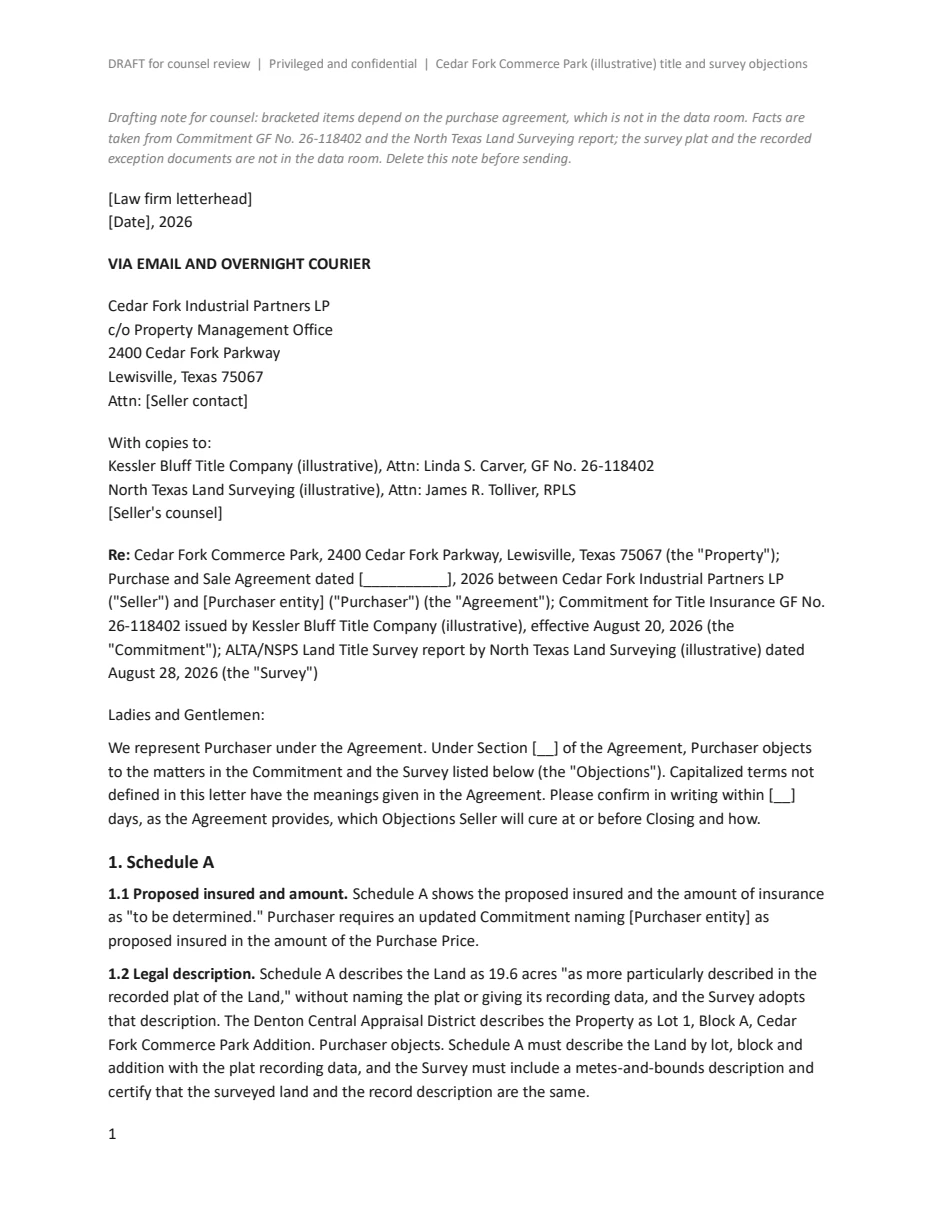
Its objection on exception 9, in the draft’s words: before closing and at the seller’s cost, deliver the recorded instrument and “obtain and record an agreement from the grantee consenting to the existing paving, truck court and trailer stalls within the easement and agreeing to restore at its cost any improvements it disturbs”, or have the title company “issue affirmative coverage acceptable to Purchaser against loss from enforced removal of those improvements.” Failing that, the buyer reserves termination or a price adjustment.
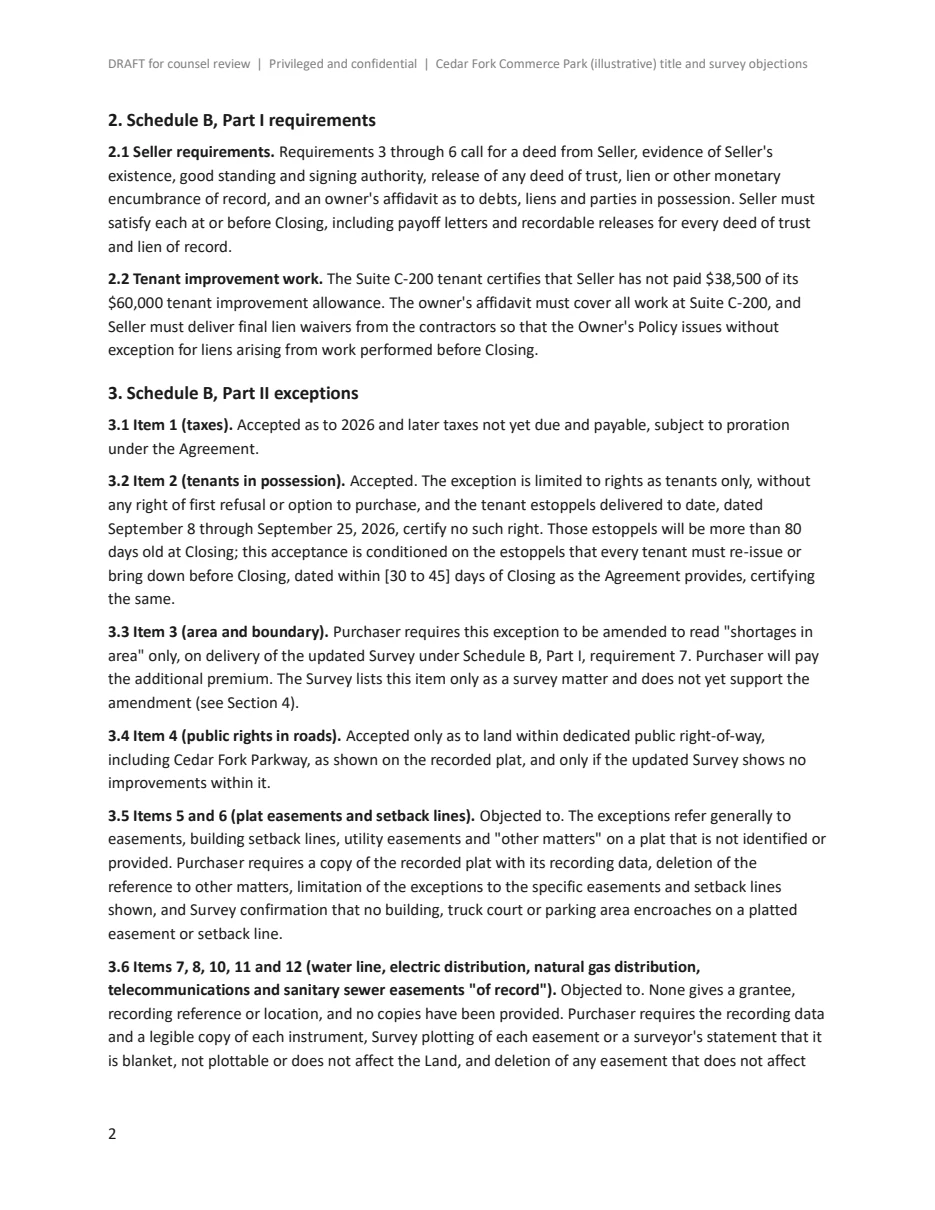
Takeaway: the seller gets the log’s questions twice, as a ranked list from the deal team and as numbered objections from counsel.
The seller’s answers decide what gets cured. If the facts stay as the reports read, what does the diligence do to the price?
What the diligence does to a $48.0M ask
The last step turns the log’s price items into value, and keeps the closing credits apart from the price.
Compound wrote the findings into a memo for the investment committee and put them on one page for the IC deck.
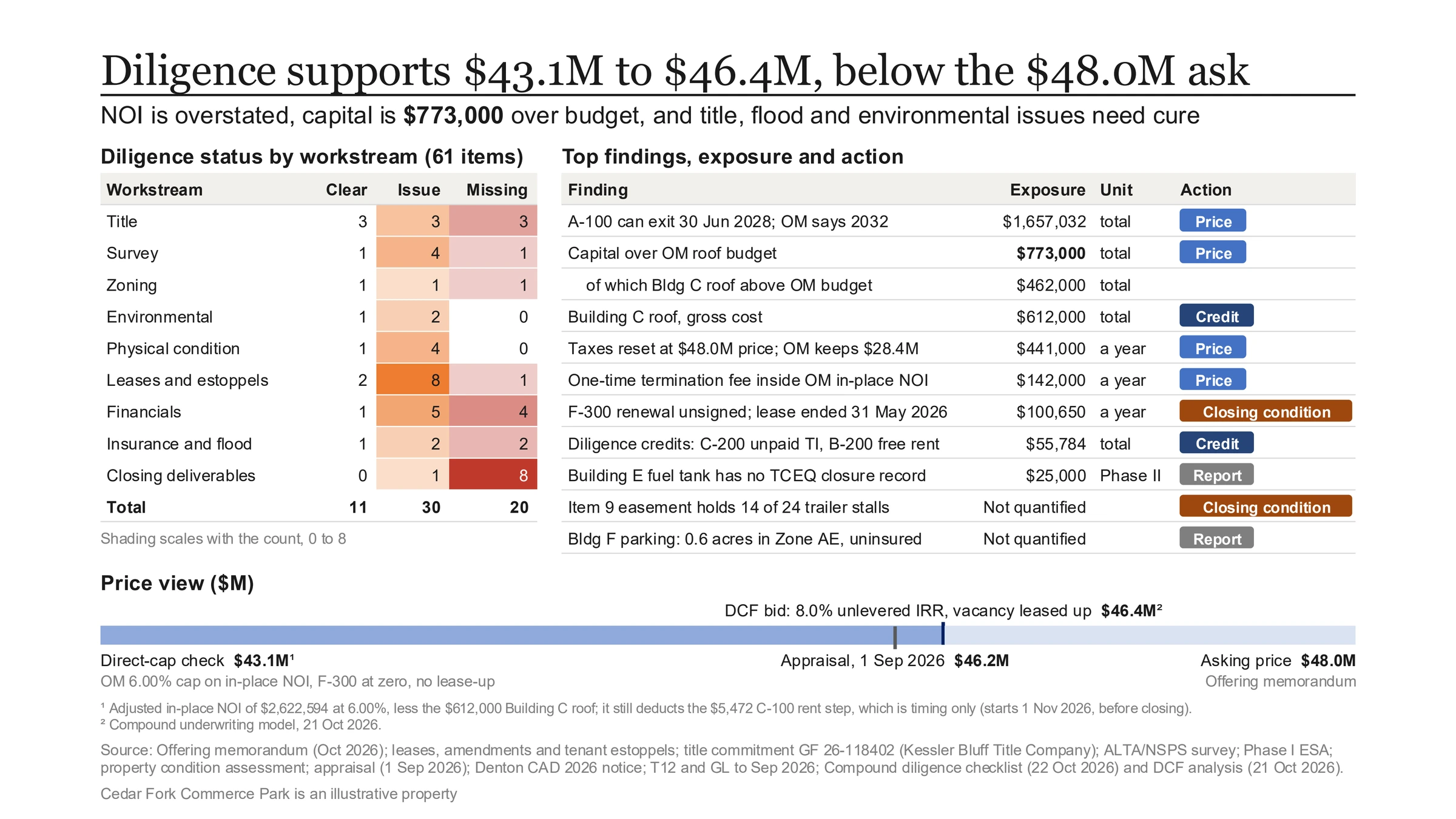
The memo asks the committee to approve a re-trade toward about $43.1M. Diligence-adjusted NOI of $2.62M at the OM’s own 6.00% cap, less the $612k Building C roof, gives $43.1M. That is $4.9M below the ask and $3.1M below the seller’s own $46.2M appraisal.
The $43.1M is a direct-cap check, and it is conservative. It capitalizes today’s NOI with F-300 at zero and no lease-up. It also deducts C-100’s $5.5k rent step, which is timing only (about $91k at 6.00%), and F-300’s $100.7k, which a signed extension would restore (about $1.68M). The pro forma prices the same findings over a ten-year hold, leases up the vacant space and bids $46.4M.
Apart from the price, two diligence findings become credits at closing. The deposits and the tax proration change hands at every closing, so the Exposure sheet keeps them in a separate block.
| B | C | |
|---|---|---|
| 95 | CLOSING CREDITS TO BUYER | |
| 96 | B-200 free rent remaining after closing (diligence finding) | 17,283.87 |
| 97 | C-200 unfunded TI allowance (diligence finding) | 38,500.00 |
| 98 | Credits from diligence findings ($) | 55,783.871 |
| 99 | Tenant security deposits (routine closing item, not a diligence finding) | 226,820.83 |
| 100 | 2026 real estate tax proration, estimate (routine closing item, not a diligence finding) | 609,238.36 |
| 101 | Routine closing items ($) | 836,059.192 |
- 1The only credits the diligence found
- 2Routine at any closing, not a diligence finding
Takeaway: the diligence supports about $43.1M on in-place income, and it adds $55.8k of credits on top of the routine closing items.
The closing conditions that come out of the log:
- Seller replaces the Building C roof before closing or credits $612k.
- Phase II on the Building E tank before the diligence period ends, with TCEQ closure or an escrow as the fallback.
- Grantee consent or title coverage on exception 9, and a survey recertified to the buyer and lender.
- A flood determination on the 0.6 acres in Zone AE.
- All 17 estoppels re-issued or brought down, dated within 30 to 45 days of closing, with first estoppels from C-400 and F-300 and a clean C-200 estoppel.
- An executed F-300 amendment, or F-300 underwritten as month-to-month.
- A certified, corrected rent roll at closing.
The A-100 exit right and the tax reset change the cash flow, so they go into the real estate pro forma rather than the credits. For an operating company, the same method applies to financial due diligence.
FAQ
How long is a commercial due diligence period, and what happens when it ends?
Commercial purchase agreements commonly give 30 to 60 days, sometimes 90 for a complex or environmental-heavy asset, often with shorter separate deadlines for title and survey objections. Until the period ends, the buyer can usually terminate and recover its earnest money. After it, the deposit goes hard. That is why the slowest items, such as a Phase II, a recertified survey and a flood determination, are ordered in the first week.
What is the difference between a due diligence checklist and a diligence log?
A checklist lists every item to review and its status. A diligence log keeps only the items that need action, and gives each one an owner, the open point, the question for the seller and a due date against the diligence period or the closing. The checklist shows coverage. The log runs the work and feeds the seller questions and the objection letter.
Who does each report, and what does Compound do with them?
An engineer writes the PCA, an environmental consultant the Phase I and any Phase II, a surveyor the ALTA/NSPS survey and a title company the commitment, alongside an appraiser, often a zoning report provider, and counsel for the objections and closing documents. Compound replaces none of these firms. It reads their reports against each other, the OM, the leases and the financials, and writes what conflicts, what is missing and what it costs, each cited to the page.
Should we rely on reports the seller commissioned?
Only with a reliance letter, and only if they are current. A survey certified only to the seller and title company does not protect the buyer or lender, and under ASTM E1527-21 a Phase I’s key components must be within 180 days of the acquisition. Ask for reliance letters and recertification, or order your own reports. Lenders typically insist on the same.
How does the checklist change for multifamily?
Title, survey, environmental and zoning stay. The lease section goes from a few dozen negotiated leases to hundreds of standard ones: a unit-level rent roll tied to the ledger, a sample of leases audited, concessions, delinquency and unit turns. Physical diligence adds unit interiors, and code violations and rental registrations matter more.
How does the checklist change for a development site?
With no rent roll or estoppels to check, the weight moves to entitlements, zoning and platting, utility capacity, geotechnical and environmental conditions, access, flood and the title exceptions that limit what can be built. Each report is still read against the business plan and against the others, with each conflict priced or made a condition. A development pro forma and construction budget replace the in-place NOI bridge.