A Day Without Email: What Microsoft's Outage Could Cost, by the SLA Math
Our model puts Microsoft's SLA credits from the Nov. 12-13 outage at about $257 million in the base case. Lost work for customers runs to roughly $12.9 billion.

Microsoft's Outlook and Microsoft 365 outage began shortly before 1 p.m. ET on Thursday, Nov. 12, and was still being cleaned up late Friday. Microsoft said the cause was a technical issue, not a cyberattack: a problem from an earlier network capacity upgrade that surfaced after a more recent network change. The company says it has fixed the underlying issue.
A large number of servers went offline, which pushed their traffic onto the remaining servers. The process that sets up secure connections on those servers became overloaded, and they stopped responding. Microsoft started rolling back a recent network configuration change on Thursday evening and brought service back in stages, checking stability before each step.
Late Friday afternoon, Microsoft had not yet closed the incident. It said recovery was holding, but it planned to keep monitoring and to clear the backlog of queued email first. Downdetector showed about 1,600 Outlook reports at 2:50 p.m. ET Friday, down from 130,000 on Thursday.
What Microsoft owes under its SLA
Microsoft's Service Level Agreement for Online Services commits to 99.9% monthly uptime for Exchange Online on business plans. When uptime falls short, customers can claim a credit on that month's fee:
- Below 99.9% uptime: 25% credit
- Below 99%: 50% credit
- Below 95%: 100% credit
Uptime is measured in user-minutes, so it depends on how many of a customer's users were affected and for how long. Only time when users could not send or receive email in Outlook on the web counts. The credit applies to Exchange Online's share of a suite price such as E3 or Business Standard, not the whole bill.
In a 30-day month, a user who lost email for more than 7.2 hours qualifies for the 50% credit. The 100% credit requires more than 36 hours of downtime, which most users probably did not reach.
We estimated the total from the $27.8 billion of Microsoft 365 cloud revenue Microsoft reported for the quarter ended Sept. 30, 2026. The model narrows that to commercial customers, the Exchange share of suite fees, the share of seats affected and the share of customers who file a claim. Microsoft does not apply credits automatically, and claims for this outage are due by Dec. 31, 2026.
Expected credits come to about $47 million in our low case, $257 million in the base case and $818 million in the high case. If every affected customer claimed, the base case would reach about $733 million, or 2.6% of one quarter's Microsoft 365 cloud revenue.
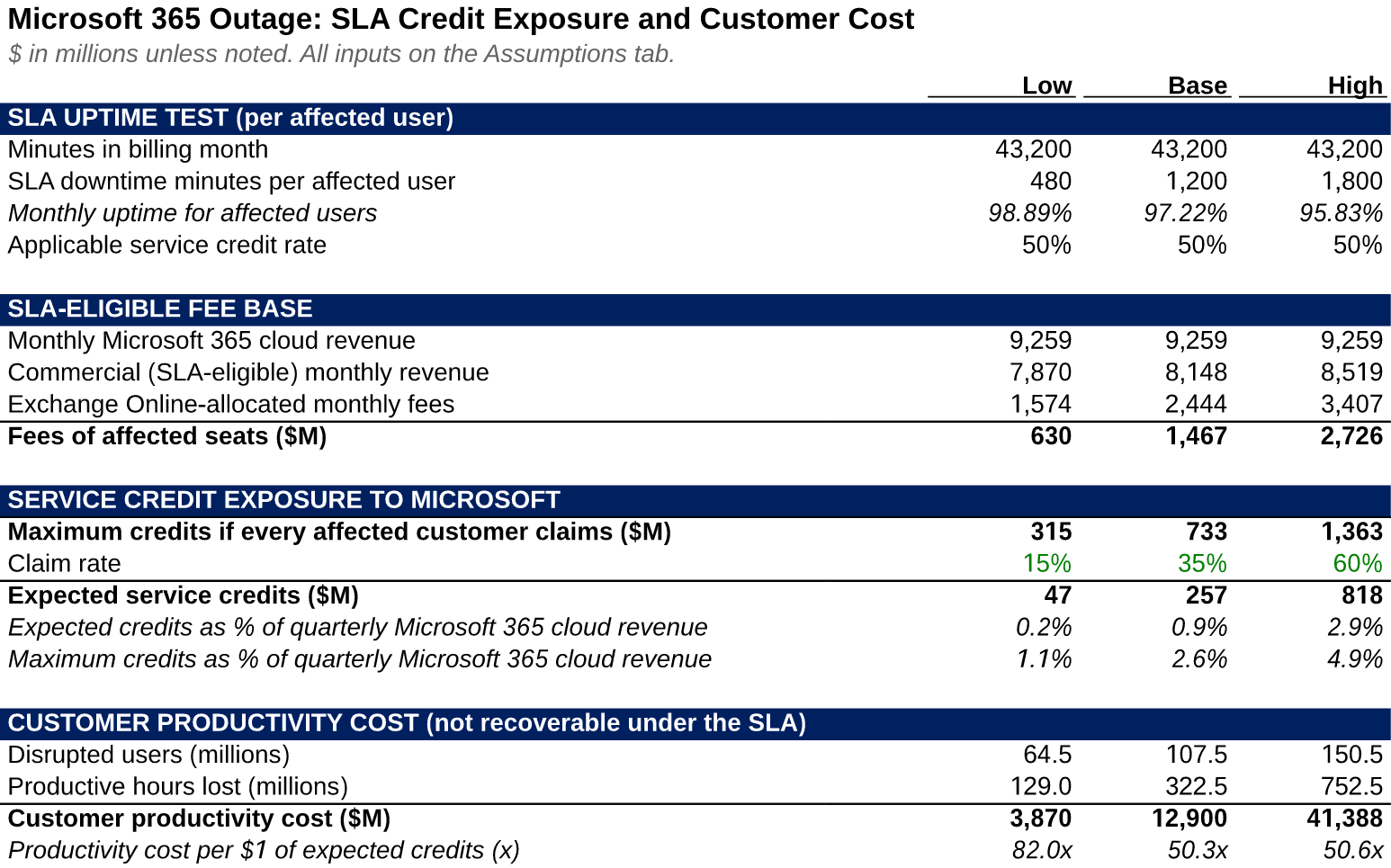
Model output: SLA credits owed by Microsoft and customer productivity cost, low, base and high cases ($ millions).

Sensitivity: base-case expected credits by hours of downtime per affected user and claim rate ($ millions).
Customers absorb most of the cost
The SLA credit is the only remedy in the contract. It does not cover lost sales, overtime or missed deadlines. Microsoft says more than 430 million people use Microsoft 365 apps. If a quarter of them each lost three hours of work valued at $40 an hour, the cost would be about $12.9 billion, about 50 times our base-case credit estimate. Ashwin Pal, a risk advisory partner at RSM Australia, told Australia's ABC that losses are likely in the billions.
What comes next
Microsoft says it will publish a full post-incident report once its review is complete. It has extended the email timeout window to 48 hours, so delayed messages keep retrying instead of bouncing. Admins seeking a credit can file a service request in the Microsoft 365 admin center, or through their reseller if they bought through one, before the Dec. 31 deadline.
How we estimated this: the commercial revenue share, Exchange fee share, seats affected, claim rates, downtime per user and productivity inputs are our assumptions, not figures Microsoft has disclosed. Consumer plans have no SLA credit and are excluded.