AES take-private breakdown: a 40% premium that was 13% below February's price
GIP and EQT close their $33.4 billion AES buyout on Dec. 2. The $15.00 price is 40.3% above the July 2025 average but 13.2% below AES's last pre-deal close. On management's forecast, a flat-multiple exit earns the buyers 7.3% a year. Model and IC deck included.
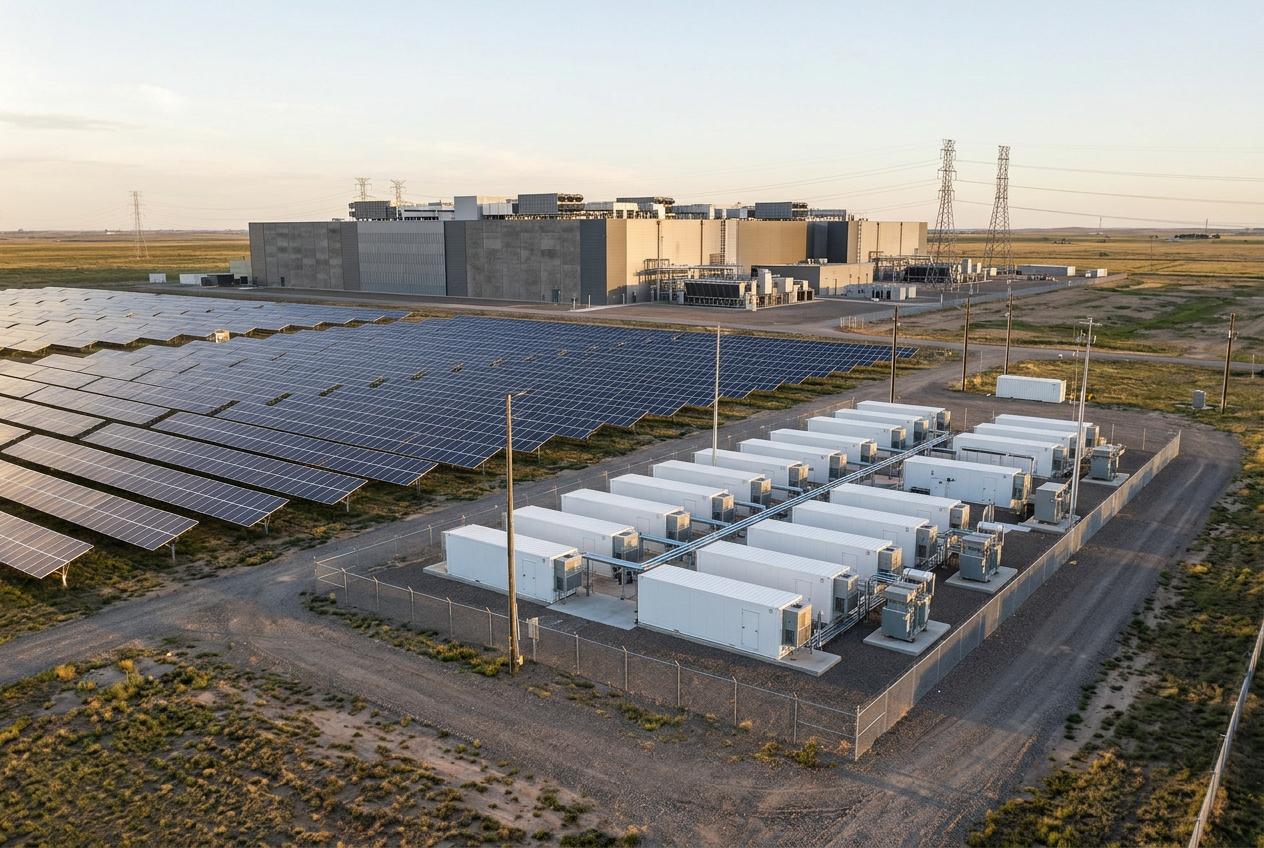
AES is expected to stop trading on Dec. 1 and go private on Dec. 2. Its buyers are a consortium led by BlackRock's Global Infrastructure Partners and EQT, paying $15.00 a share in cash for a $10.7 billion equity value and a $33.4 billion enterprise value, according to the deal announcement. The Federal Energy Regulatory Commission approved the merger on Nov. 17, the last condition to closing, AES said in an 8-K. On Monday, S&P Dow Jones Indices said SharkNinja will replace AES in the S&P 500, CNBC reported.
We rebuilt the deal from AES's filings. The headline premium flatters it, and at the entry multiple the buyers' returns look like infrastructure returns. Download the model and the IC-style deck below.
The premium depends on the starting date
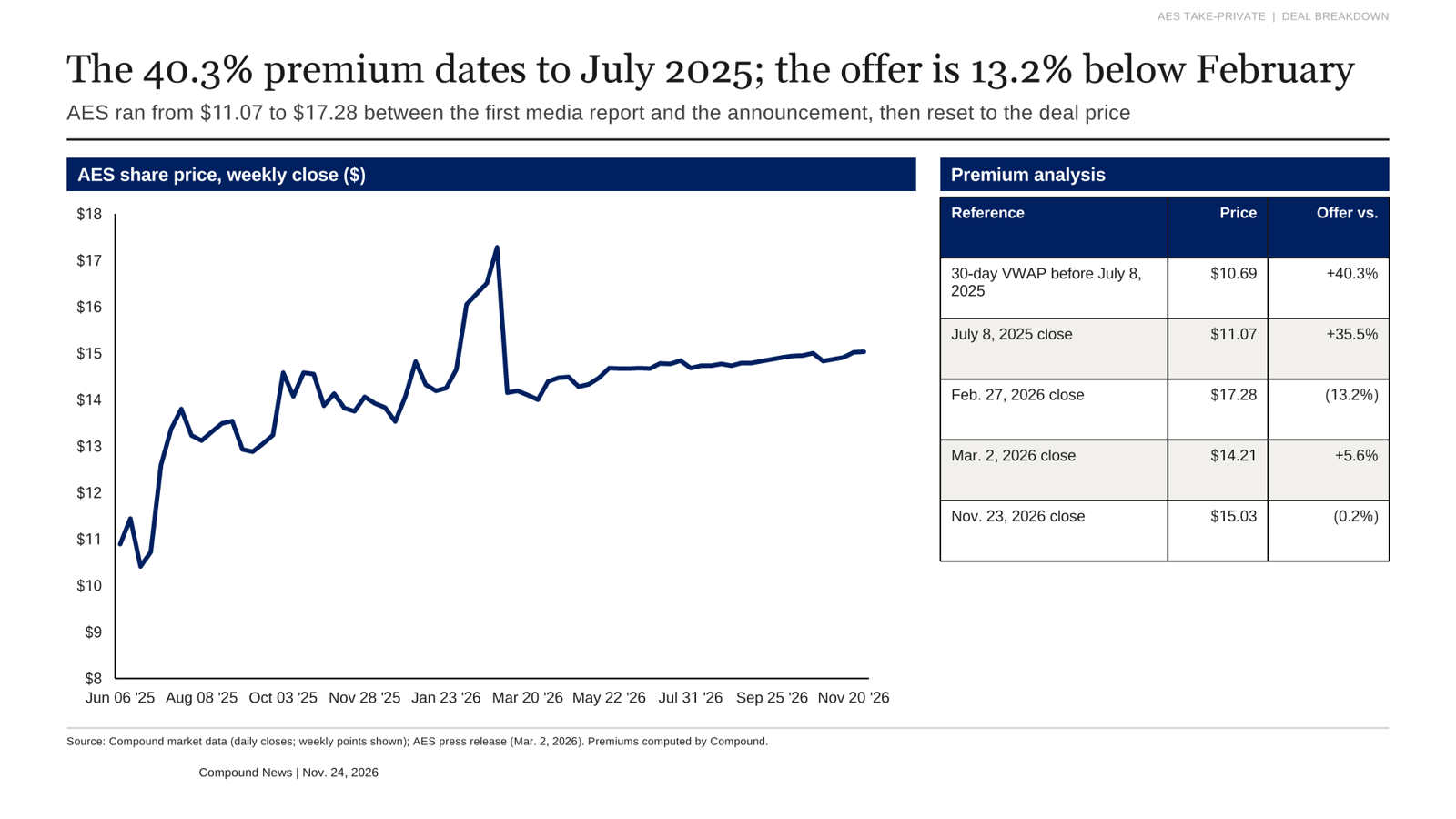
The 40.3% premium is measured against AES's 30-day average price before July 8, 2025, the last trading day before the first media report of a possible sale. AES closed at $11.07 that day. By Feb. 27, 2026, the last close before the deal was announced, the stock was at $17.28. The $15.00 offer is 13.2% below that close, or about $1.6 billion less for shareholders in total. AES fell to $14.21 on announcement day and closed at $15.03 on Nov. 23.
The board's case was about capital. AES said it had "a significant need for capital to support growth beyond 2027." Without a deal, it said, it would likely have had to cut or eliminate the dividend or issue a large amount of new equity.
Who pays what
| Item | Value |
|---|---|
| Offer price | $15.00 per share in cash |
| Equity value | $10.7bn (712m shares) |
| Proportional net debt, Dec. 31, 2025 | $22.7bn |
| Enterprise value | $33.4bn |
| Consolidated net debt | $27.6bn |
| Funding | 100% equity |
| Buyers | GIP (BlackRock), EQT Infrastructure VI, CalPERS, Qatar Investment Authority |
| Stub dividend | $0.06369 per share, record date Dec. 1 |
The consortium is paying the full price with equity, so there is no new acquisition debt. It takes on AES's existing $22.7 billion of proportional net debt, about 7.2 times management's 2026 Adjusted EBITDA forecast. Equity is 32% of the enterprise value.
Management's forecast
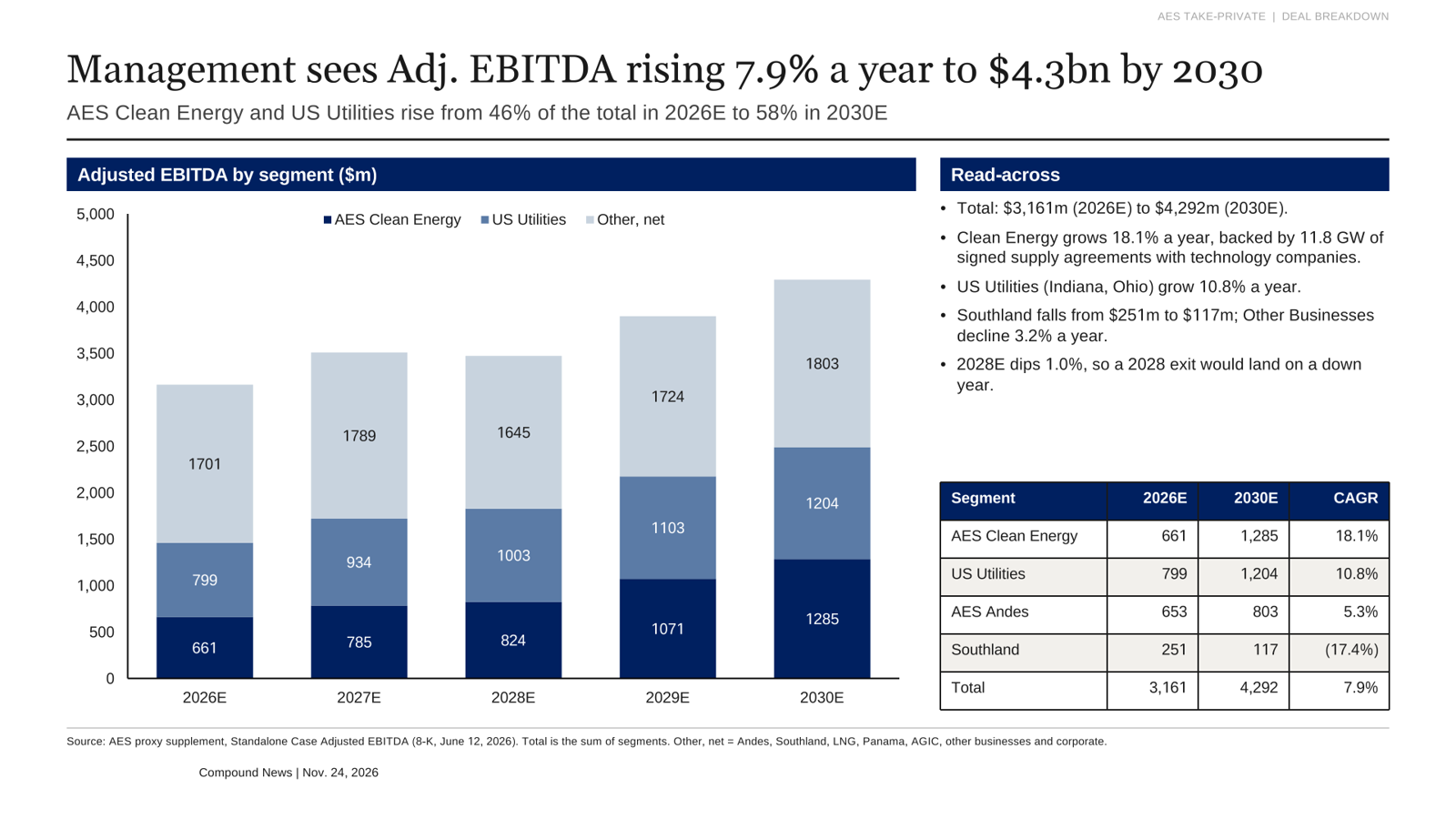
AES's proxy supplement shows management's standalone forecast: Adjusted EBITDA rising from $3.16 billion in 2026 to $4.29 billion in 2030, 7.9% a year. AES Clean Energy grows 18.1% a year and US Utilities 10.8%. Southland's legacy plants fall from $251 million to $117 million. Our 2030 total is the sum of the segments; the amended table in the filing shows two different totals.
$15.00 against the advisers' ranges
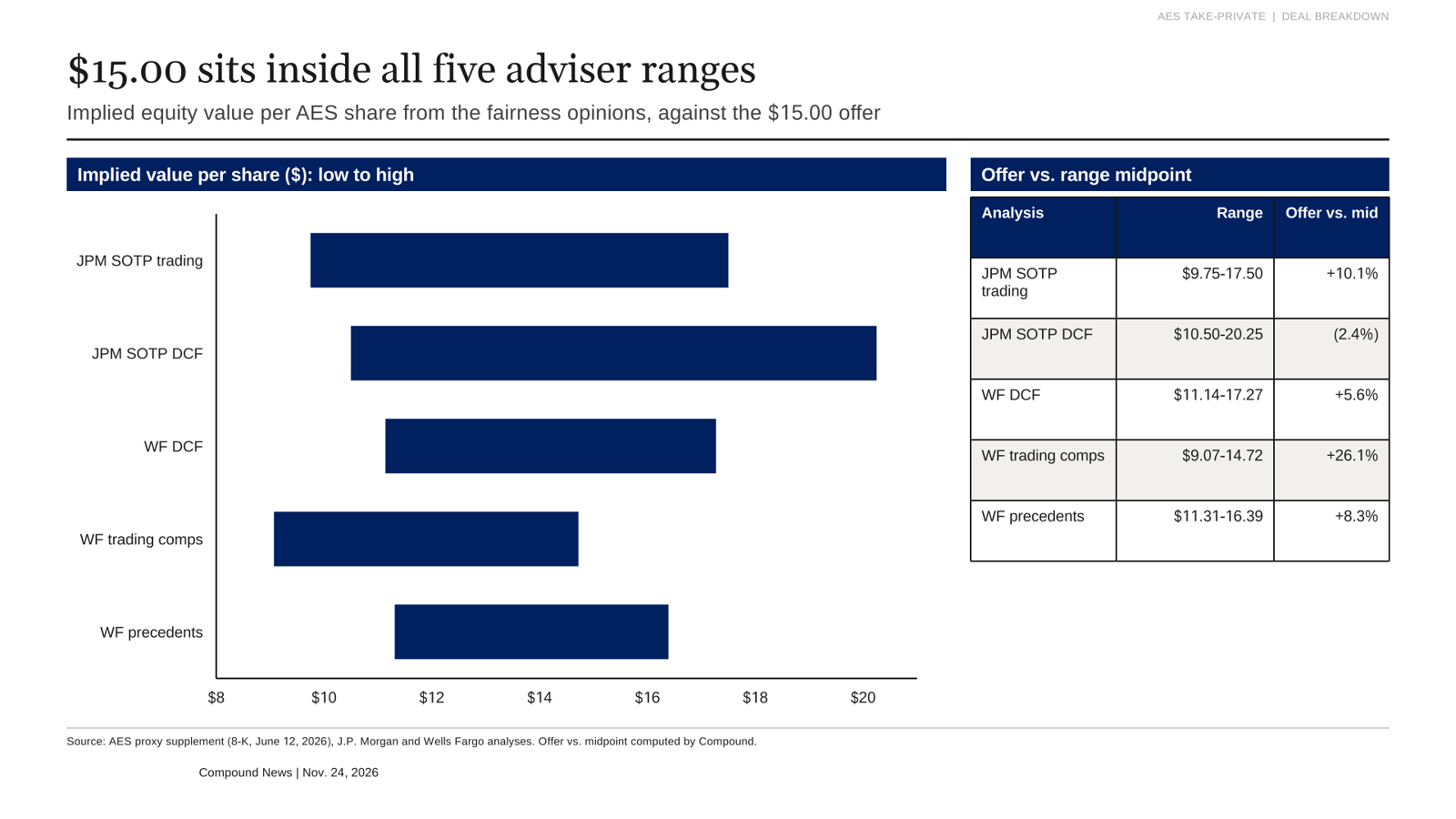
All five valuation ranges in the fairness opinions include $15.00. The offer sits 26.1% above the midpoint of Wells Fargo's trading comparables range ($9.07 to $14.72) and 2.4% below the midpoint of J.P. Morgan's sum-of-the-parts DCF ($10.50 to $20.25).
What the buyers earn
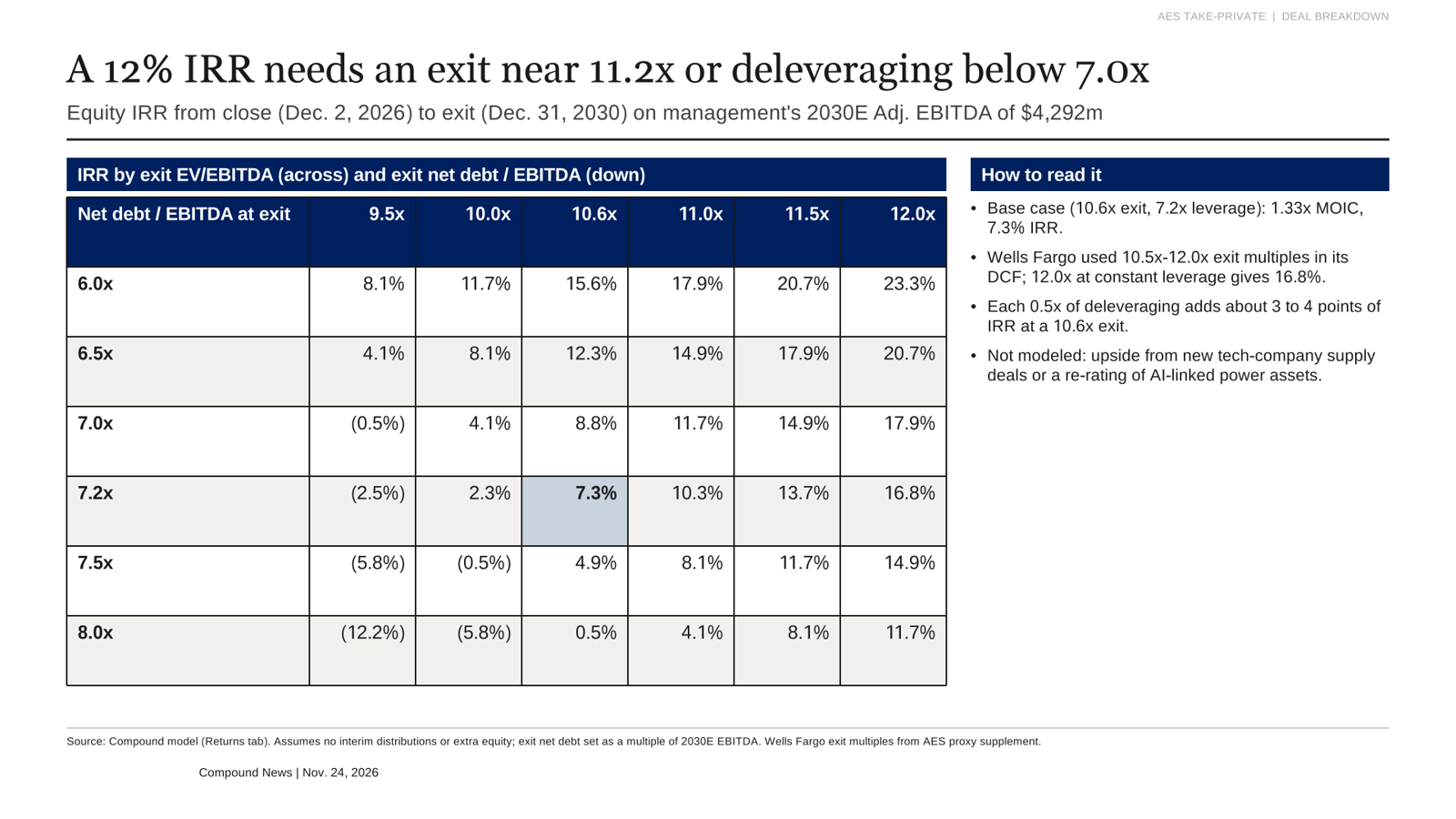
The consortium is paying 10.6 times 2026 Adjusted EBITDA. If it sells at the end of 2030 for the same multiple, with leverage still at 7.2 times, its equity grows to about $14.6 billion. That is 1.33 times its $10.9 billion outlay including fees, or a 7.3% IRR. Getting to 12% takes an exit multiple of about 11.2 times. Wells Fargo used exit multiples of 10.5 to 12.0 times in its DCF; at 12.0 times, the IRR is 16.8%. Each half-turn of debt paid down adds 3 to 4 points of IRR.
These returns assume no dividends to the owners, no extra equity and management's forecast as written. The 11.8 GW of signed agreements to supply power to technology companies is the main source of upside the model does not include.
The model and the deck
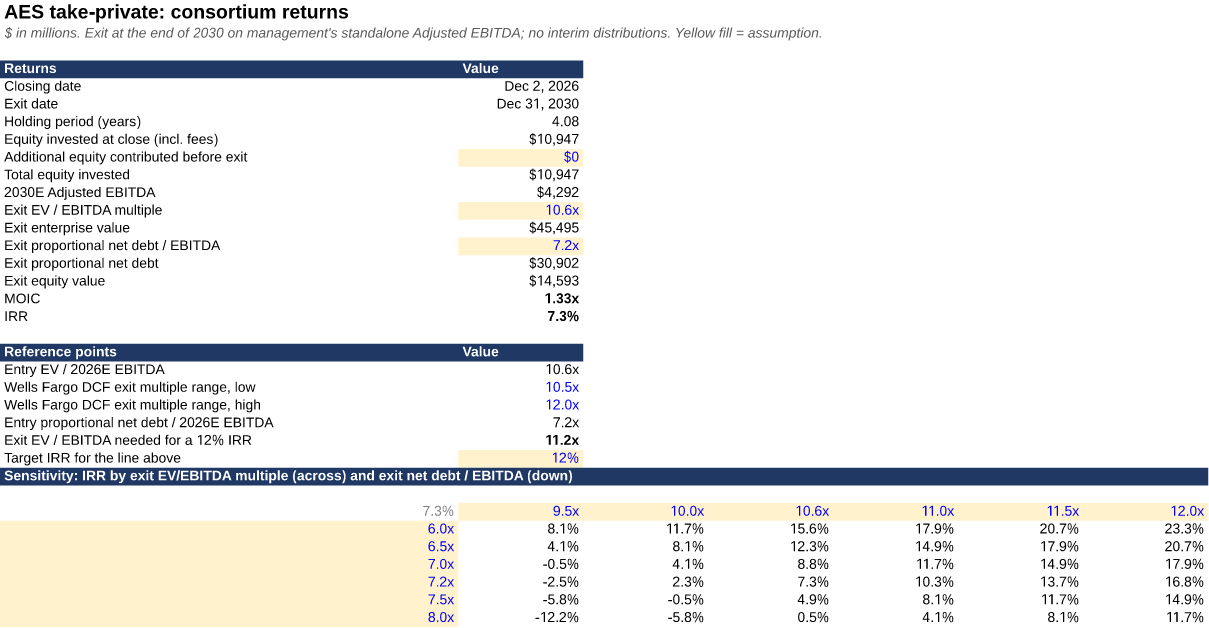
 AES take-private model (Excel)Deal terms, premium analysis, management's segment forecast, sources and uses, returns and a native Excel IRR data table.Download · Free
 AES take-private IC deck (PowerPoint)Eight slides in investment committee format: summary, premium, structure, forecast, valuation, returns and timeline.Download · Free
What to watch
- Dec. 1: AES's expected last day on the NYSE and the record date for the $0.06369 stub dividend.
- Dec. 2: expected close. SharkNinja joins the S&P 500 and Paycom moves to the S&P MidCap 400.
- 2027: whether the new owners keep AES's US utilities and clean energy businesses together, and how fast they add data center supply contracts.
Share prices are Compound market data closes. Premiums, multiples and returns are Compound calculations from AES filings; fees of 2.5% of equity value are our assumption.
More from Compound News

Black Friday 2026 forecast: $13.0 billion online, while gas takes $16.7 billion of holiday budgets
We forecast $13.0 billion of US Black Friday online sales, up 9.8% and slightly above Adobe's $12.9 billion. Higher pump prices add about $16.7 billion to November-December fuel bills, equal to 41% of the NRF's forecast increase in holiday retail sales.
Read article →
Why your Thanksgiving flight costs $800: jet fuel explains the whole 17% jump
AAA's average Thanksgiving round trip is $800, up $116. Using United's fuel burn per passenger mile, fuel for a typical round trip rose from about $119 to $236, which accounts for the whole increase. Download the model.
Read article →
SFO faces a near-record king tide on the busiest travel day after a week of airline outages
San Francisco Bay is forecast to reach 8.6 feet, or about 9.9 feet with storm surge, at 10:49 a.m. on Nov. 25, against SFO's 8-foot lowest seawall. Delta's system outage and an O'Hare staffing ground stop have already hit Thanksgiving travel.
Read article →