FAA grounds every US departure: what we know about the nationwide ground stop
A communications failure at air traffic control centers led the FAA to halt departures at every US airport on Friday afternoon. Here is what happened, how it compares with the 2023 outage, and what to watch.
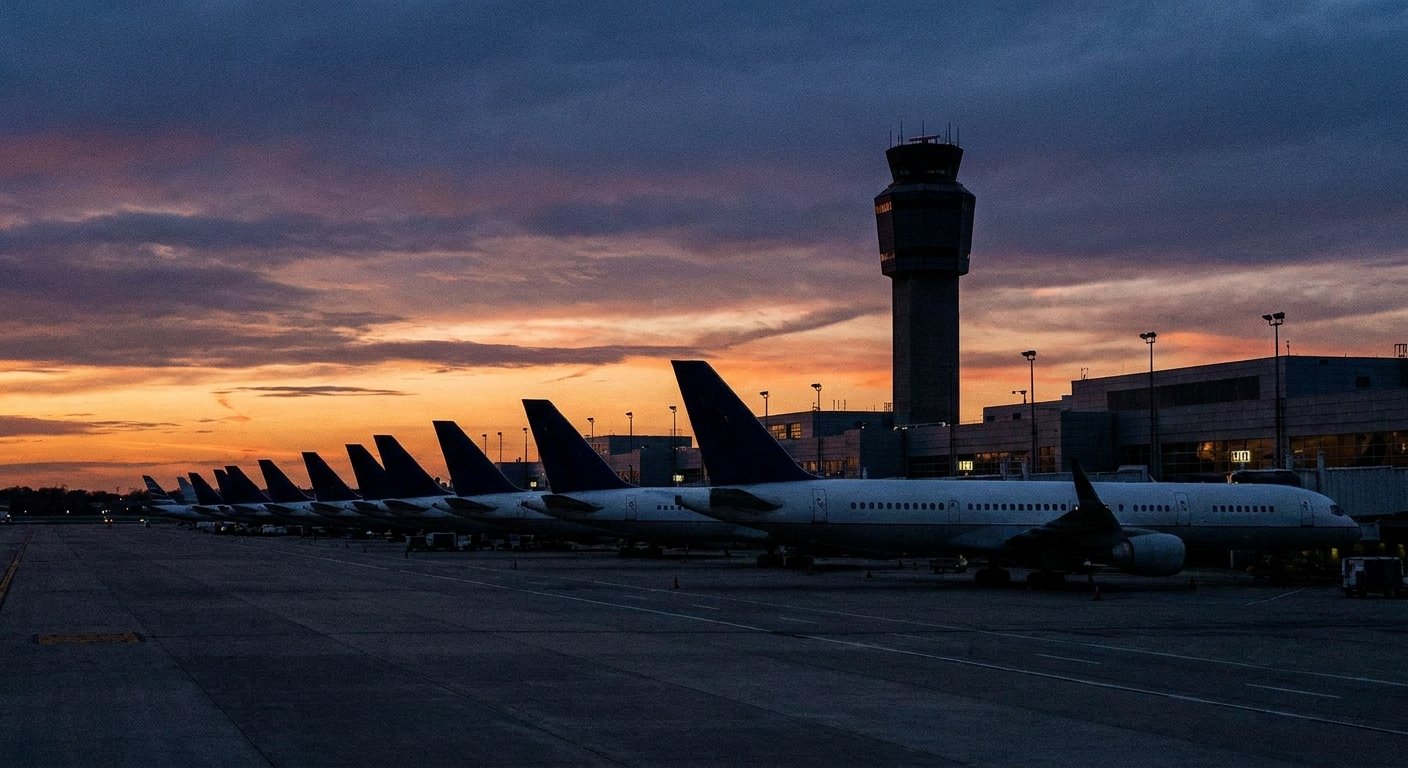
The Federal Aviation Administration halted departures at every US airport at 3:54 p.m. ET on Friday, November 13, after a failure in the communications network that links the country's air traffic control centers. It is the third nationwide ground stop on record, after the September 11, 2001 attacks and the January 2023 NOTAM outage. As of 7:10 p.m. ET, the stop had lasted more than three hours with no timeline for lifting it, and more than 3,000 flights had been canceled.
Latest
- 6:45 p.m. ET: Fewer than 700 aircraft were in US airspace (Flightradar24). Cancellations passed 3,000 just after 6:30 p.m., and more than 370 Saturday flights had already been canceled, according to FlightAware (New York Times).
- Cause: The FAA told airlines the outage came from a problem with network routers that is believed to have started at Chicago Midway and cascaded nationwide (CNN). Sources told CBS News that an update to the private communications network linking air traffic control, operated by L3Harris, caused the system to reboot and crash (CBS News).
- Europe: The FAA asked Eurocontrol to suspend all flights to the US from 42 European countries (New York Times). Some transatlantic departures from the Northeast are being allowed out (Flightradar24).
- Airlines: United, Delta and Alaska issued waivers that let travelers change or cancel flights without fees or fare differences (New York Times). JetBlue told customers flying this evening to expect delays and cancellations (CNN).
- Markets: airline shares fell in after-hours trading on Friday. Monday will be the first full trading session to price the disruption, including weekend cancellations.Bloomberg).
- Not an attack: NORAD said there is no evidence yet of nefarious action (New York Times). DHS Secretary Mullin said he sees no reason to connect the outage with this week's Microsoft outage (GeekWire).
- 6:03 p.m. ET: United said it would fly tonight if it can but had no update on when the stop would be lifted (United on X). American said it is ready to rebook passengers once departures resume (American on X).
- 6:00 p.m. ET: Only about 1,000 flights were airborne and bound for US airports, compared with more than 4,500 at the same time last week (Flightradar24).
- 5:59 p.m. ET: DHS Secretary Mullin again called the cause a "telecommunication outage" and said "this isn't another 9/11" (Reuters).
- 5:54 p.m. ET: More than 1,000 US flights had been canceled. New York's JFK (155) and LaGuardia (142) and Chicago O'Hare (120) were hit hardest (Flightradar24). Nearly 10,000 flights had been delayed (MarketWatch).
- 5:40 p.m. ET: Our estimate: the stop could cost the six largest US airlines about $29 million in lost revenue if it lasts four hours, and about $55 million if it runs to midnight. See the analysis below.
- 5:23 p.m. ET: Verizon said its network is fully functioning and it is not aware of any issue related to air traffic control systems (via @DeItaone).
- 5:16 p.m. ET: The FBI does not believe the communications issue was caused by a cyberattack or criminality (Bloomberg).
- 5:10 p.m. ET: Homeland Security Secretary Markwayne Mullin said it will take "some time" to resolve the issue and that everyone is safe, with all flights accounted for. Asked about a possible link to AI, he said he "can't rule anything out" (via @DeItaone).
- 5:05 p.m. ET: Some international flights are being allowed to depart case by case. Etihad's Boston to Abu Dhabi flight took off (Flightradar24).
- 5:02 p.m. ET: The FAA said the cause was "a temporary telecommunications outage" and that all flights were halted "out of an abundance of caution" (FAA on X).
What happened
The trouble surfaced in Chicago. At about 3:10 p.m. ET, an FAA advisory halted flights headed to O'Hare, citing an equipment outage and communications issues, and Midway got a similar stop minutes later (The Auto Wire via Yahoo).
The national order followed. The FAA's Air Traffic Control System Command Center told operators: "All departing traffic should remain ground stopped until further notice. Inbound international flights will be managed on a case by case basis" (CBS News). The advisory lists an effective period running to 11:30 p.m. ET, though it says the stop lasts until further notice (USA Today).
The @FAAnews issued a nationwide ground stop for all U.S. airports following a communication issue impacting all Air Route Traffic Control Centers. FAA technicians are investigating the issue. Transportation Secretary Sean Duffy, on X
That matters because of where the failure sits. The US has 22 Air Route Traffic Control Centers, which handle aircraft in the cruise portion of their flights (Flightradar24). A problem there affects traffic between airports across the country, not just one airport. The accounts differ on scope: Duffy said the problem hit all of the centers, while the FAA's own statement referred to multiple centers (CNBC).
By the numbers
- 4,042 flights were in the air and headed for US airports when the stop was issued (Flightradar24). About 25 minutes later, 3,100 were still airborne, and no more were taking off.
- More than 3,000 cancellations by just after 6:30 p.m. ET, plus more than 10,000 delays, according to FlightAware. More than 370 Saturday flights had also been canceled. The FAA has not released its own count.
- 22 en route centers are affected, according to Duffy, who said the communications issue hit the regional centers that direct planes between airports (AP).
- Third ever: only September 11, 2001 and January 11, 2023 brought earlier nationwide halts (CNN).
How it compares with January 2023
The closest precedent is the 2023 NOTAM outage, when the system that alerts pilots to hazards went down. The FAA paused all departures from 7:30 a.m. to 9 a.m. ET (Wikipedia). By noon that day, FlightAware counted 6,988 delayed flights and just over 1,100 cancellations, out of 21,464 scheduled departures (NPR). The cause turned out to be a contractor who deleted files while syncing a primary and a backup database.
Three things make Friday's stop more serious:
- Scale, faster. Disrupted flights neared 7,000 within about 40 minutes and passed 10,000 delays within two hours. In 2023, delays reached about 7,000 only after a full morning.
- Timing. The 2023 stop hit early on a Wednesday morning. This one hit on a Friday afternoon heading into the weekend, which can leave crews and aircraft out of position for days.
- Open-ended. The 2023 order came with a restart time. This one says "until further notice" and cites "extraordinary circumstances and for reasons of safety", rather than naming a failed system.
The bigger issue: aging air traffic control
The failure comes in the middle of an overhaul. Congress approved $12.5 billion last year to replace the outdated technology controllers rely on. Copper wiring is being swapped for fiber, and old radio systems are being replaced airport by airport. Duffy has said another $30 billion will be needed to finish the job, and the White House has started lobbying Congress for it (AP).
Hours before the stop, the White House and the Transportation Department asked Congress for an additional $30.1 billion to modernize aviation infrastructure, including $10.1 billion for air traffic control (GeekWire).
The FAA has also been rolling out a new AI tool to manage airspace congestion. It is not clear whether that system has any connection to Friday's communications problems (Axios).
What it could cost airlines: our estimate
We estimated the revenue the six largest US carriers (Delta, United, American, Southwest, Alaska and JetBlue) could lose. Together they generated about $255 billion in revenue over the past 12 months, or roughly $734 million on an average Friday.
Most of the revenue on affected flights is not lost. Delayed flights still operate, and many passengers on canceled flights rebook with the same airline. Our base case assumes a four-hour stop, with 35% of disrupted flights canceled and 55% of revenue on those trips recaptured through rebooking. On that basis:
- About $183 million of revenue sits on flights in the disrupted window.
- About $29 million of it is lost after rebooking: Delta $8.1 million, United $6.9 million, American $6.8 million, Southwest $4.1 million, Alaska $1.9 million and JetBlue $1.1 million.
- About $55 million if the stop runs to midnight (about eight hours). With weaker rebooking (30% recapture), the eight-hour figure rises to about $85 million.
With the stop now past three hours and cancellations spilling into Saturday, the eight-hour case looks more likely than the base case. These are revenue figures only. They leave out the cost of delays, crew and hotel expenses and passenger compensation, so the full hit to airline earnings will be larger. We'll update the estimate when the stop is lifted.
What we don't know yet
- The cause. The FAA describes a telecommunications outage. Reports point to a network router problem that started at Chicago Midway, and to a network update that caused a reboot and crash. The FAA has not confirmed the root cause. DHS has not ruled out a link to the FAA's new AI traffic tool, SMART, which the FAA expanded to all 22 centers on Tuesday. Air Space Intelligence, which built SMART, denied any connection (GeekWire).
- How long it lasts. The FAA has not given an estimate, and DHS says it will take some time. Prediction market traders on Polymarket put the odds of the stop being lifted by midnight ET at about 70% (Polymarket on X). Even after the stop lifts, airlines need hours to reposition aircraft and crews.
- Whether other outages are related. DHS sees no link to the Microsoft outage, and Microsoft said it has no indication its services were involved. No link to the National Weather Service radar outage has been reported.
What to watch
- Markets: airline shares fell in after-hours trading on Friday. Monday will be the first full trading session to price the disruption, including weekend cancellations.
- The holidays: Thanksgiving is 13 days away, on November 26. A prolonged outage or slow recovery would land just before the year's peak travel period.
- Washington: the 2023 outage led to calls in Congress for an FAA fix. A failure that reached the en route centers, while the administration is asking for $30 billion more for modernization, will likely put that request at the center of the debate.
This is a developing story, last updated at 7:10 p.m. ET. We will update it as the FAA releases more information.