The US Oil Reserve Is at a 44-Year Low. How Much Can It Still Release?
The Strategic Petroleum Reserve held 276.4 million barrels last week, the lowest since 1982. Our model finds about 111 million barrels releasable at next year's trough, and a refill gap of about $17 billion.
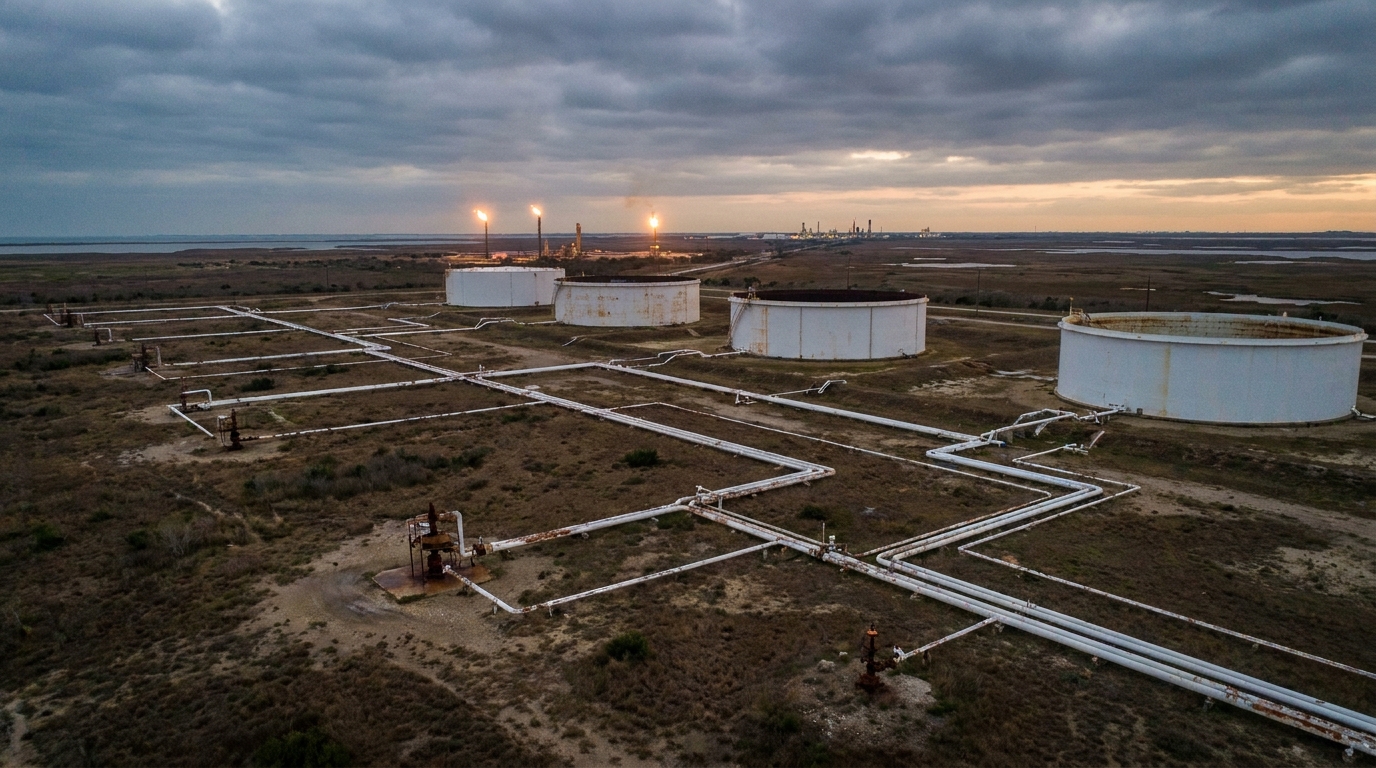
The US Strategic Petroleum Reserve held 276.4 million barrels in the week ending Nov. 13, the lowest since August 1982, Reuters reported from Department of Energy data. That is down from 415.4 million barrels on Feb. 27, the day before the war with Iran closed most tanker traffic through the Strait of Hormuz, according to EIA weekly data.
The reserve has not bottomed. The EIA's November Short-Term Energy Outlook has it falling to 241.5 million barrels in the first half of 2027 as the last of the US's 172-million-barrel emergency release is delivered.
We built a model to answer three questions: how much oil the reserve can still release, whether that covers a second Gulf shock, and how long a refill takes. By our estimate, about 111 million barrels will be releasable at the trough, 65% of what the US committed in March. Refilling to effective capacity would cost about $17 billion, and Congress has funded about 1% of that.
How far the reserve has fallen
The SPR held 621.3 million barrels in November 2021, EPRINC notes. The 2022 release after Russia invaded Ukraine took out 180 million barrels, and the March 2026 release added another 172 million, Energy Secretary Chris Wright said at the time. At 279.5 million barrels on Nov. 6, the reserve was 38.5% of its 726.6-million-barrel record from December 2009, according to DOE, and 41% of the roughly 680 million barrels DOE says it can hold in practice.
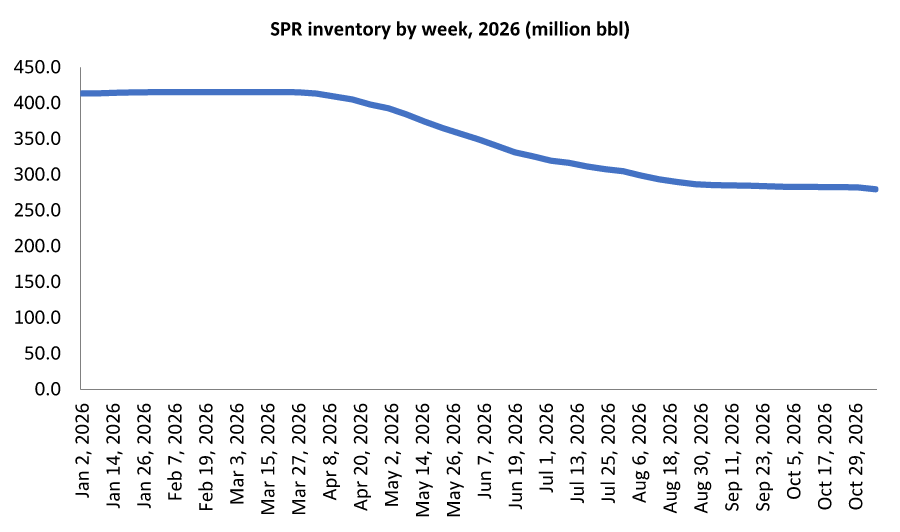
SPR crude inventory by week, 2026, million barrels. Source: EIA.
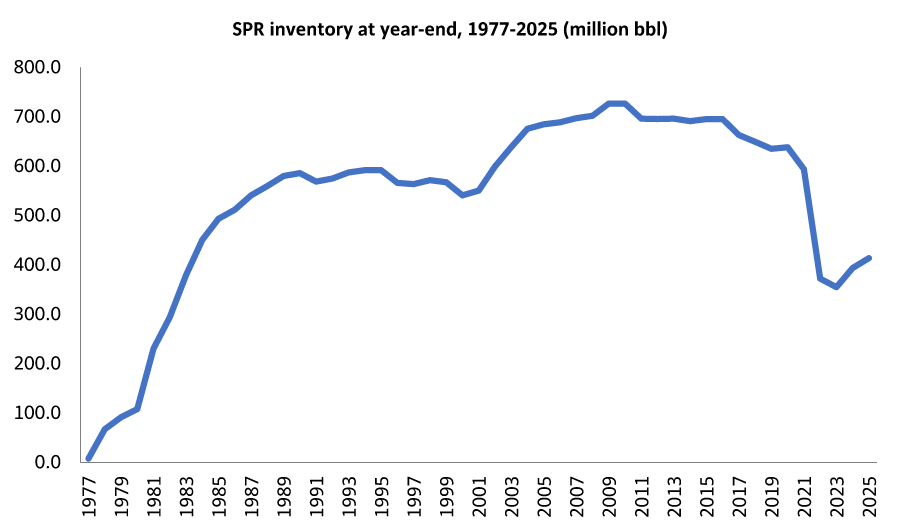
SPR crude inventory at year-end, 1977 to 2025, million barrels. Source: EIA.
Days of cover
Whether 279.5 million barrels is a lot depends on what it is measured against:
- 14 days of total US petroleum consumption (19.8 mb/d in the latest week, EIA).
- 17 days of US refinery crude runs (16.6 mb/d in October, EIA).
- 107 days of crude net imports at August's rate, and 153 days at the EIA's 2026 average.
The US was a net exporter of crude and products by 3.1 mb/d in the week ending Nov. 6, so the IEA's rule that members hold 90 days of net imports does not apply to it. The US still supplies just over 40% of any IEA collective release, the Atlantic Council notes, and committed 43% in March.
The low level does not mean the US could run out of crude. US crude still trades at world prices, and the reserve's job now is to cap prices and back up allies.
How much oil the reserve can still release
A GAO review published in May found more than a quarter of the reserve unavailable for drawdown because of construction and cavern outages, CNBC reported. DOE told CNBC that about 70 million barrels must stay in to manage the caverns safely. Take both out and about 140 million barrels can be released today, and 111 million at the EIA's trough.
Speed is the second limit. DOE rates the reserve at 4.4 mb/d, but at low inventories the realistic rate is 1 to 1.4 mb/d, according to the Bipartisan Policy Center. The 2026 release averaged 0.8 mb/d through Aug. 28, the Atlantic Council found. Three of the six caverns at Bayou Choctaw have one drawdown left before they risk losing structural integrity, it added.
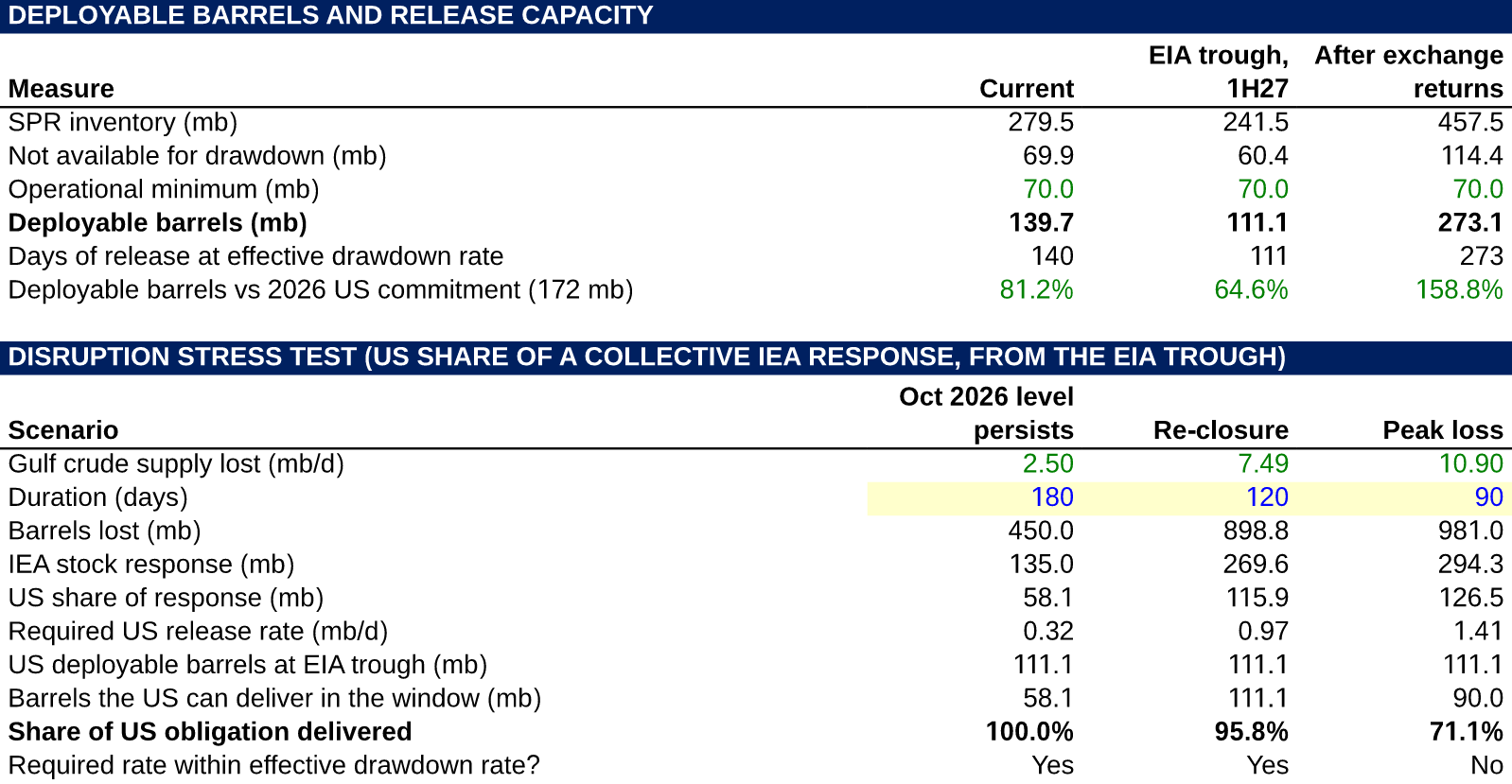
Deployable barrels and disruption stress test. Source: Compound model; inputs from EIA, DOE, GAO, IEA and BPC.
Stress test: a second Gulf shock
We tested three disruptions starting from the EIA's 241.5-million-barrel trough. In each, IEA emergency stocks cover 30% of the lost Gulf supply and the US supplies 43% of that, as in March. The 30% is our assumption.
- October level persists: Gulf shut-ins stay at 2.5 mb/d for six months. The US share is 58 million barrels at 0.32 mb/d. The reserve covers all of it.
- Re-closure: Losses return to the March to September average of 7.49 mb/d for 120 days. The US share is 116 million barrels at 0.97 mb/d. The reserve covers 96%.
- Peak loss: Losses return to May's 10.9 mb/d for 90 days. The US share is 127 million barrels at 1.41 mb/d, above the realistic release rate. The reserve delivers 90 million barrels, 71% of the US share.
Other IEA governments still hold about 1.1 billion barrels of public emergency stocks, the IEA said on Oct. 7, after releasing about 325 million under the March action. In a second shock, allies would carry more of the load.
Refill timeline and cost
The 2026 release was structured as an exchange, not a sale. DOE said on Oct. 29 that companies will return more than 216 million barrels starting early next year, including 44 million premium barrels. If all of it comes back, the reserve reaches about 458 million barrels, 42 million above its pre-war level.
The barrels can only go back in so fast. The four sites can take in 672,000 barrels a day at most, according to the Atlantic Council. That puts the full return at 321 days at maximum rate, or about 14 months at 75% efficiency (our assumption). The EIA's forecast has only 103 million barrels back by the end of 2027, when the reserve reaches 344.7 million.
Topping up to 680 million barrels after the returns would take 222.5 million more. At the EIA's $77 forecast for Brent in late 2027, that is about $17.1 billion. Congress appropriated $171 million for crude purchases in the 2025 reconciliation law, enough for about 2 million barrels. The president has said a Venezuela deal will refill the reserve "for nothing," Yahoo Finance reported. The SPR does not store crude as heavy as Venezuela's, according to the Atlantic Council.
What it means for oil prices and policy
- Risk premium: Traders can see a US backstop of about 111 million releasable barrels at about 1 mb/d. A second Gulf shock before mid-2027 would likely carry a bigger risk premium than the first.
- 2027 demand: Taking back 216 million barrels over about 14 months adds about 0.5 mb/d of government buying while the EIA expects Brent to ease to $77. Governments restocking after the war add a new layer of demand, Fortune noted.
- Diesel: Lost refining in the Middle East and Russia has left diesel about 1 mb/d short, according to EPRINC. The SPR holds only crude.
- Legal floor: Limited drawdowns that don't need a presidential finding, such as hurricane exchanges, cannot take the reserve below 252.4 million barrels. That leaves 27 million barrels of headroom from Nov. 6, and the floor will be crossed as deliveries finish. The current release is not bound by it.
- Planning: Congress has never set a target size, and DOE has not finished a long-term review since 2016, GAO found. GAO asked Congress to consider limiting non-emergency sales.
Sensitivity table
The table varies the reserve's inventory and its release rate. At 240 million barrels and 1 mb/d, the releasable barrels last 110 days. At the pre-war 415 million, they last 241 days.
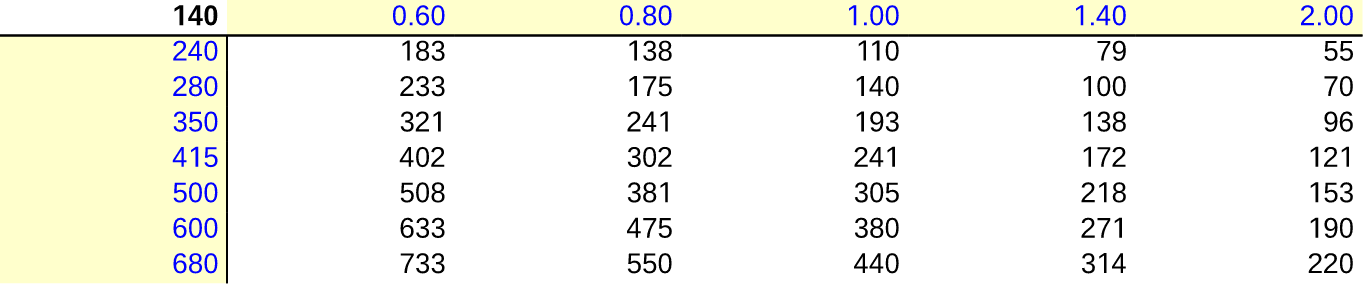
Days of release by SPR inventory in million barrels (rows) and drawdown rate in mb/d (columns), with 25% unavailable and a 70-million-barrel operating minimum.
 Download the SPR model (Excel)Our model of SPR inventory, days of cover, deployable barrels, a three-scenario disruption stress test, the refill path and cost, with every input sourced and live Excel data tables.Download · Free
What to watch
- EIA's weekly SPR figures, for the week the reserve drops below the 252.4-million-barrel floor.
- The EIA's next Short-Term Energy Outlook on Dec. 8, for any change to the 241.5-million-barrel trough.
- The first exchange barrels returning in early 2027, and whether intake gets near 672,000 barrels a day.
- FY2027 appropriations for SPR crude purchases and maintenance.
How we built the model
Releasable barrels are inventory minus GAO's 25% unavailable share and DOE's 70-million-barrel operating minimum. Release days divide those barrels by an effective rate of 1 mb/d, the low end of BPC's range. The stress test multiplies Gulf shut-ins from the EIA by a scenario duration, takes 30% as the IEA stock response and 43% as the US share, then caps US delivery at the effective rate. The refill path uses the EIA's quarterly SPR forecast, DOE's 216-million-barrel return figure and the 672,000-barrel daily intake limit.
Durations, the 30% IEA offset and 75% fill efficiency are our assumptions. Every other input comes from the EIA, DOE, GAO, IEA, EPRINC, the Atlantic Council, the Bipartisan Policy Center, CNBC or Reuters.
More from Compound News

America's China Drug Habit: A $132 Billion Pipeline and a $6 Billion Peptide Boom
The FDA rejected a China-invented cancer drug on Sunday, just as Chinese molecules make up half of big pharma's major licensing deals. Our model puts peak sales of China-invented drugs at about $132 billion a year, and the US peptide market at about $6.3 billion.
Read article →
Who Will Run Nvidia? Polymarket's Favorites, and Four Dark Horses Nobody Is Pricing
Polymarket makes Arm's Rene Haas a slim favorite at 25.7%, ahead of Nvidia's Ian Buck at 22.5% and interim CEO Colette Kress at 11.9%. A second market leaves more room for an outsider than the named outsiders add up to. We looked past the 25 names and found four who fit the job as it now stands.
Read article →
Nvidia after Jensen Huang: the live timeline
From the first spy report on October 29 to Huang's resignation and the fight in Washington, every development in the Nvidia story, newest first and updated as news breaks.
Read article →