Coatue EMW 2024 keynote, two years later: which calls held up
We rebuilt the public- and private-market slides of Coatue's June 2024 East Meets West "State of the Markets" deck with data through October 29, 2026, and graded its five main calls
by Compound Team · November 2, 2026 · 11 min read
East Meets West (EMW) is Coatue’s annual technology conference in Montecito, California. It opens with the founders’ keynote, “Coatue View on the State of the Markets”, a deck on public markets, private markets and AI. The June 2024 deck called AI the start of a super-cycle and argued against the bubble view. Most of its calls held up.
At EMW 2024, NVIDIA was worth about $3T, AI took roughly 15% of US venture dollars, and the question on stage was whether AI was a bubble. Two and a half years on, we had Compound rebuild the keynote’s public- and private-market slides with data through October 29, 2026: 40 slides and a backing workbook, each slide sourced and compared with the 2024 version.
Four of the five calls held up. The one that missed was the bleak view of private markets. NVIDIA’s stock is up 62% since the keynote, yet its forward P/E fell from 39x to 14x because earnings grew faster. The debate has moved on to whether $154B of AI revenue can grow into ~$730B a year of capex.
Coatue EMW 2024 keynote, refreshed to October 2026 (PDF)The 40-slide deck Compound built for this post: each EMW 2024 public- and private-market slide rebuilt with data through October 29, 2026, with the 2024 figure beside today’s and the source in every footnote.Download · FreeThe EMW 2024 scorecard
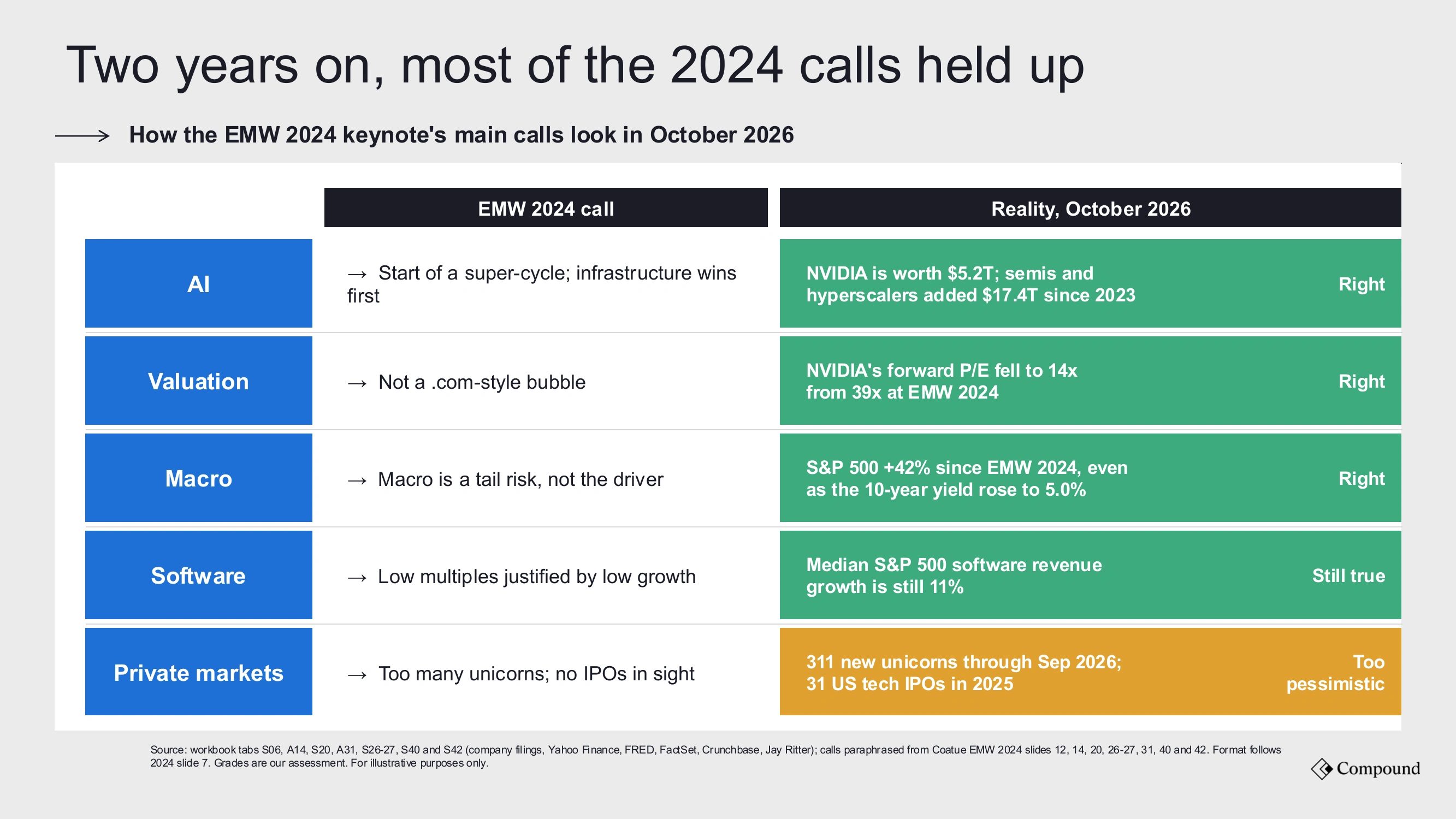
We took the five main calls in the 2024 keynote and set each against the October 2026 data. The grades are our assessment.
| EMW 2024 call | October 2026 | Grade |
|---|---|---|
| AI is the start of a super-cycle; infrastructure wins first | NVIDIA is worth $5.2T; S&P 500 semis and five hyperscalers added $17.4T since 2023 | Right |
| Not a .com-style bubble | NVIDIA’s forward P/E fell to 14x from 39x | Right |
| Macro is only a tail risk | S&P 500 +42% even as the 10-year yield rose to 5.0% | Right |
| Low software multiples are justified by low growth | Median S&P 500 software revenue growth is still 11% | Still true |
| Too many unicorns; no IPOs in sight | 311 new unicorns through September 2026; 31 US tech IPOs in 2025 | Too pessimistic |
Public markets: the rally kept going
From the keynote on June 14, 2024 to October 29, 2026, the Nasdaq Composite rose 48% and the S&P 500 42%. The pace slowed: the Nasdaq gained 9% over the last twelve months, against 29% in the year before the 2024 keynote. NVIDIA rose 62% over the full period but only 3% in the last twelve months.
The biggest names, and two that weren’t public
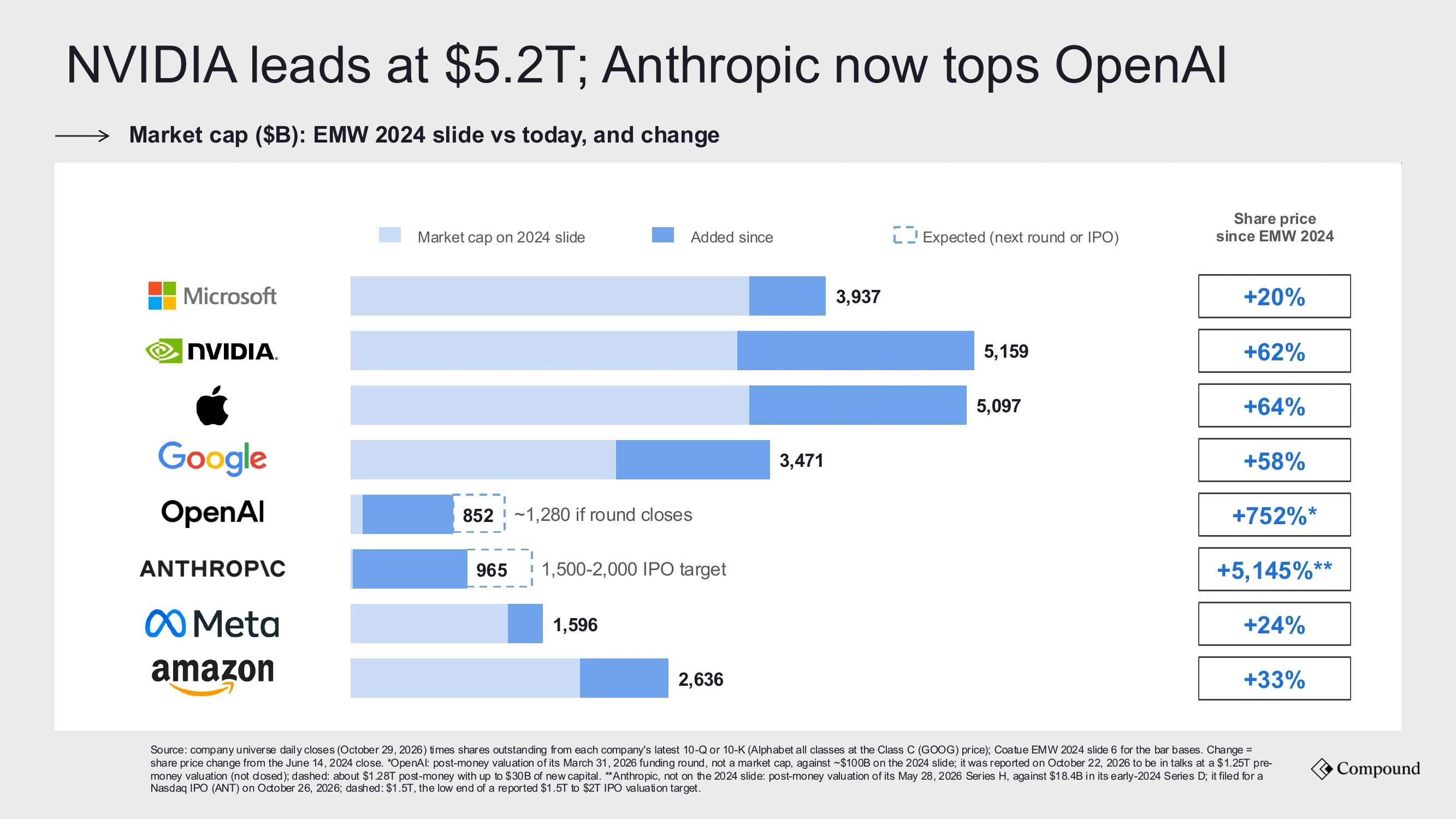
NVIDIA leads at a $5.2T market cap, with Apple close behind at $5.1T. The bigger change is in private AI. OpenAI’s March 2026 round valued it at $852B post-money, against ~$100B on the 2024 slide. Anthropic was not on the 2024 slide at all: its May 2026 Series H valued it at $965B, against $18.4B in its early-2024 Series D, and it filed for a Nasdaq IPO on October 26 with a reported $1.5-2T target. Both figures are private-round valuations.
NVIDIA’s forward P/E: from the priciest megacap to the cheapest
The 2024 keynote’s answer to “is it a bubble?” was that NVIDIA’s multiple was nowhere near Cisco’s 132x peak in 1999. Two years later the case is stronger. NVIDIA’s next-twelve-month consensus EPS rose 4.9x, from $2.9 to $14.1, so its forward P/E fell from 39x (2025E, on the 2024 slide) to 14x (fiscal year ending January 2028). Apple went the other way, from 28x to 36x. Of the six megacaps on the 2024 slide, NVIDIA is now the cheapest and Apple the most expensive.
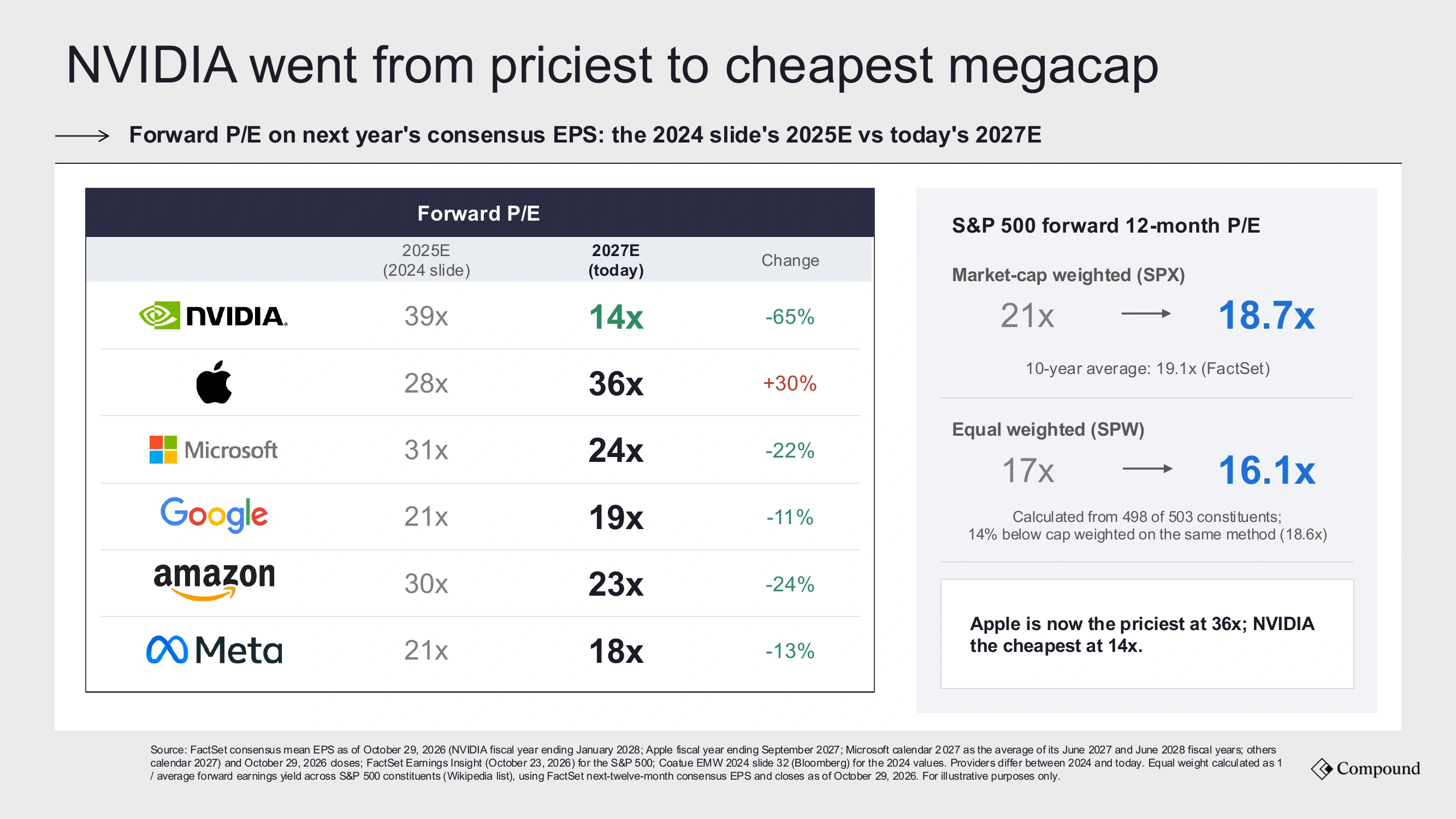
| Company | Forward P/E, 2024 slide (2025E) | Today (2027E) | Change |
|---|---|---|---|
| NVIDIA | 39x | 14x | -65% |
| Apple | 28x | 36x | +30% |
| Microsoft | 31x | 24x | -22% |
| Alphabet | 21x | 19x | -11% |
| Amazon | 30x | 23x | -24% |
| Meta | 21x | 18x | -13% |
| S&P 500 (cap weighted) | 21x | 18.7x | -11% |
The market as a whole is no more expensive either. The S&P 500 trades at 18.7x forward earnings, below its 10-year average of 19.1x, because FactSet’s bottom-up consensus has S&P 500 EPS growing 24% a year from 2025 to 2027, against 13% for 2024-2026 on the 2024 slide.
AI infrastructure added ~$17T
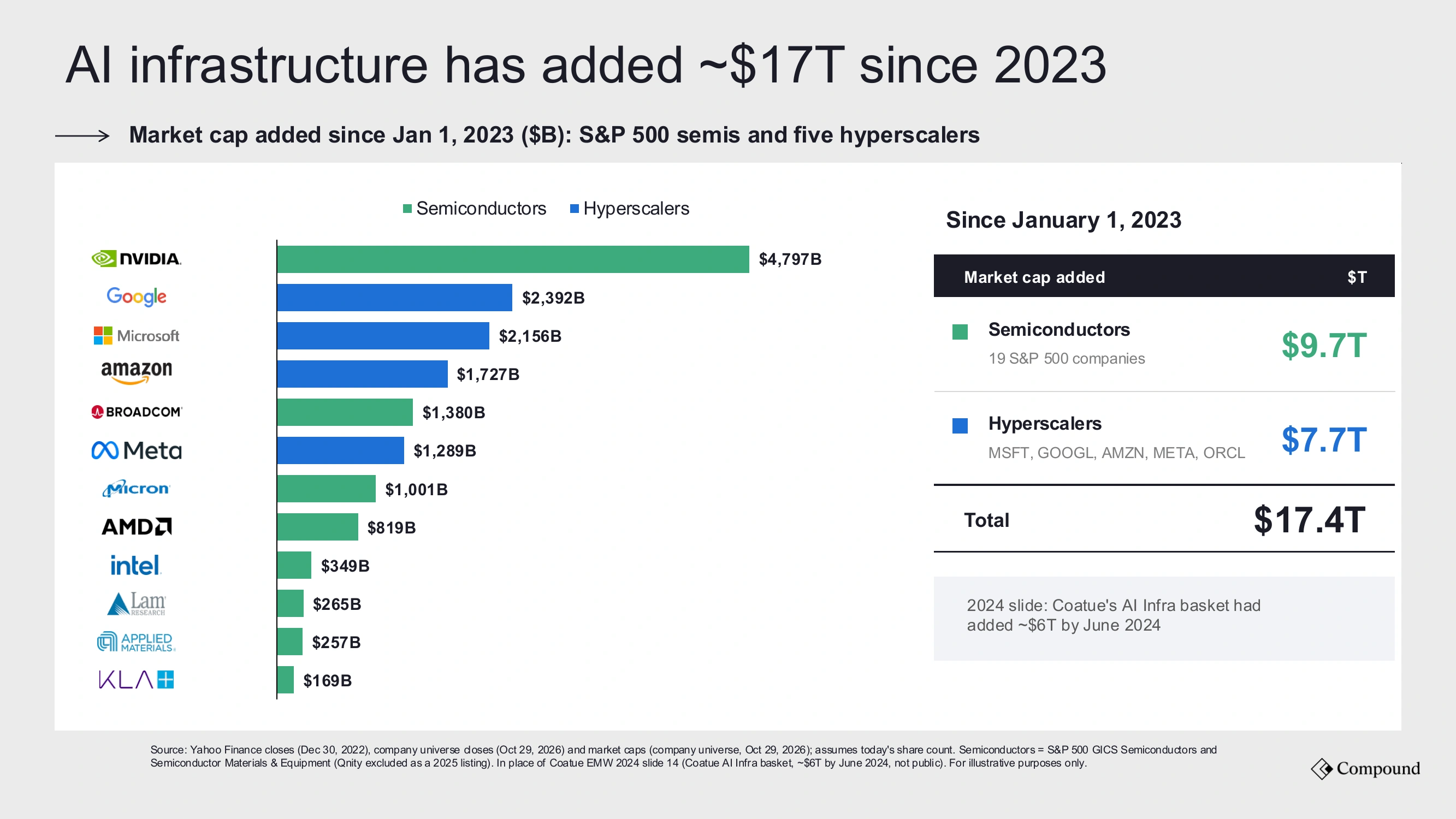
At EMW 2024, Coatue’s AI infrastructure basket had added about $6T of market cap since the start of 2023. That basket isn’t public, so we rebuilt the measure from the S&P 500’s 19 semiconductor companies and five hyperscalers (Microsoft, Alphabet, Amazon, Meta and Oracle). Together they have added $17.4T since January 1, 2023: $9.7T from semis and $7.7T from hyperscalers. NVIDIA alone added $4.8T.
AI names drove about 35% of the S&P 500’s 13% gain in 2026 so far, from about 33% of the index’s starting weight. The rest of the index pulled its weight: 139 S&P 500 stocks are up 25% or more this year, and 97 of them are outside information technology.
The power trade kept pace with the chips
The 2024 keynote flagged power as the next AI bottleneck. An equal-weight basket of the US-listed names in Coatue’s AI power basket (Vertiv, Vistra, Eaton and Constellation) is up 69% since the keynote, against NVIDIA’s 62%. Vertiv led at +169%. The GPU server maker on the same 2024 slide, Supermicro, is down 59%.
AI capex vs AI revenue
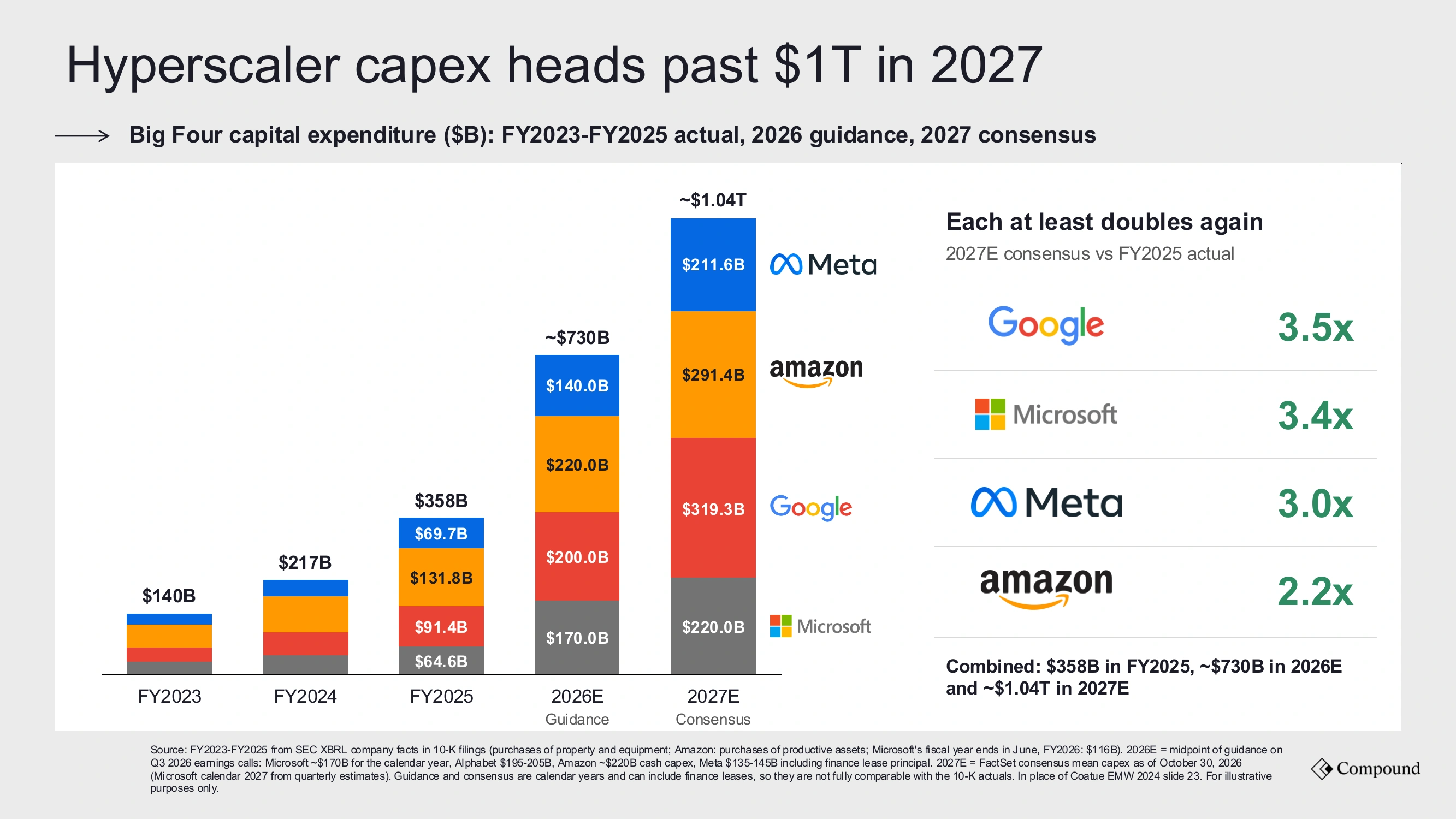
The four largest hyperscalers spent $358B on capex in fiscal 2025. Their 2026 guidance midpoints add up to ~$730B, and FactSet consensus for 2027 is ~$1.04T. Each of the four at least doubles its 2025 capex by 2027.
On the revenue side, the three largest disclosed AI businesses now run at $154B a year: Anthropic at $67B (up from about $9B at the end of 2025), OpenAI at $50B and Microsoft’s AI business at $37B. That is 21% of 2026 capex guidance. The bases differ: Anthropic’s is Q3 revenue annualized, OpenAI’s a late-September run-rate and Microsoft’s its own disclosed run rate.
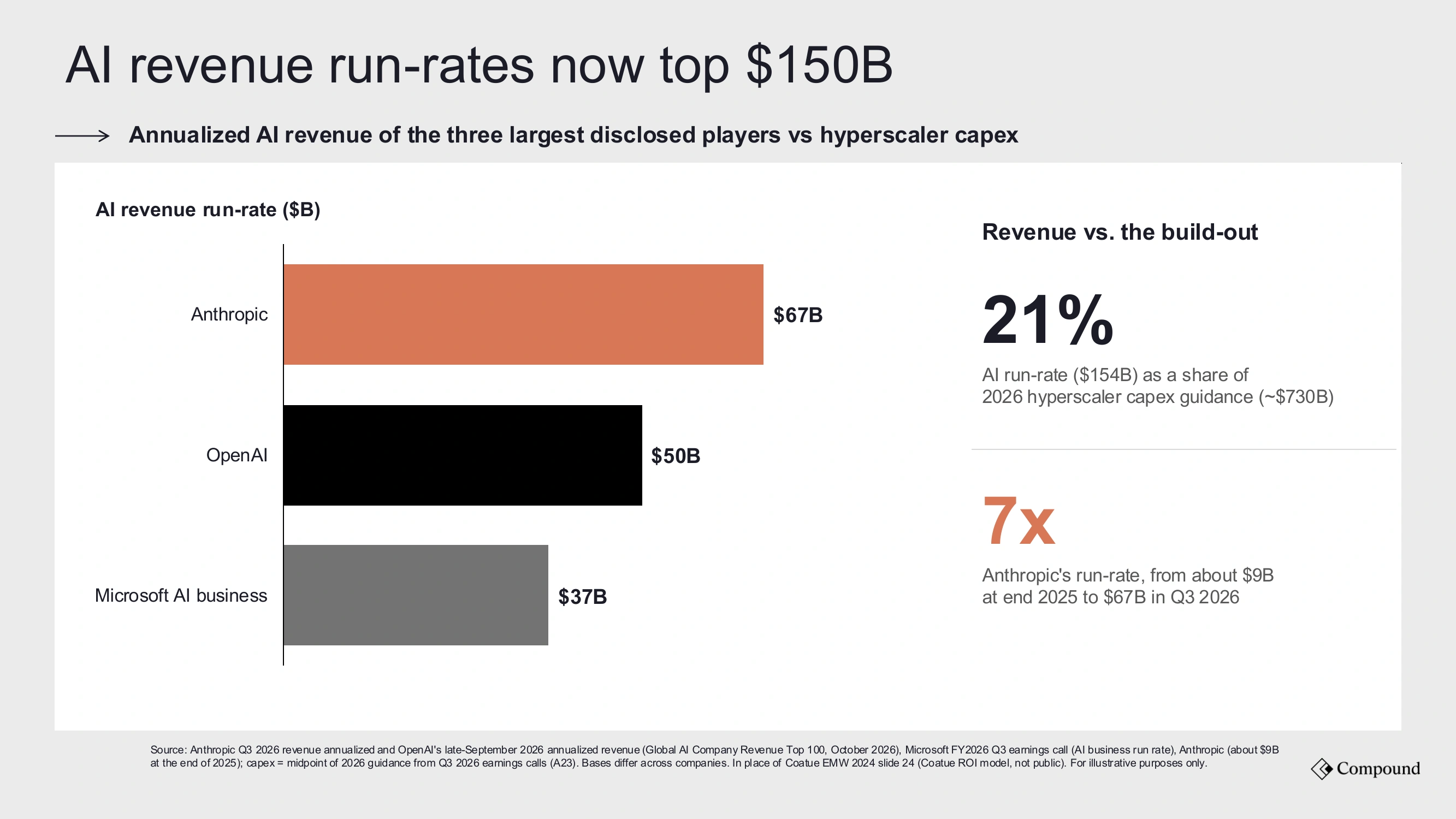
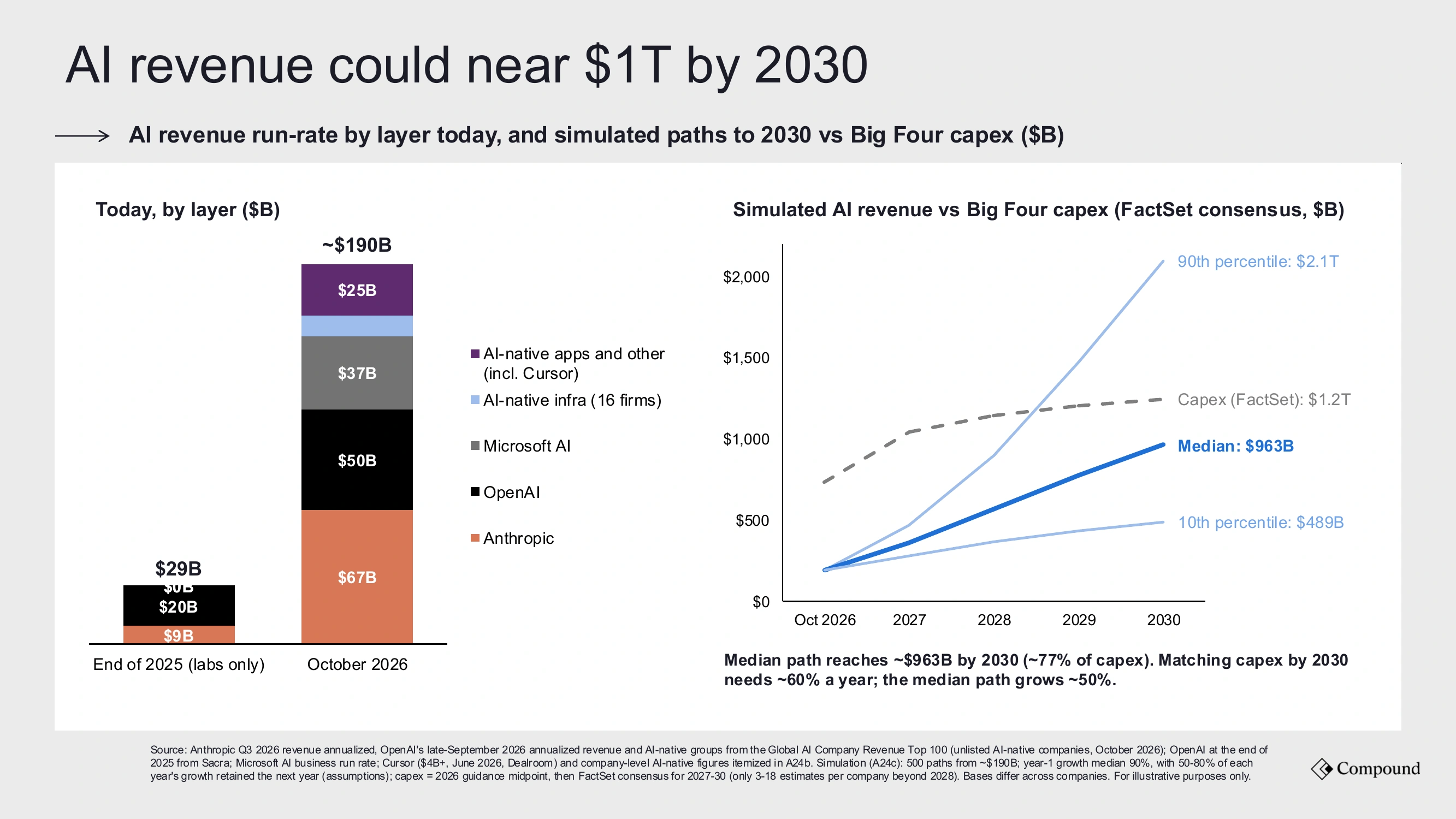
Adding AI-native infrastructure and application companies (Cursor among them) takes total AI revenue to about $190B. To see whether that can catch up with capex, Compound simulated 500 growth paths to 2030, starting from ~$190B with a median first-year growth rate of 90% that fades each year. The median path reaches ~$963B by 2030, about 77% of consensus capex of $1.2T. Matching capex by 2030 takes ~60% growth a year; the median path grows ~50%. The 10th and 90th percentiles are $489B and $2.1T. The growth and fade rates are our assumptions, and consensus capex beyond 2028 rests on 3-18 estimates per company.
Software is still growing at 11%
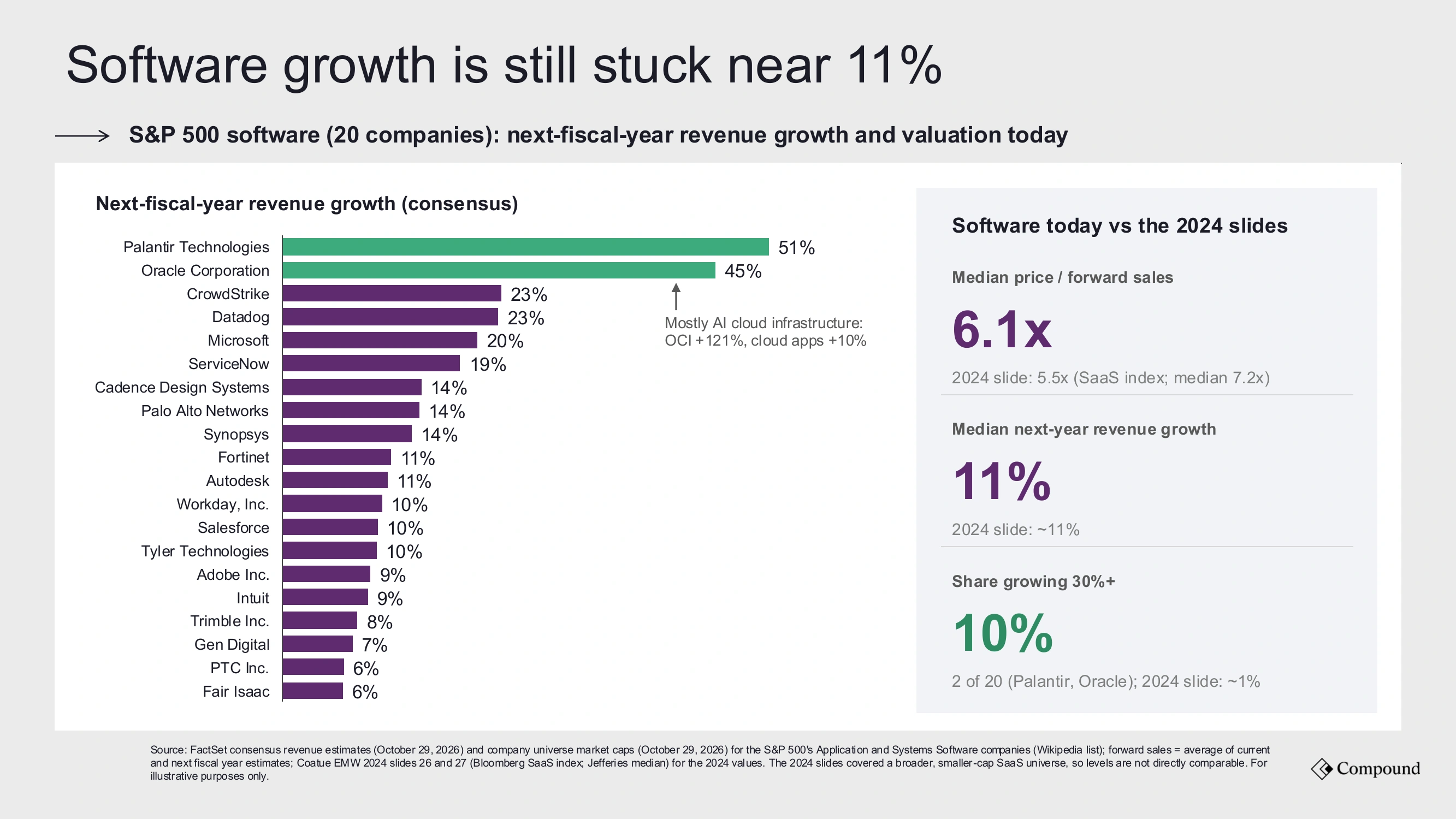
The 2024 keynote argued that software’s low multiples were justified by low growth. That still holds. The median S&P 500 software company is expected to grow revenue 11% next year, the same as on the 2024 slide, and trades at 6.1x forward sales. Only 2 of 20, Palantir and Oracle, are growing 30% or more, and Oracle’s growth is mostly AI cloud infrastructure (OCI +121%, cloud apps +10%). The 2024 slides covered a broader, smaller-cap SaaS universe, so the levels aren’t directly comparable.
AI is starting to show up in the numbers. At Salesforce, Agentforce and Data ARR of $3.9B contributed about 6.4 of its 11 points of growth. At Workday it was 5.1 of 13 points, and at Adobe 1.6 of 12. The public SaaS index is still 29% below its November 2021 high, while the Nasdaq 100 is 77% above its own.
Macro mattered less than expected
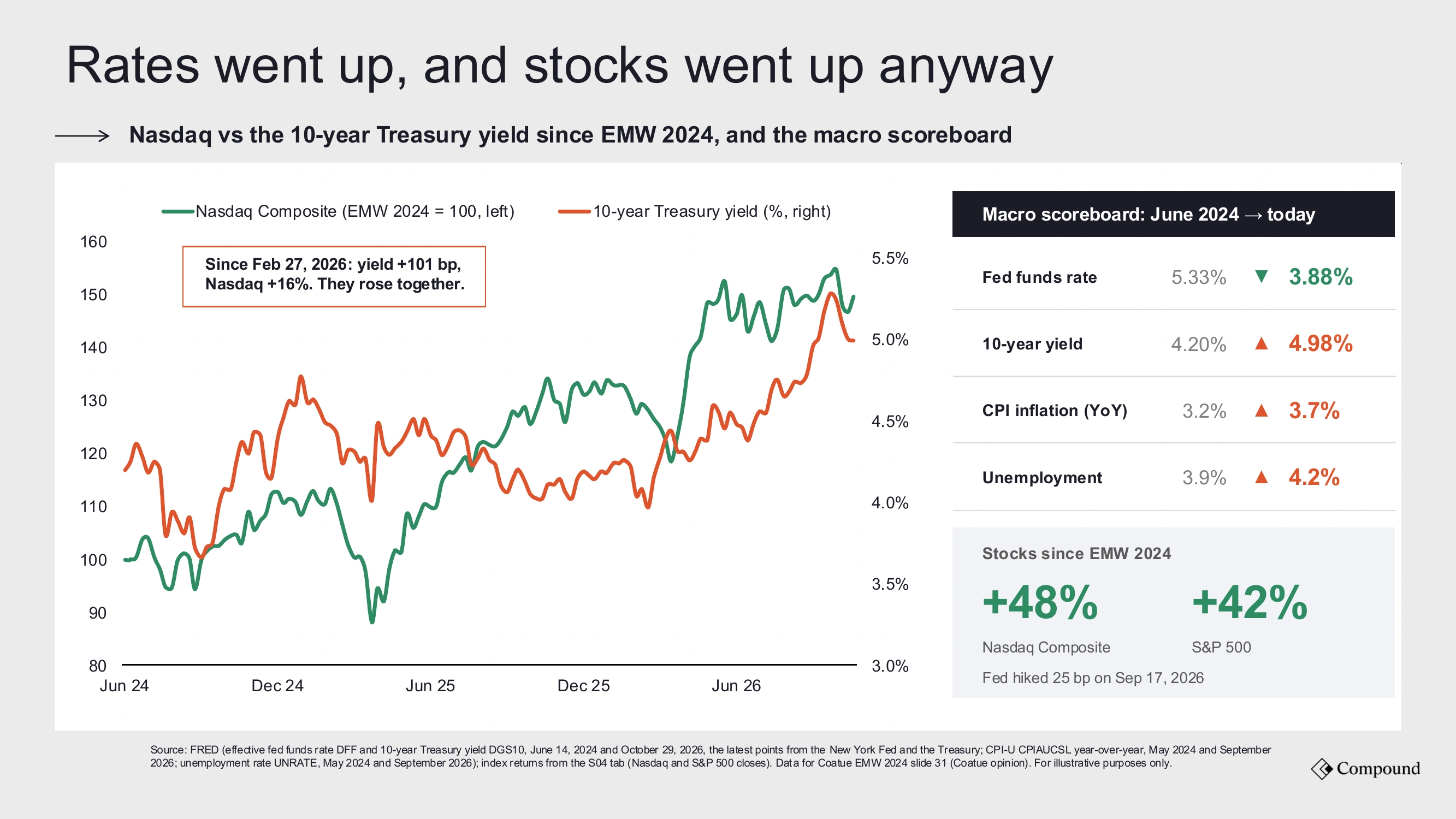
The 2024 keynote treated macro as a tail risk. Since then rates and inflation have moved the wrong way: the 10-year yield rose from 4.20% to 4.98%, CPI inflation from 3.2% to 3.7% and unemployment from 3.9% to 4.2%, and the Fed hiked 25 bp on September 17, 2026, though the fed funds rate is still lower than in June 2024 (3.88% against 5.33%). Stocks rose anyway. Since February 27, 2026, the 10-year yield is up 101 bp and the Nasdaq is up 16%.
Private markets: the gloom was overdone
This is the one call the 2024 keynote got wrong. In June 2024 it saw too many unicorns and no IPO window. Since then AI money has flooded venture, and both unicorn creation and IPOs are recovering, although the companies listing now are fewer and older.
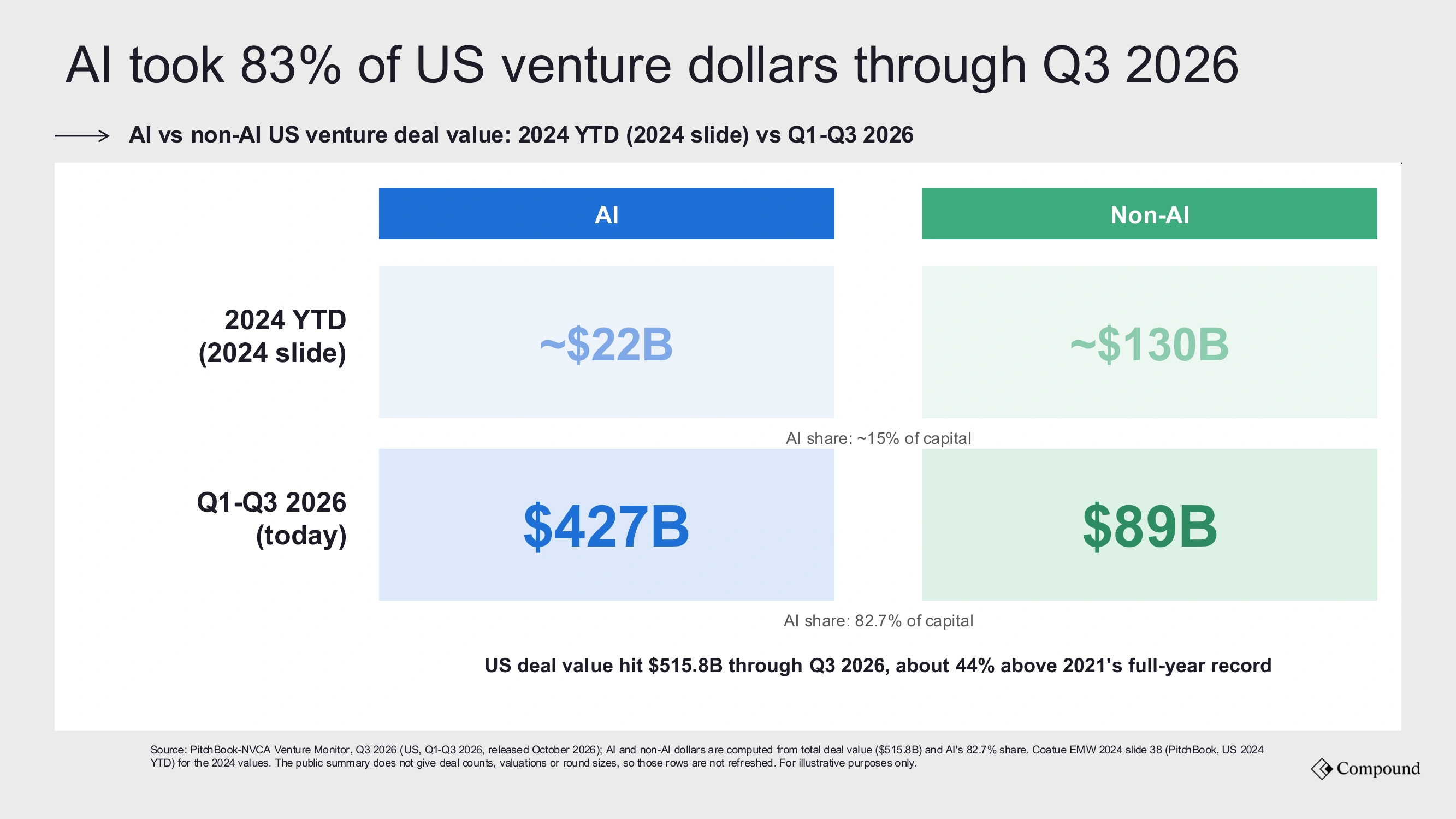
AI’s share of venture funding: 83% of US dollars
On the 2024 slide, AI was about 15% of US venture deal value year to date: ~$22B of ~$152B. Through Q3 2026, it is 82.7%: $427B to AI and $89B to everything else, per the PitchBook-NVCA Venture Monitor. US deal value of $515.8B through Q3 is already about 44% above 2021’s full-year record. The 2024 figure covers only the year to the June keynote.
Globally, Crunchbase shows the same pattern. Non-AI venture funding was flat at $214B in both 2024 and 2025, so AI drove nearly all of the growth. AI raised $242B in Q1 2026 alone, more than in all of 2025. OpenAI and Anthropic took 43% of all global startup funding in the first half of 2026.
Unicorn creation restarted
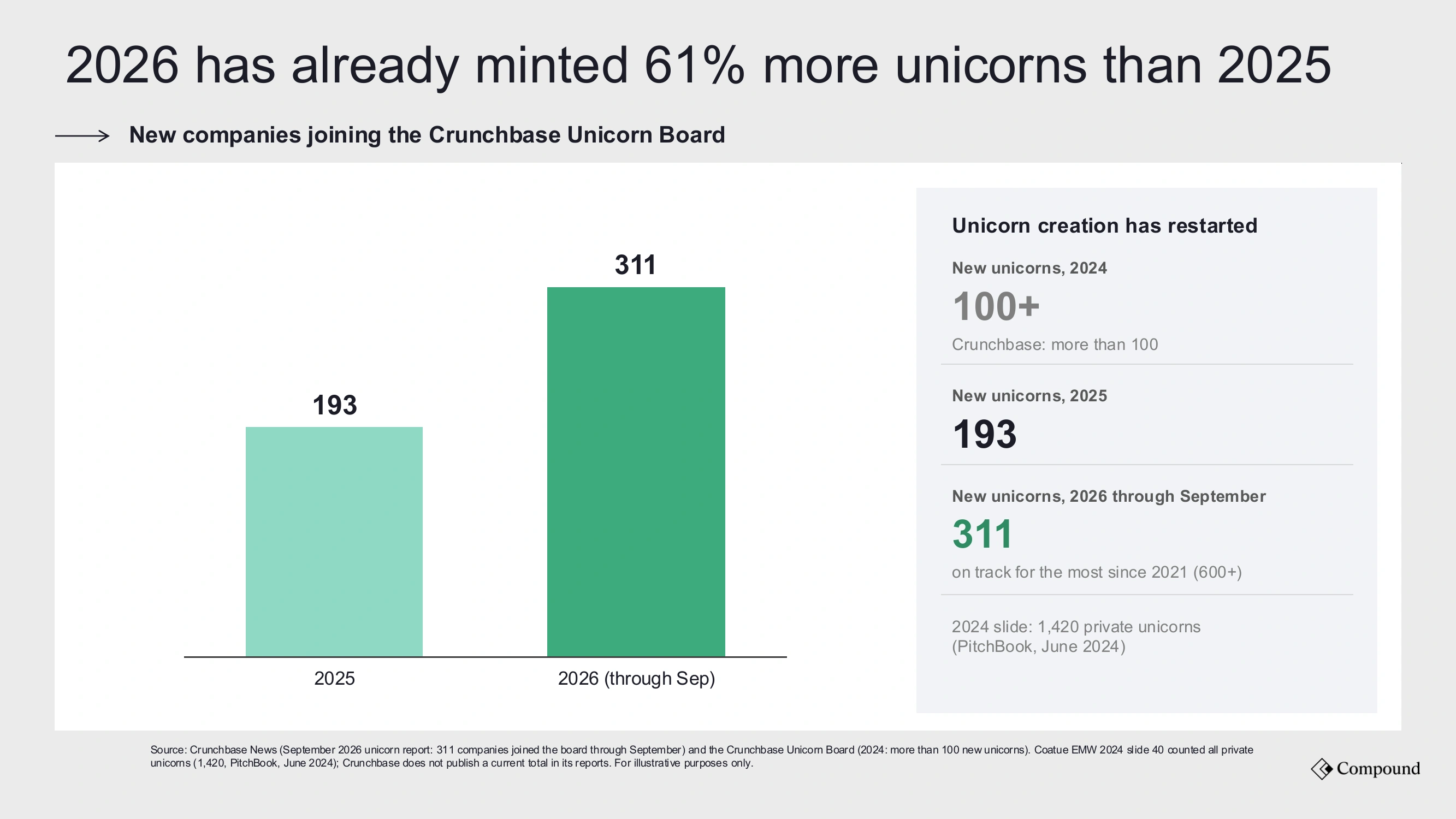
311 companies joined the Crunchbase Unicorn Board through September 2026, against 193 in all of 2025 and just over 100 in 2024. 2026 is on track for the most new unicorns since 2021. The backlog the 2024 keynote worried about is still there, though: as of January 2025, half of all unicorns had not raised a priced round since the start of 2022.
IPOs are back, for older companies
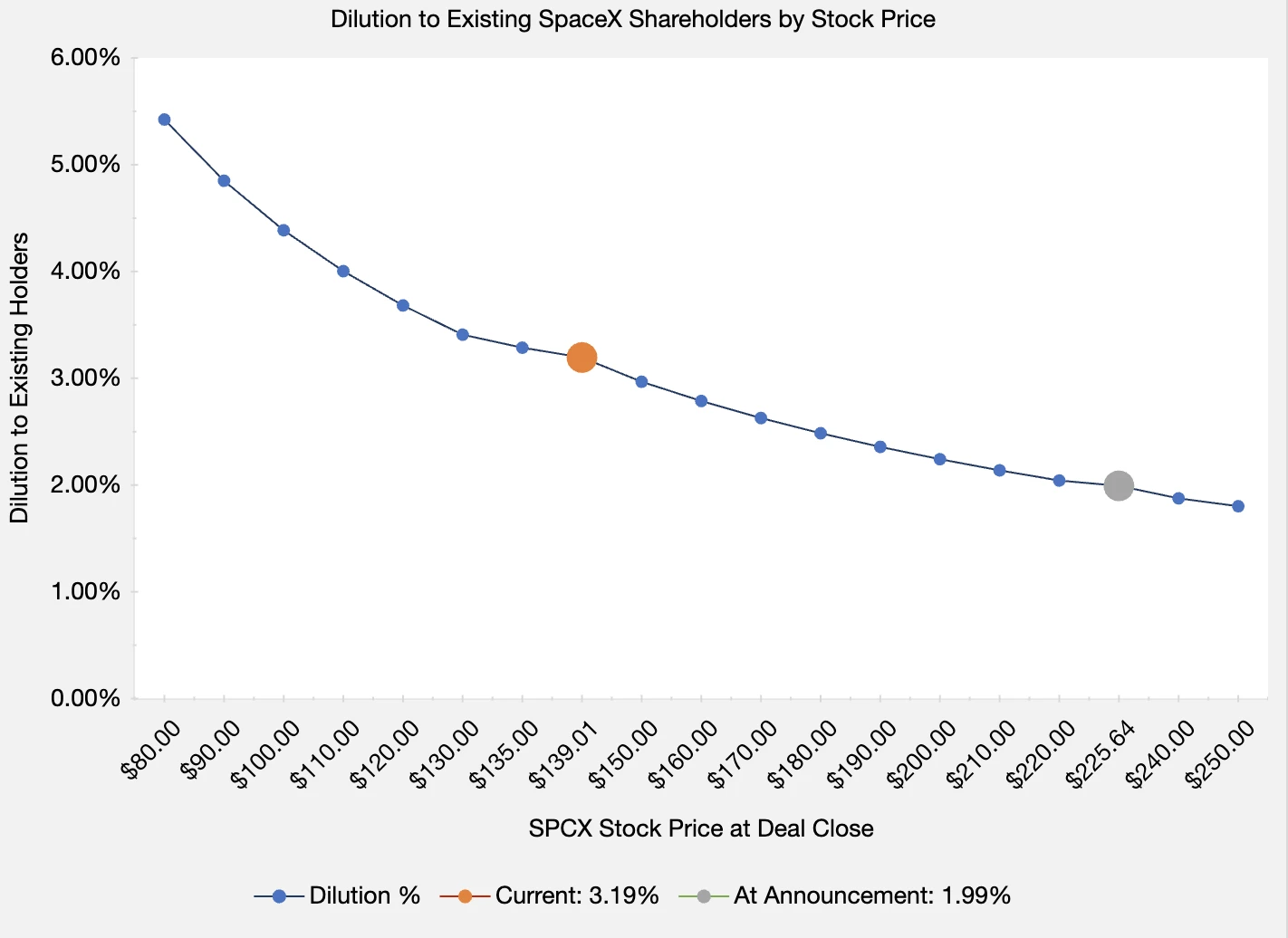
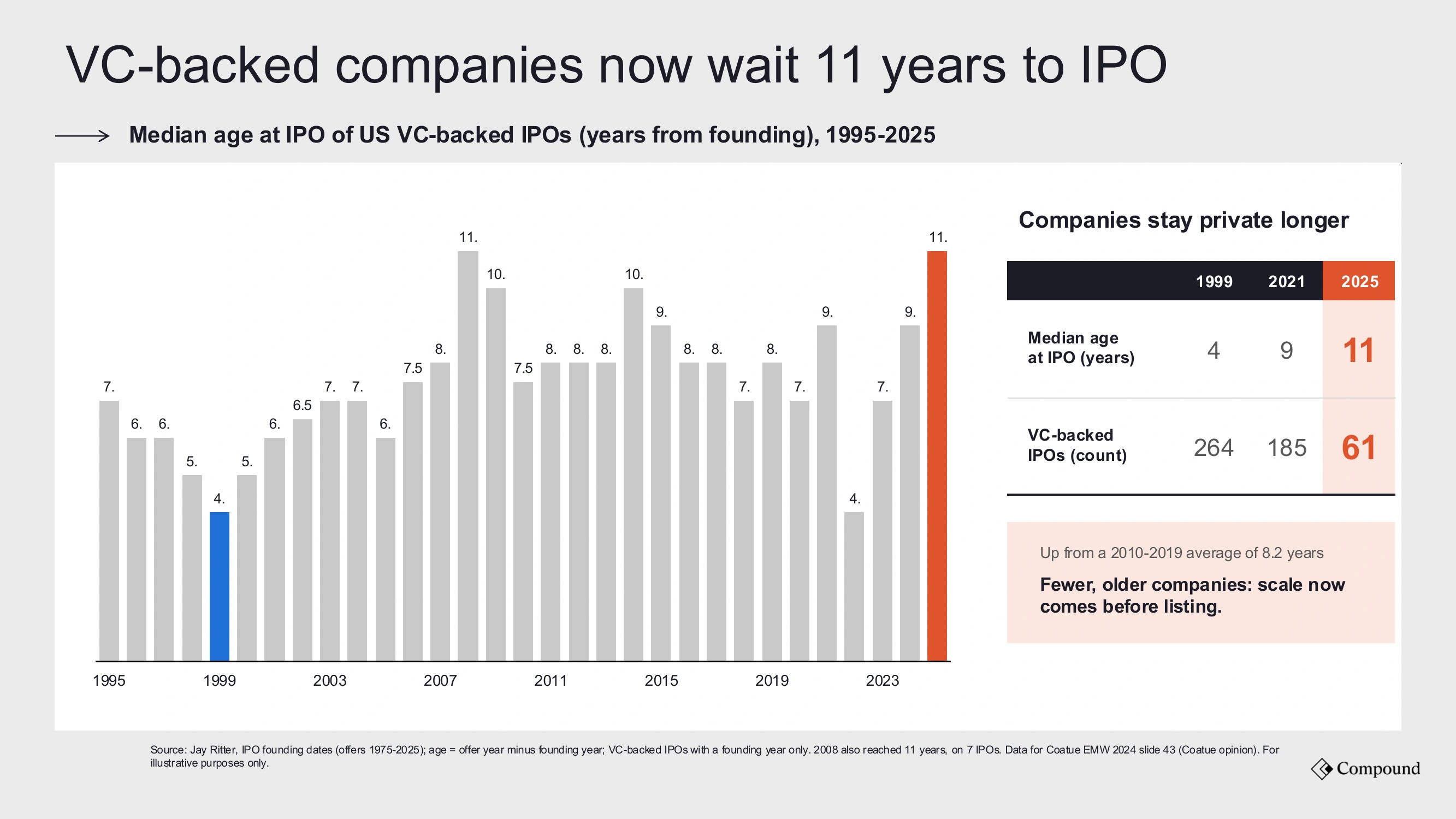
US tech IPOs rose from 14 in 2024 to 31 in 2025 (Jay Ritter’s count), and 112 US IPOs of all kinds have priced in 2026 so far. SpaceX listed in Q2 2026 at $1.77T, the largest venture-backed IPO on record. But companies are waiting longer. The median age of a VC-backed company at IPO was 11 years in 2025, tied with 2008 for the longest since 1995, against 4 years in 1999 and 9 in 2021. Only 61 VC-backed companies went public in 2025, against 264 in 1999.
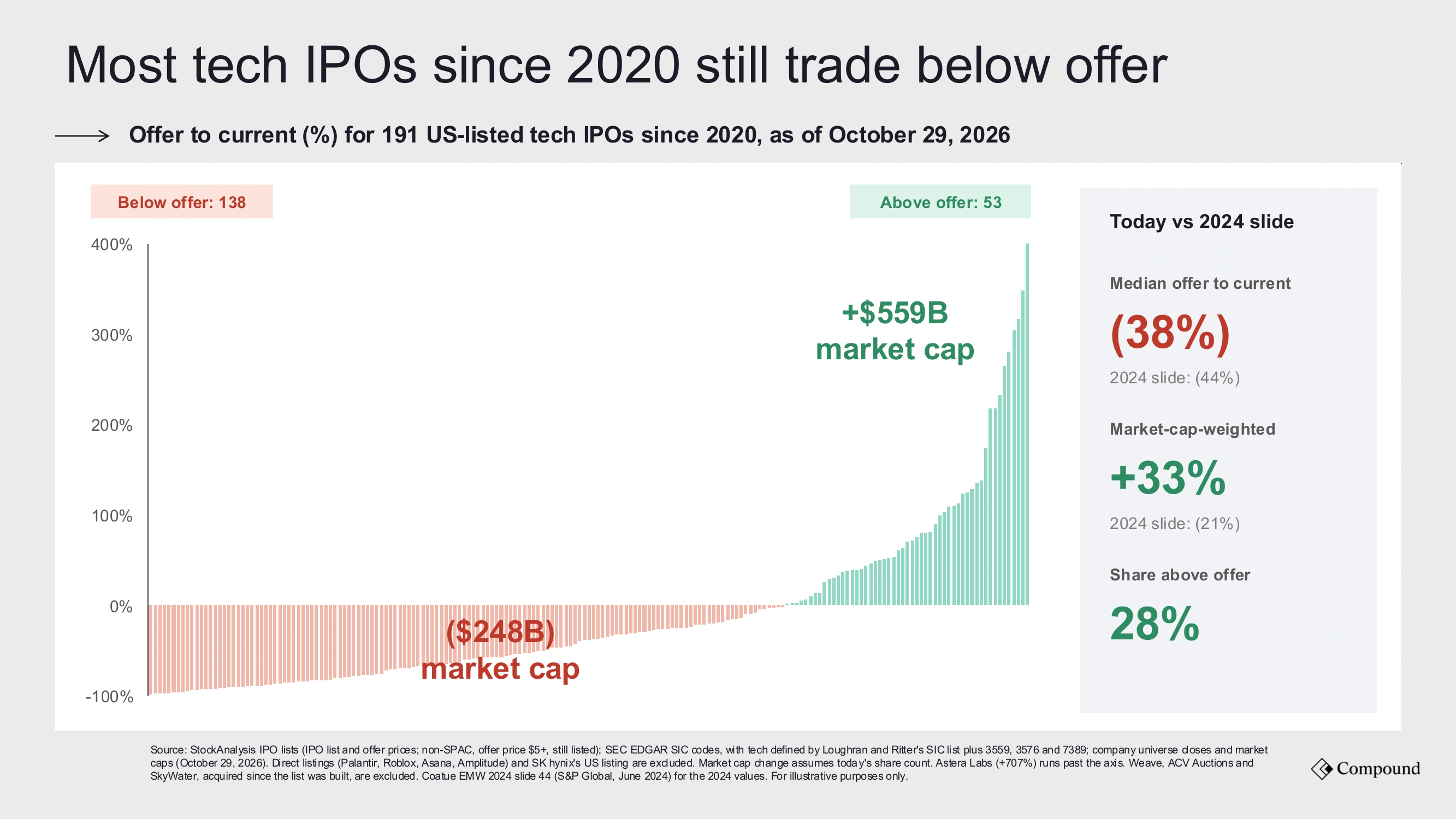
For the companies that did list, the median result is still poor. Of 191 US tech IPOs since 2020, 138 trade below their offer price, and the median is down 38% (the 2024 slide showed -44%). The winners are big enough to outweigh them, though: market-cap weighted, the group is up 33%, against -21% on the 2024 slide. The 53 above offer have added $559B of market cap, while the 138 below have lost $248B.
M&A is the other exit
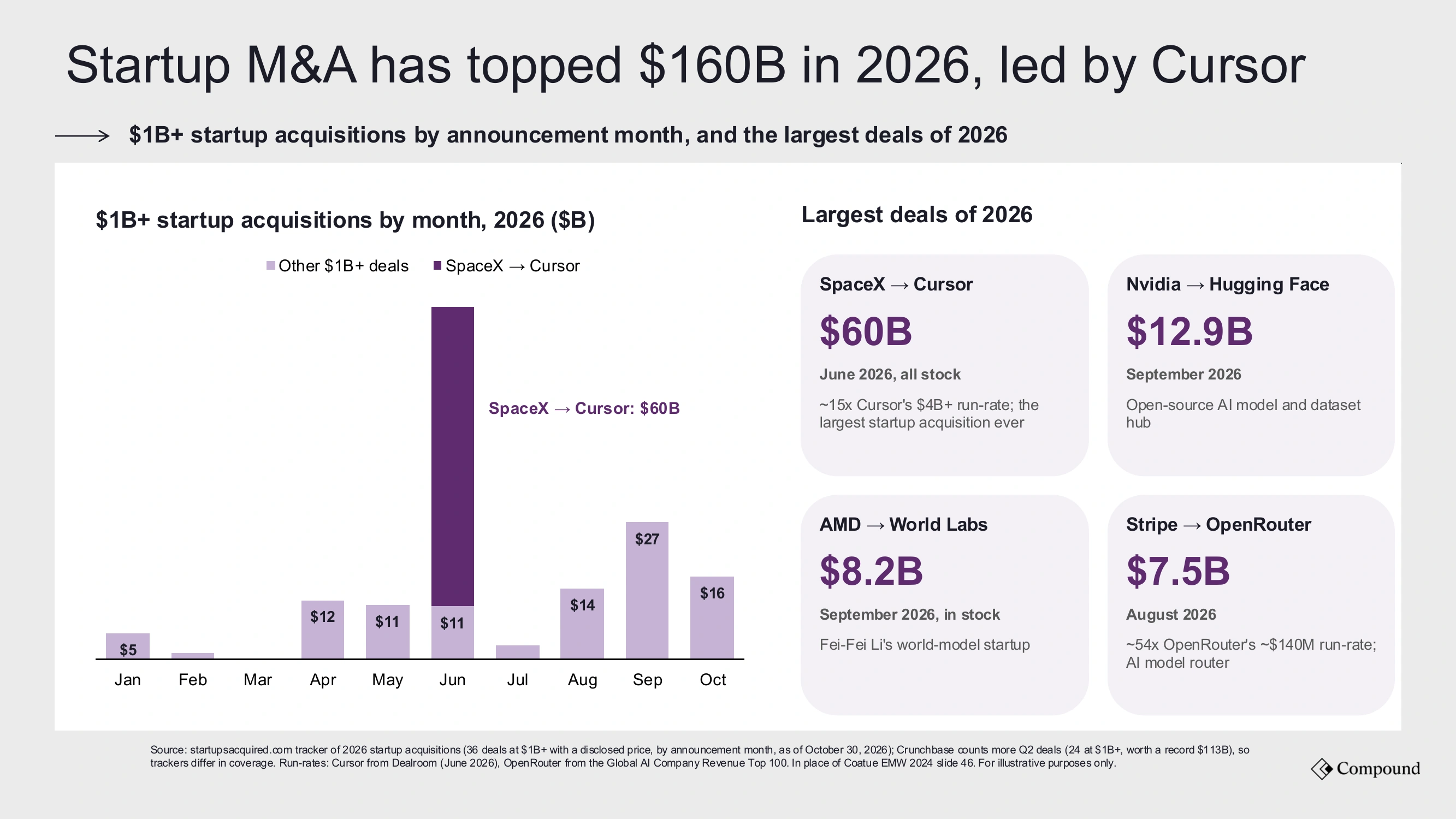
$1B+ startup acquisitions have topped $160B in 2026, led by SpaceX’s $60B all-stock purchase of Cursor in June, the largest startup acquisition on record (our analysis). The other large deals are AI too: Nvidia bought Hugging Face for $12.9B, AMD bought World Labs for $8.2B and Stripe bought OpenRouter for $7.5B.
The questions for the next two years
In 2024 the keynote’s open questions were whether AI was a bubble, why NVIDIA was worth $3T and whether software was dead. With October 2026 data, two different questions matter more.
The first is whether AI revenue can pay for the buildout. The largest AI businesses run at $154B a year against $730B of 2026 capex, and on our simulation the median path still falls short of consensus capex in 2030.
The second is whether AI can lift software growth above 11%. AI products already add several points of growth at Salesforce and Workday, but the median S&P 500 software company has not moved.
How we built it
We gave Compound one thing: the link to Coatue’s public EMW 2024 presentation, as posted on Coatue’s blog. We did not upload the deck as a PDF or PowerPoint file, and we gave it none of Coatue’s data. Compound read the slides from the public copies of the presentation and worked out what each one measured and on what basis.
Every number in the refresh came from Compound’s own research: SEC filings, FRED, Nasdaq index levels, Crunchbase, the PitchBook-NVCA Venture Monitor and Jay Ritter’s IPO statistics, plus the FactSet consensus estimates built into Compound. Each slide keeps the 2024 format with the 2024 number beside today’s, and its footnote names the source and says where the basis differs from 2024.
Where a 2024 slide used a Coatue basket or model that isn’t public (the AI infrastructure basket, the AI basket’s share of S&P 500 gains, the AI ROI model), Compound built the nearest public equivalent and says so on the slide. Those rebuilt measures are our own.
Every number in the deck traces back to the workbook cell behind it, and from there to the filing or dataset it came from, so a reviewer can check any figure without asking who built it. The same workflow refreshes any recurring market deck, such as an annual outlook or a quarterly LP letter. See industry research with Compound.
Frequently asked questions
What did Coatue predict at EMW 2024?
Five main calls: AI is the start of a super-cycle with infrastructure winning first; AI is not a .com-style bubble; macro is only a tail risk; software’s low multiples reflect its low growth; and private markets have too many unicorns and no IPO window.
Was Coatue right about AI?
On our grading, yes. AI infrastructure added $17.4T of market cap from January 2023 to October 2026, and AI names drove about 35% of the S&P 500’s 2026 gain. The private-market call was the one that missed: unicorn creation and tech IPOs are actually recovering.
Is NVIDIA more expensive now than at EMW 2024?
No. NVIDIA’s stock is up 62% since June 14, 2024, but its consensus earnings grew faster, so its forward P/E fell from 39x to 14x. It is now the cheapest of the six megacaps on the 2024 slide.
How much venture funding goes to AI in 2026?
82.7% of US venture deal value through Q3 2026 ($427B of $515.8B), per the PitchBook-NVCA Venture Monitor, against about 15% in the first half of 2024. Globally, Crunchbase shows AI at 64-80% of funding in each quarter of 2026.
Sources: Coatue EMW 2024 keynote (June 2024) for the 2024 values; company 10-Q, 10-K and 8-K filings; FactSet consensus and Earnings Insight (October 2026); FRED; Nasdaq (SOXX and BVP Nasdaq Emerging Cloud Index); Crunchbase News; PitchBook-NVCA Venture Monitor, Q3 2026; Jay R. Ritter, IPO Statistics; Renaissance Capital; StockAnalysis; startupsacquired.com. Prices are as of October 29, 2026. Grades, rebuilt baskets and the 2030 simulation are our own analysis. OpenAI and Anthropic values are private-round valuations.