Data center moratorium tracker: 68 GW of US AI capacity
Local votes, permits, lease protections and state policy behind 68 GW of neocloud, hyperscaler and AI-lab campuses in the US, as of November 9, 2026
by Compound Team · November 9, 2026 · 12 min read

The full 13-slide dashboard behind this post, from the 2026 local ballot measures to permits, lease protections, state policy and a lease diligence checklist, every figure sourced to company filings, S&P Global Ratings, SemiAnalysis, Ballotpedia, state and local trackers or Polymarket.
Download · FreeData centers were one of the few issues both parties’ voters agreed on in the 2026 midterms. Voters sided with limits on data centers in 46 of 47 local ballot measures decided this year, with an average of 75% voting for limits in counties Trump won in 2024 and in counties Harris won. Governors-elect in Texas, Georgia, New Mexico and Michigan back a pause or moratorium on new data centers, Ohio’s backs a conditional one, and New Hampshire’s Republican governor-elect backs a budget moratorium.
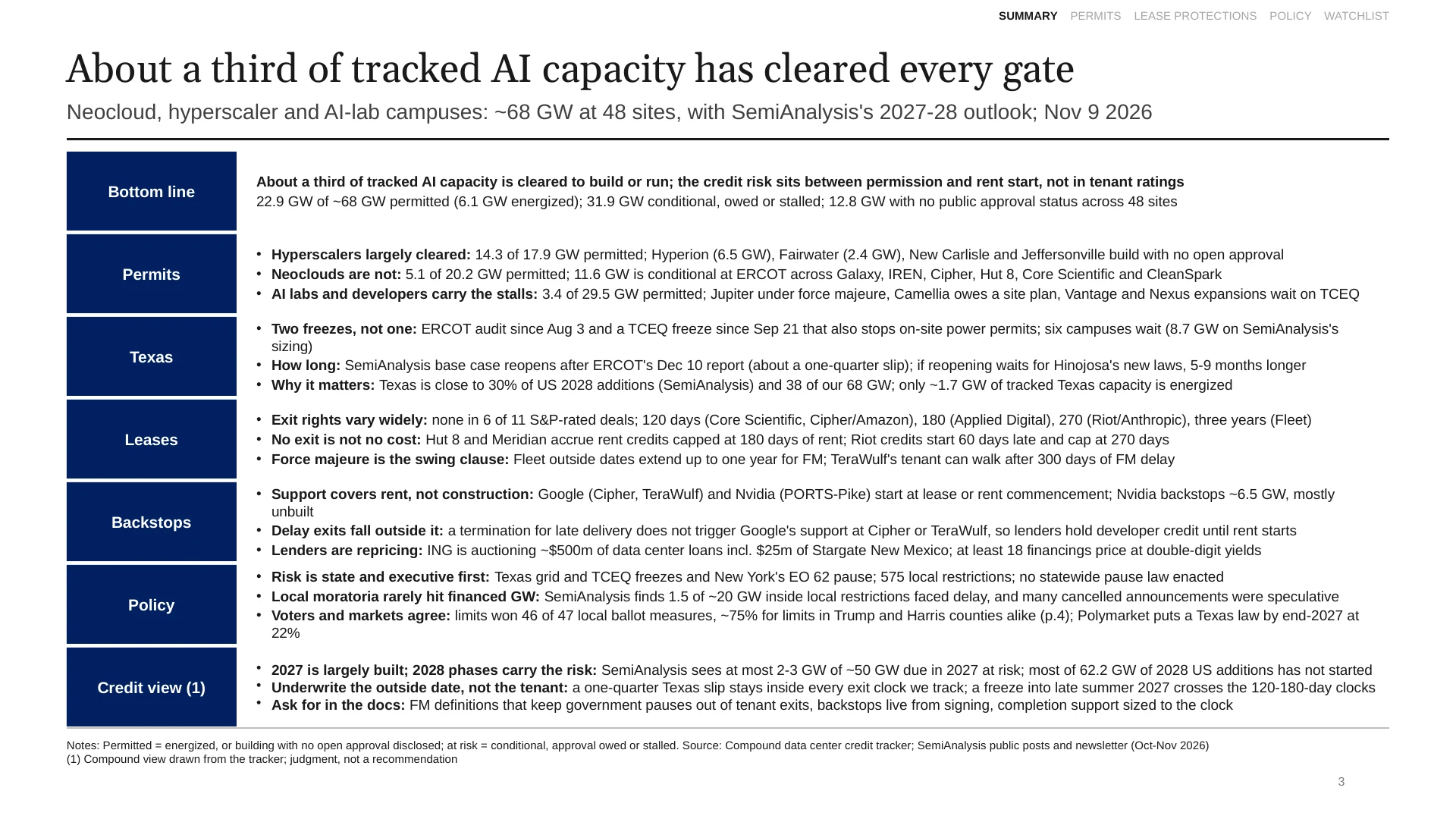
We had Compound track about 68 GW of neocloud, hyperscaler and AI-lab campuses at 48 US sites, and read the leases and financings behind them. On November 9, 2026, about a third of that capacity was cleared to build or run: 22.9 GW was permitted, of which 6.1 GW was energized. Texas holds 38 GW, and has frozen new large loads twice since August.
Five findings
- The backlash is bipartisan. Limits won 46 of 47 local ballot measures in 2026, at an average of 75% in Trump-won and Harris-won counties alike.
- Hyperscalers have largely cleared their permits; neoclouds are close behind on paper. Hyperscalers have 14.3 of 17.9 GW permitted. Neoclouds have 5.1 of 20.2 GW permitted and another 11.6 GW conditionally approved by ERCOT, most of it with no disclosed tenant.
- Texas decides the pipeline. It holds 38 of the 68 GW, and only 1.7 GW of it is energized. An ERCOT grid audit since August 3 and a TCEQ permit freeze since September 21 hold up most of the rest.
- 2027 is largely built; 2028 carries the permit risk. SemiAnalysis sees at most 2 to 3 GW of the roughly 50 GW due in 2027 at risk. Most of the 62.2 GW due in 2028 has not started, and close to 30% of it is in Texas.
- Leases and backstops were not written for a government pause. Six of eleven S&P-rated deals give the tenant no exit for late delivery, and where the start date is disclosed (Cipher, TeraWulf and PORTS-Pike), Google’s and Nvidia’s guarantees start only once the lease or rent does.
The local vote
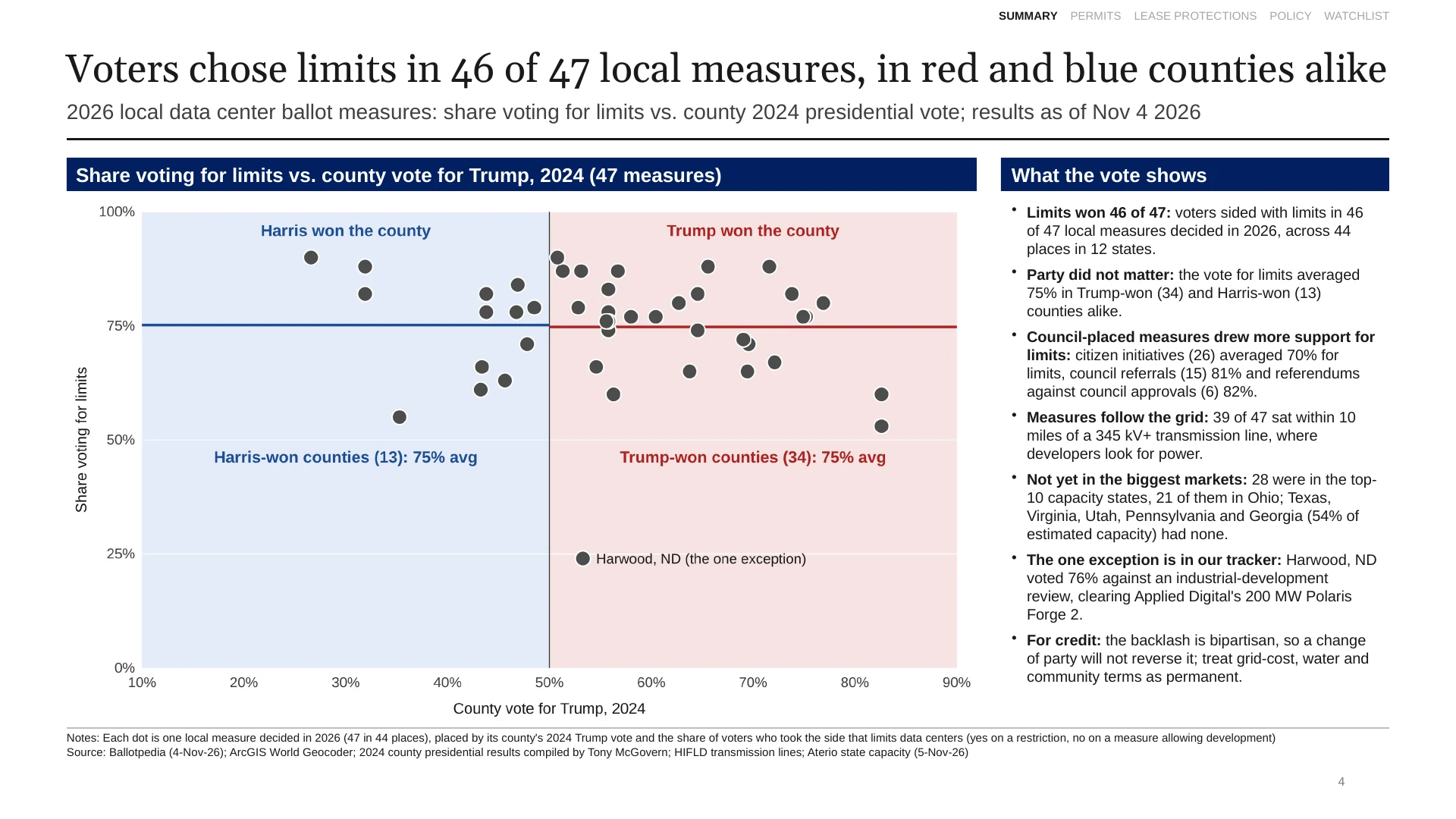
Voters chose limits in 46 of 47 local measures, in red and blue counties alike
Voters took the side that limits data centers in 46 of 47 local measures decided in 2026, across 44 places in 12 states. The vote for limits averaged 75% in the 34 Trump-won counties and in the 13 Harris-won counties. Council referrals (81% for limits) and referendums against council approvals (82%) drew more support for limits than citizen initiatives (70%).
The measures follow the grid: 39 of 47 sat within 10 miles of a 345 kV or larger transmission line, where developers look for power. They have not yet reached the biggest markets. Texas, Virginia, Utah, Pennsylvania and Georgia, 54% of estimated capacity, had none; 21 of the 47 were in Ohio. The one exception is in our tracker: Harwood, North Dakota voted 76% against an industrial-development review, clearing Applied Digital’s 200 MW Polaris Forge 2.
Because the backlash crosses party lines, a change of party in a statehouse is unlikely to reverse it. We treat grid-cost, water and community terms as permanent.
Permits
Most at-risk capacity has no disclosed tenant
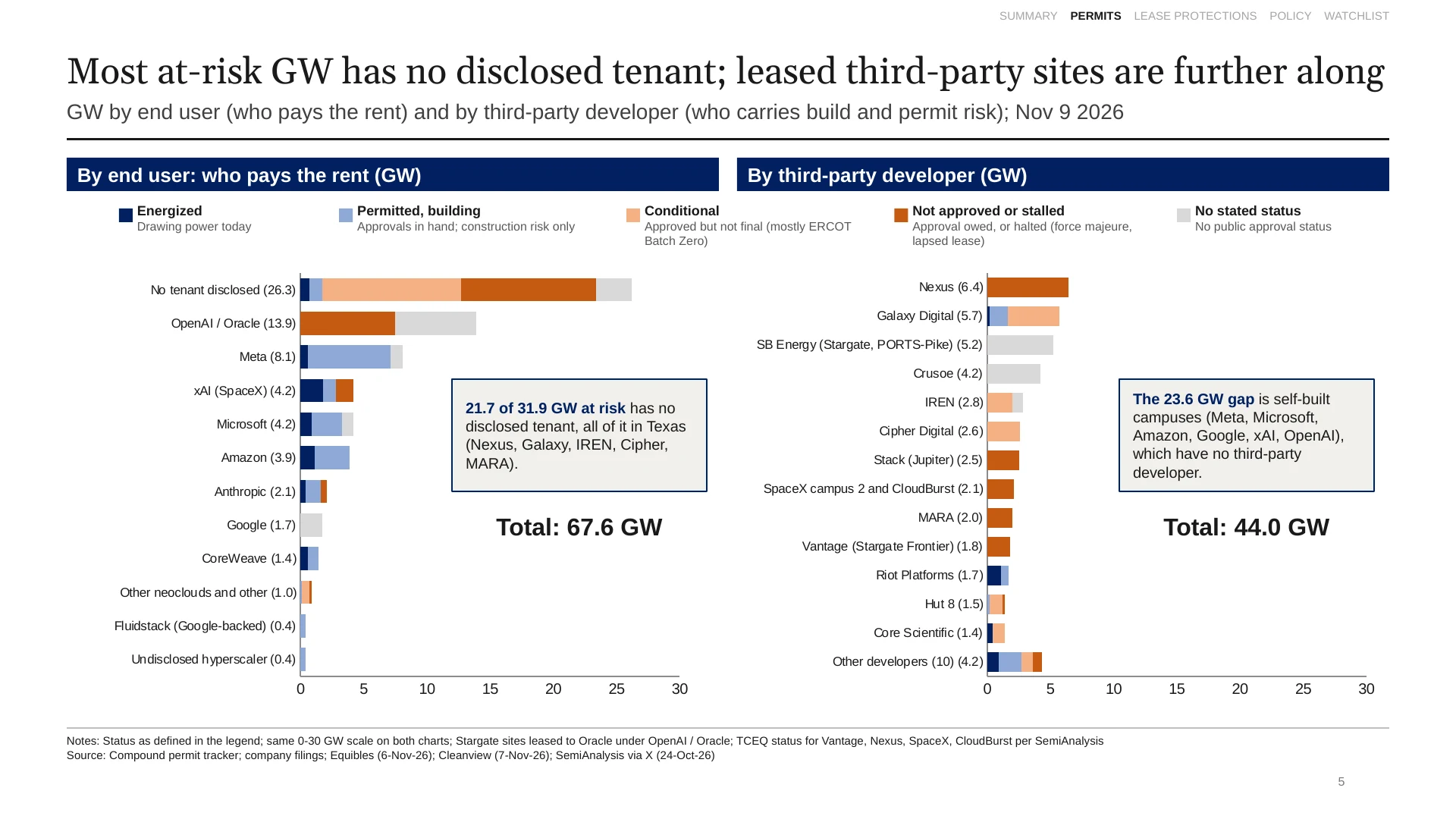
We counted a site as permitted when it is energized, or building with no open approval disclosed, and as at risk when an approval is conditional, owed or stalled. Of the 31.9 GW at risk, 21.7 GW has no disclosed tenant, all of it in Texas, at sites developed by Nexus, Galaxy, IREN, Cipher and MARA.
The 23.6 GW that hyperscalers and AI labs build themselves has no third-party developer, which is why the right chart totals 44.0 GW; 16.3 GW of it is permitted. OpenAI’s Camellia campus in Georgia (3.2 GW) and SpaceX’s Texas campus (1.4 GW) are the exceptions. Leased third-party sites have 4.9 of 17.7 GW permitted.
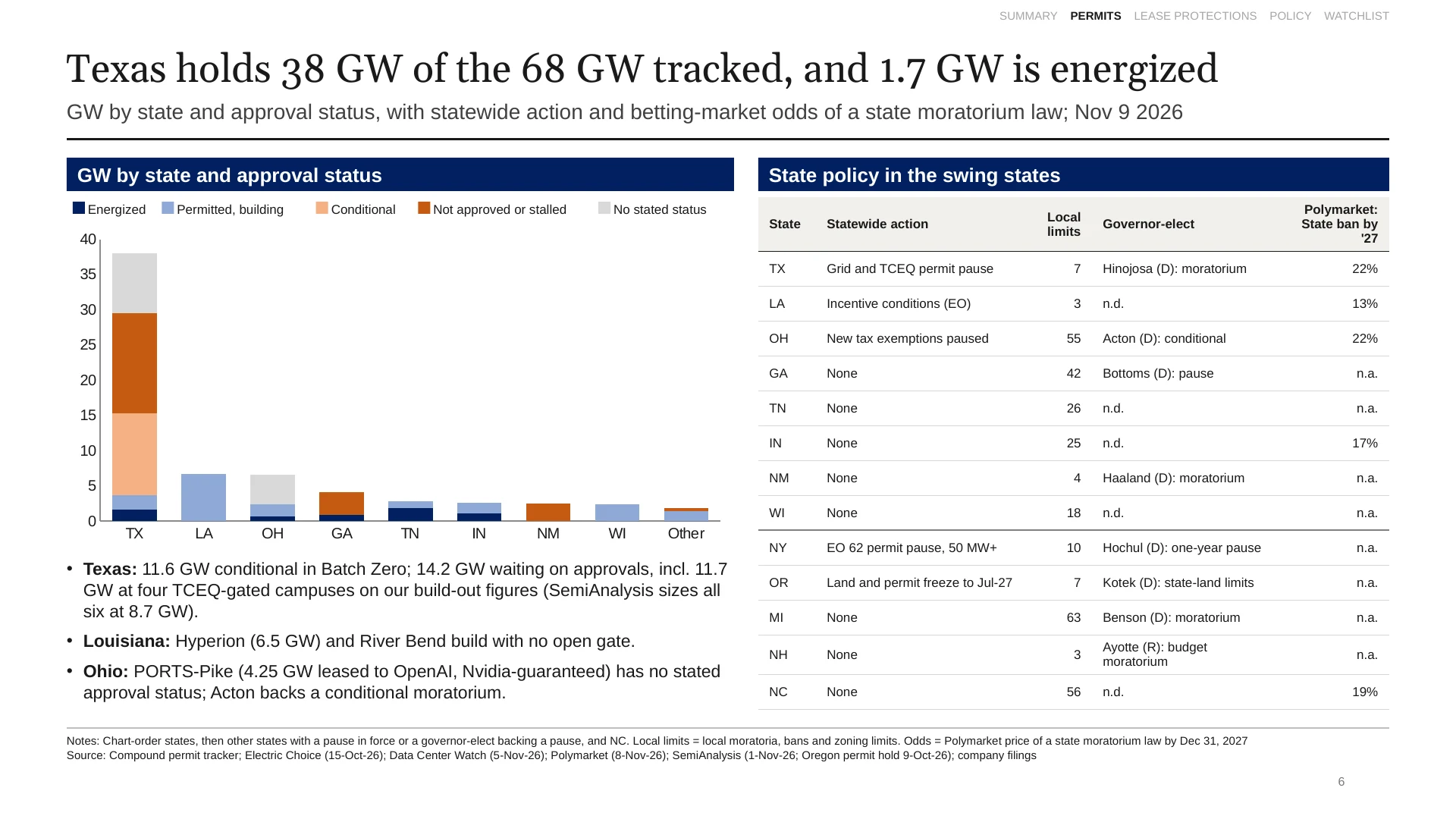
Texas holds 38 GW, and 1.7 GW is energized
Texas has 11.6 GW conditional in ERCOT’s Batch Zero and 14.2 GW waiting on other approvals, mostly TCEQ air permits at Nexus, Vantage, SpaceX and CloudBurst. Louisiana is the cleanest large state: Meta’s Hyperion campus (6.5 GW) and Hut 8’s River Bend build with no open approval. In Ohio, PORTS-Pike (4.25 GW, leased to OpenAI and guaranteed by Nvidia) has no stated approval status.
In the state table, local limits counts the city, county and township moratoria, bans and zoning limits on data centers. The Polymarket column is the betting-market price that the state enacts a data center moratorium law by December 31, 2027: 22% for Texas and Ohio.
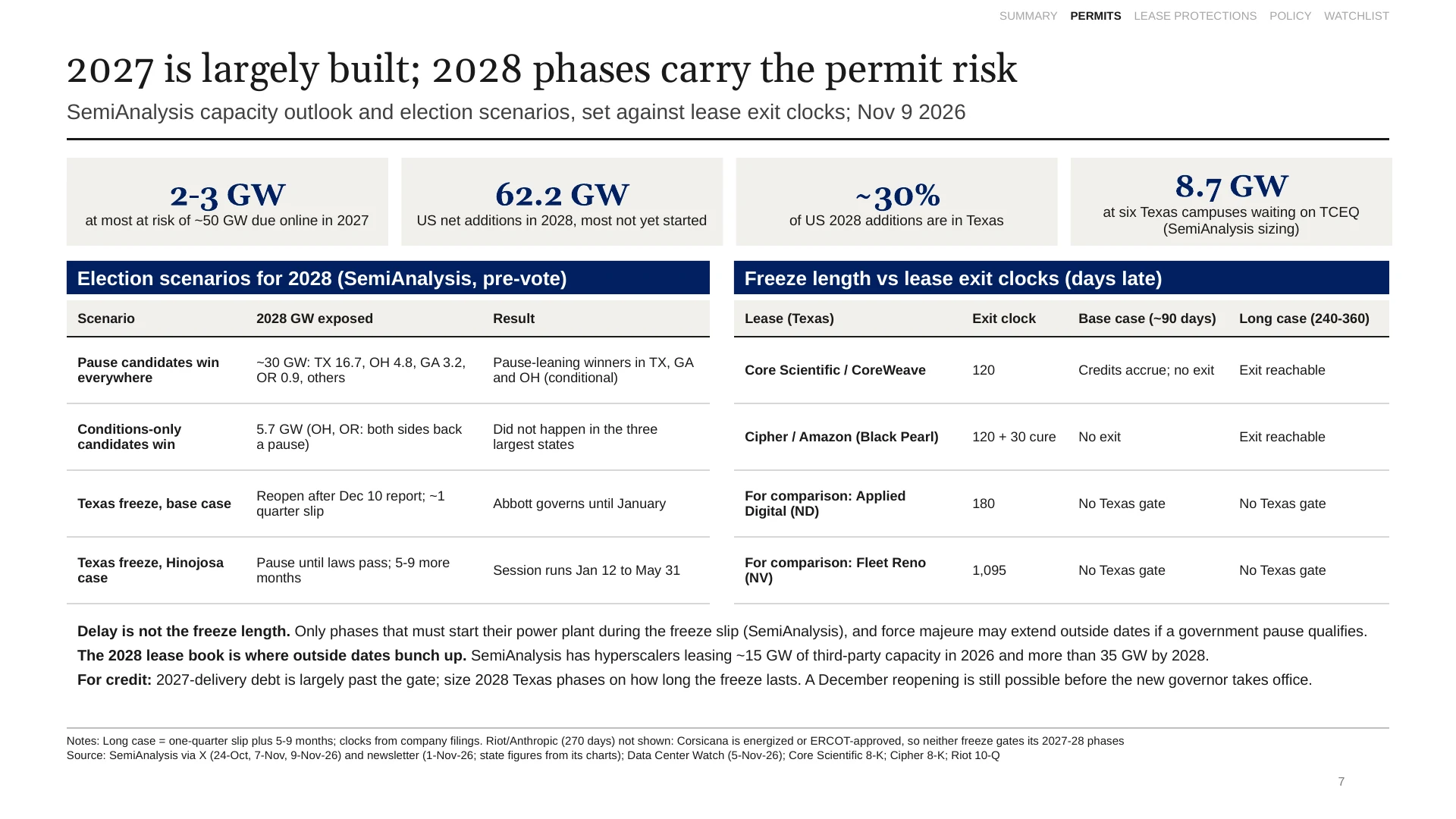
2027 is largely built; 2028 phases carry the permit risk
A freeze delays only the phases that must start their power plant while it lasts. That is why SemiAnalysis sees at most 2 to 3 GW of the roughly 50 GW due in 2027 at risk. The exposure is the 62.2 GW of US additions due in 2028, most of it not yet started.
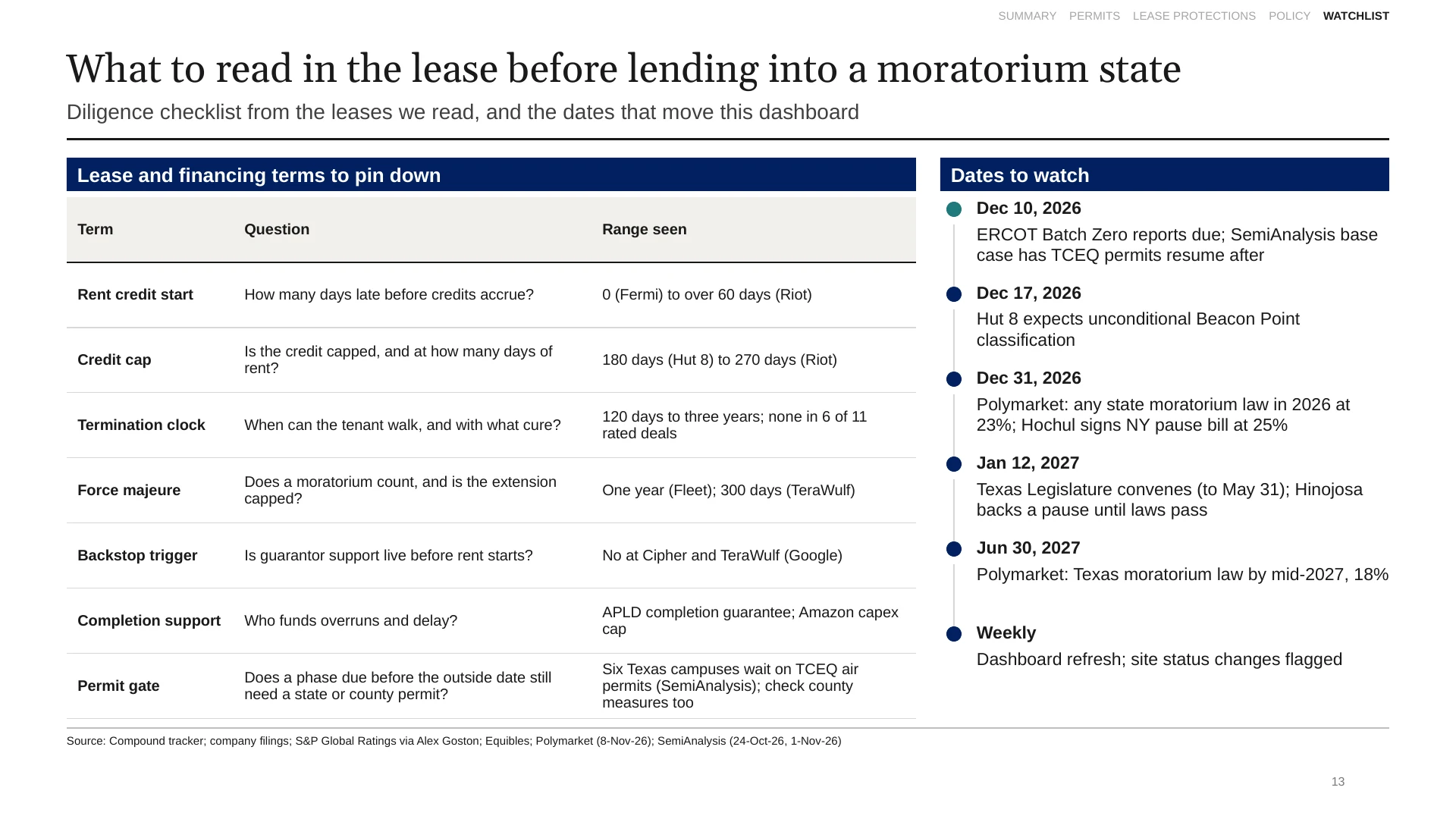
In SemiAnalysis’s base case, Texas lifts its freeze after ERCOT’s December 10 report, and projects slip about three months, inside every lease exit clock we track. If Governor-elect Hinojosa, who takes office in January, keeps the freeze until the legislature passes new data center laws (the session runs January 12 to May 31), projects slip another 5 to 9 months. At that length, Core Scientific’s and Cipher’s 120-day exits come into reach.
Lease protections
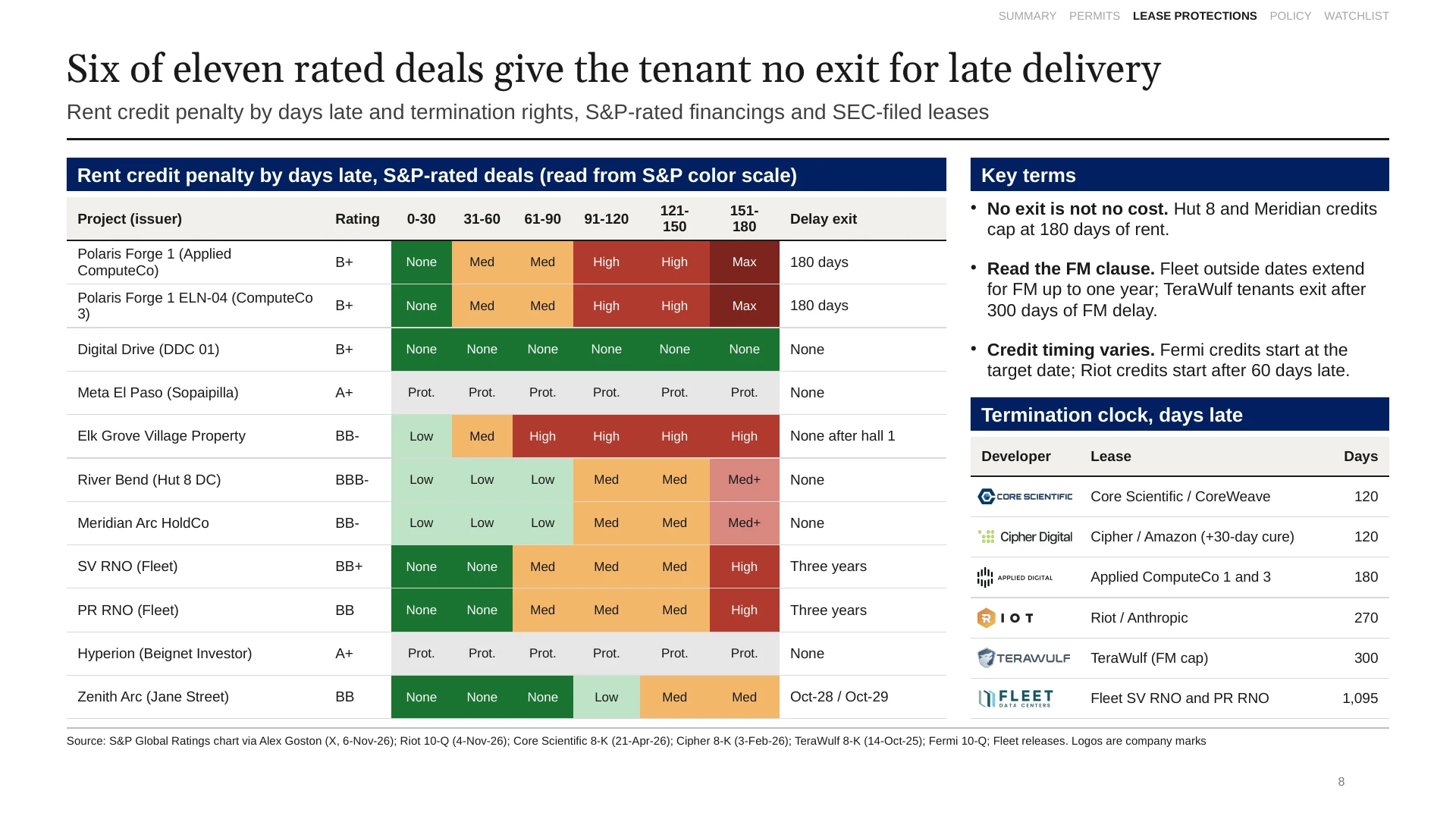
Six of eleven rated deals give the tenant no exit for late delivery
We read S&P’s chart of rent-credit penalties in eleven rated data center financings, and the delay terms in leases filed with the SEC. Six of the eleven give the tenant no right to terminate for late delivery. Three of them accrue rent credits instead: Hut 8’s River Bend and Meridian Arc, capped at 180 days of rent, and Elk Grove Village. Meta’s El Paso and Hyperion deals allow credits only for force majeure, and Digital Drive has none.
Where the tenant can walk, the clock runs from 120 days late (Core Scientific, Cipher) to three years (Fleet). Force majeure decides the rest: Fleet’s outside dates extend by up to a year for it, and TeraWulf’s tenant can exit after 300 days of it.
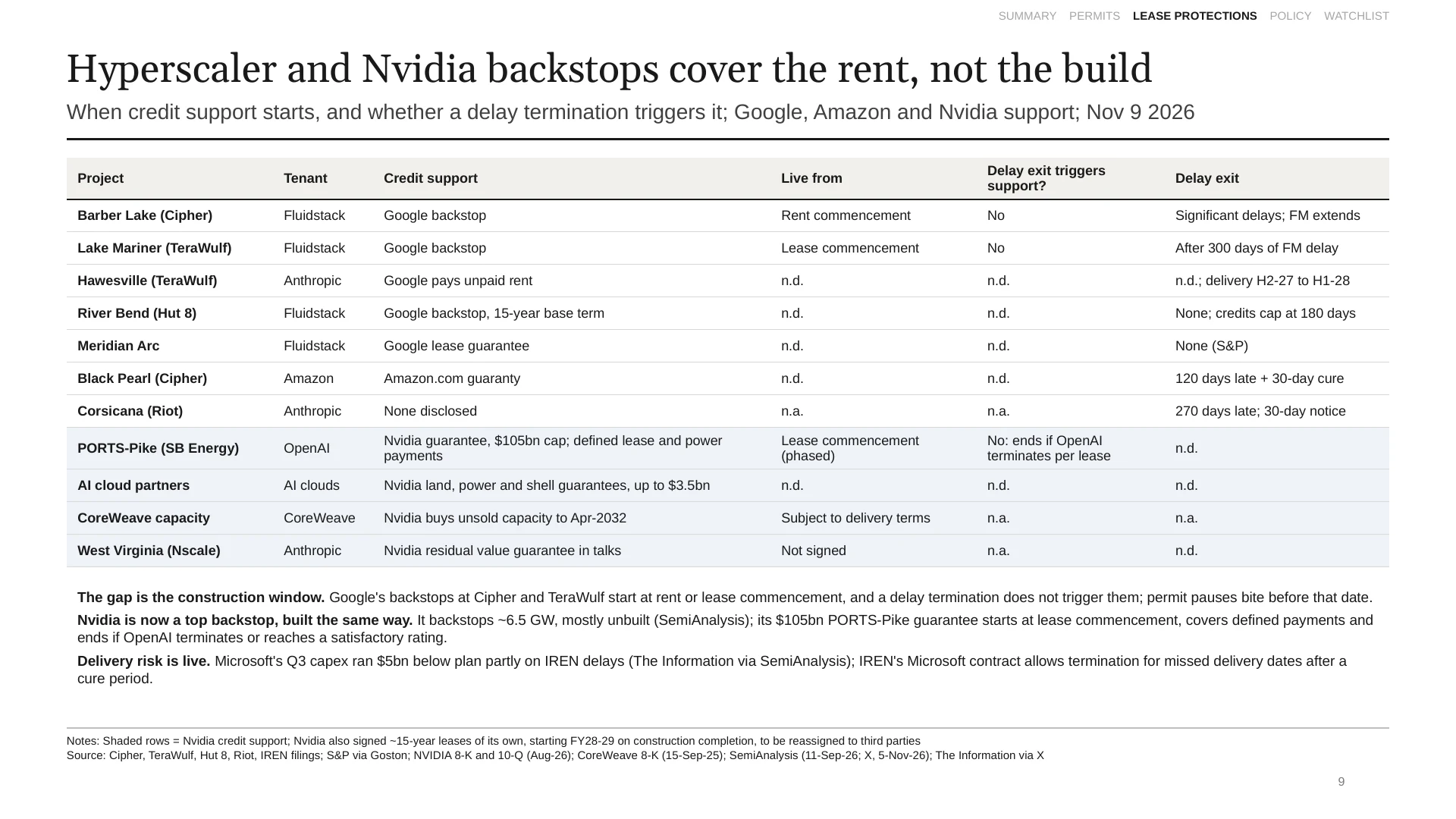
Hyperscaler and Nvidia backstops cover the rent, not the build
Google’s backstops at Cipher and TeraWulf start at rent or lease commencement, and a termination for late delivery does not trigger them. Until rent starts, the lender holds developer credit, not Google credit. Nvidia, which backstops about 6.5 GW, mostly unbuilt, structured its $105bn PORTS-Pike guarantee the same way.
Delivery risk is already showing up. Microsoft’s third-quarter capex ran $5bn below plan, partly on IREN delays, according to The Information. ING is auctioning about $500m of data center loans, including $25m of Stargate New Mexico.
Policy and cancellations
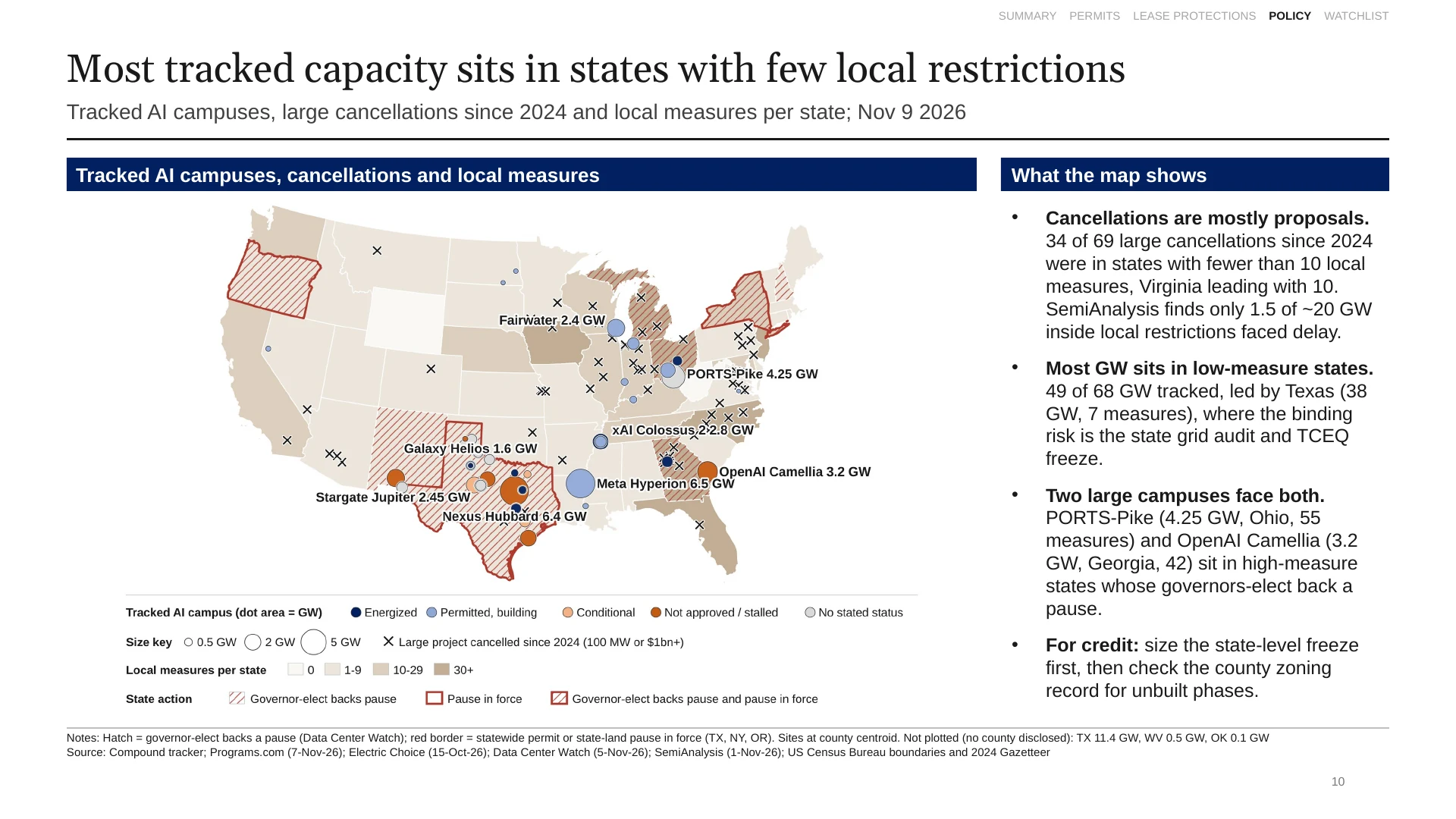
Most tracked capacity sits in states with few local restrictions
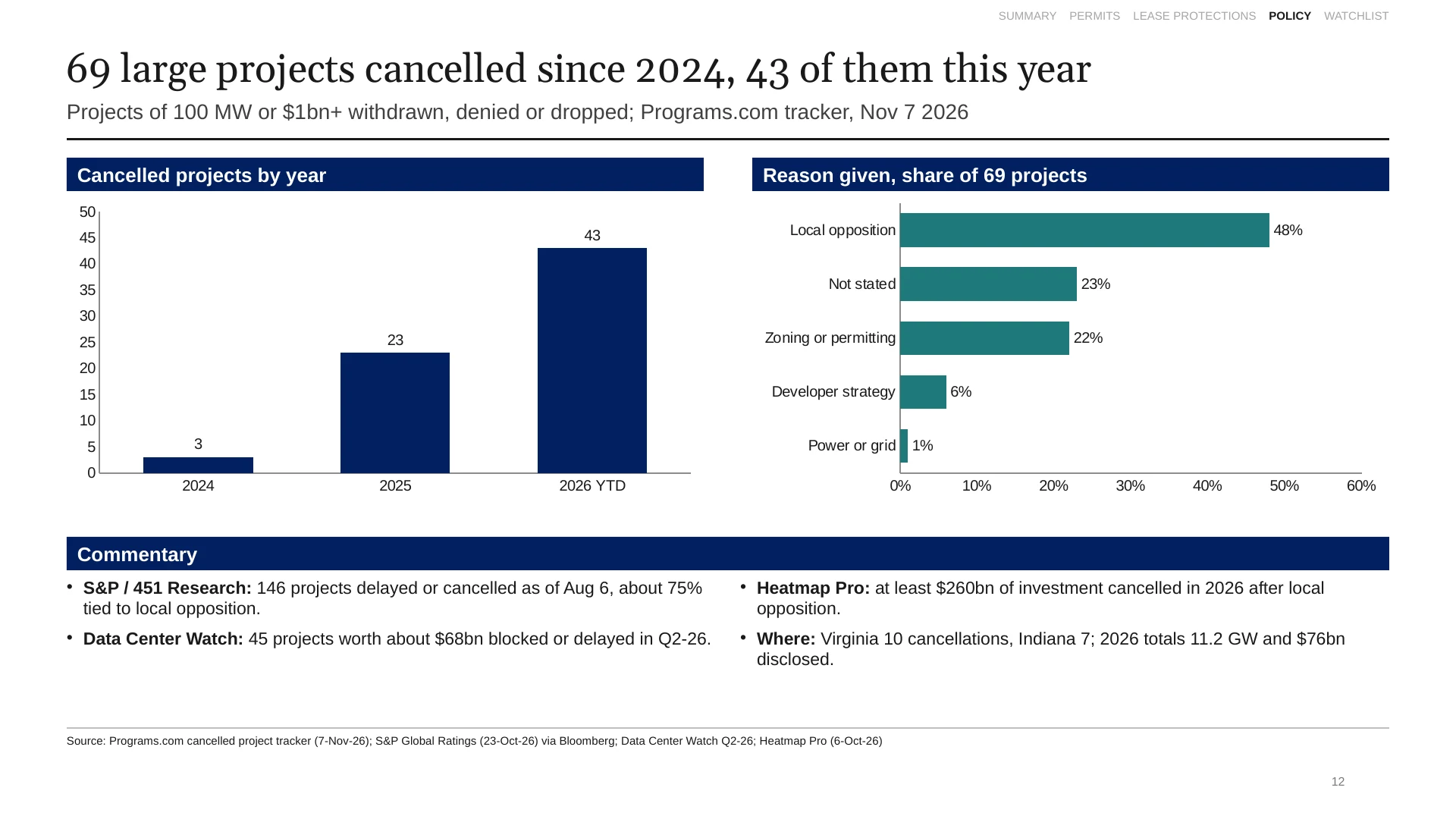
49 of the 68 GW we track is in states with fewer than 10 local restrictions, led by Texas, where the binding risk is the state’s grid audit and permit freeze. Half of the large cancellations since 2024 were in those states too, Virginia leading with 10, but most were proposals: SemiAnalysis finds only 1.5 of about 20 GW inside local restrictions faced delay.
Two large campuses face both state and local risk. PORTS-Pike in Ohio (55 local restrictions) and OpenAI Camellia in Georgia (42) sit in states whose governors-elect back a pause.
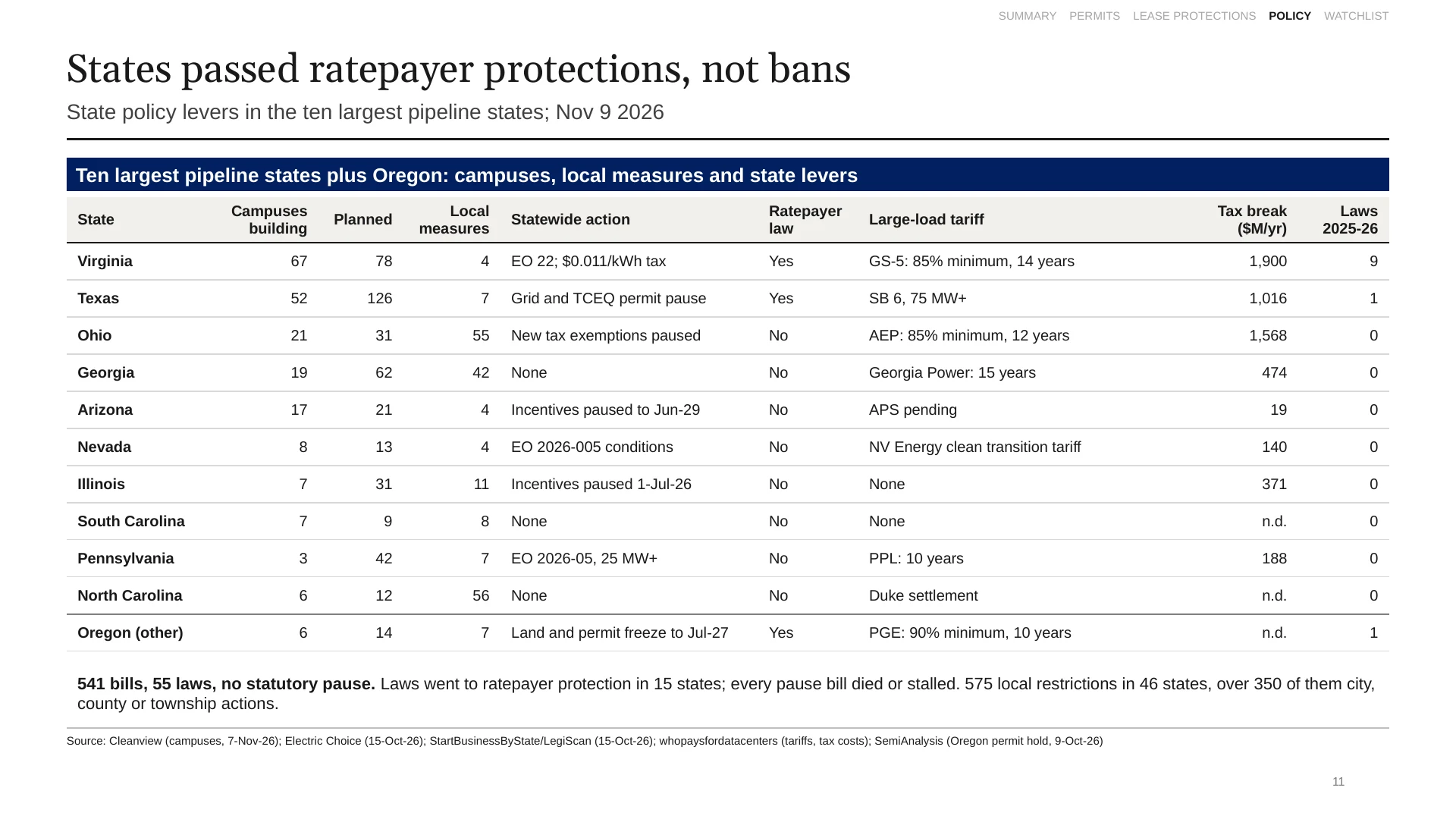
States passed ratepayer protections, not bans
Of 541 state data center bills in 2025-26, 55 became law, mostly ratepayer protections in 15 states, such as large-load tariffs that make data centers pay a minimum share of their contracted power. Every pause bill died or stalled. The pauses in force come from governors and agencies, not legislatures: New York’s EO 62, Texas’s grid audit and permit freeze, Oregon’s land and permit freeze to July 2027, and incentive pauses in Ohio, Arizona and Illinois.
Large cancellations rose from 3 in 2024 to 43 so far in 2026
Cancellations of projects of 100 MW or $1bn or more rose from 3 in 2024 to 23 in 2025 and 43 so far in 2026, totalling 11.2 GW and $76bn disclosed this year. By reason given, local opposition accounts for 48% of cancellations, zoning or permitting for 22%, and power or grid for 1%.
What to read in the lease
We turned the leases we read into seven questions for a loan into a moratorium state, from when rent credits start to whether a phase still needs a permit before its outside date. Three dates will move the dashboard next: ERCOT’s December 10 report, Hut 8’s Beacon Point ruling on December 17, and the Texas Legislature’s session from January 12.
What comes next
Voters in both parties now favor limits on data centers, and the leases behind the build-out were not written for a government pause. Six of eleven rated deals give the tenant no exit for late delivery, and the backstops whose start date is disclosed begin only once the lease or rent does.
Debt on 2027 deliveries is largely past the gate. The test for 2028 Texas phases is how long the freeze lasts: a three-month slip stays inside every exit clock we track, while a freeze into late summer 2027 reaches the 120- to 180-day clocks. In new documents, lenders should ask for force majeure definitions that keep government pauses out of tenant exits, backstops that are live from signing, and completion support sized to the termination clock.
How we built it
Compound built the analysis as a 13-slide deck with a backing tracker workbook.
- Universe. 48 neocloud, hyperscaler and AI-lab campuses in the US with about 68 GW of planned capacity, from company filings, Equibles and Cleanview.
- Approval status. Each site is energized, permitted and building, conditional (approved but not final, mostly ERCOT Batch Zero), not approved or stalled, or has no stated status. Permitted means energized, or building with no open approval disclosed.
- Local vote. Every local data center measure decided in 2026 on Ballotpedia, placed by its county’s 2024 presidential vote.
- Outlook. 2027 and 2028 capacity, the Texas share, election scenarios and freeze cases come from SemiAnalysis’s public posts and newsletter.
- Leases. Termination clocks and rent credits come from 10-Qs, 8-Ks and proxy statements. Penalty levels for the eleven rated deals are our reading of S&P’s color scale.
- Policy. Local restrictions from Electric Choice and Data Center Watch, state bills and laws from LegiScan, cancellations from Programs.com, and market-implied odds from Polymarket.
Every number in the deck traces back through the workbook to its source and date. That is full auditability of financial models. Put the tracker on a schedule and Compound refreshes site statuses each week and flags what moved. See industry research with Compound and risk assessment.
Download the dashboard
US data center credit dashboard (PDF): November 2026The 13-slide dashboard behind this post: the summary and credit view, the 2026 local ballot measures by county vote, GW by end user, developer and state, the 2027 and 2028 outlook against lease exit clocks, rent-credit penalties and termination clocks in eleven rated deals, hyperscaler and Nvidia backstops, a map of campuses and cancellations, state policy levers, cancellations by year and reason, and the lease diligence checklist with dates to watch.
Download · FreeFrequently asked questions
Is opposition to data centers partisan?
No. Voters sided with limits in 46 of 47 local data center measures decided in 2026, and the vote for limits averaged 75% in counties Trump won in 2024 and in counties Harris won. Council referrals and referendums against council approvals drew more support for limits (81% and 82%) than citizen initiatives (70%).
Which states have a data center moratorium?
No state has passed a statutory moratorium; every pause bill in 2025-26 died or stalled, and Maine’s was vetoed. The pauses in force come from governors and agencies: New York’s EO 62 pauses permits for sites of 50 MW or more, Texas has an ERCOT audit of large loads since August 3 and a TCEQ permit freeze since September 21, and Oregon has a land and permit freeze to July 2027. Ohio, Arizona and Illinois have paused tax incentives. Locally, 575 restrictions stand in 46 states.
How did the 2026 midterms change data center risk?
Pause-leaning candidates won the governor’s races in Texas and Georgia, and a conditional one in Ohio; before the vote, SemiAnalysis put about 30 GW of 2028 capacity in states where pause candidates were running. In Texas, if reopening waits for new laws, the freeze runs 5 to 9 months beyond SemiAnalysis’s base case of a three-month slip. Polymarket puts a Texas moratorium law by end-2027 at 22%.
How much US AI data center capacity is permitted?
Of about 68 GW we track at 48 sites, 22.9 GW is permitted and 6.1 GW of that is energized. Another 31.9 GW is conditional, owed an approval or stalled, and 12.8 GW has no public approval status. Hyperscalers have 14.3 of 17.9 GW permitted; neoclouds 5.1 of 20.2 GW.
Will a Texas data center freeze delay 2027 capacity?
Mostly not. SemiAnalysis sees at most 2 to 3 GW of the roughly 50 GW due online in 2027 at risk, because only phases that must start their power plant during the freeze slip. The risk is in 2028: 62.2 GW of US additions, most not yet started, close to 30% of them in Texas.
Can a data center tenant terminate a lease if the site is delivered late?
In six of eleven S&P-rated financings, no. Three of them accrue rent credits instead: Hut 8’s River Bend and Meridian Arc, capped at 180 days of rent, and Elk Grove Village. Meta’s El Paso and Hyperion deals allow credits only for force majeure, and Digital Drive has none. Where an exit exists, it ranges from 120 days late (Core Scientific / CoreWeave, Cipher / Amazon) to three years (Fleet), and force majeure can extend the clock.
Do hyperscaler backstops protect data center lenders during construction?
Not on the leases we read. Google’s backstops at Cipher and TeraWulf start at rent or lease commencement, and a termination for late delivery does not trigger them. Nvidia’s PORTS-Pike guarantee also starts at lease commencement. Until rent starts, lenders hold developer credit.
How do you keep a data center permit tracker current?
Put it on a schedule. Compound reruns the tracker each week from company filings, state and local trackers and market data, flags every change in a site’s status, and refreshes the dashboard. Every number traces back to its source and date, so each refresh can be audited number by number.
Sources: company 10-Q, 8-K, 10-K and DEF 14A filings (Cipher, TeraWulf, Hut 8, Riot, Core Scientific, Applied Digital, Fermi, IREN, NVIDIA, CoreWeave) and releases (Fleet); S&P Global Ratings rent-credit chart, shared on X November 6, 2026, and S&P Global Ratings (October 23, 2026) via Bloomberg; SemiAnalysis public posts and newsletter (September 11, October 24, November 1, 5, 7 and 9, 2026); Ballotpedia (November 4, 2026) and 2024 county presidential results; HIFLD transmission lines; Aterio state capacity (November 5, 2026); Equibles (November 6, 2026); Cleanview (November 7, 2026); Data Center Watch (November 5, 2026, and Q2 2026); Electric Choice (October 15, 2026); StartBusinessByState and LegiScan (October 15, 2026); whopaysfordatacenters; Programs.com cancelled project tracker (November 7, 2026); Heatmap Pro (October 6, 2026); The Information; Polymarket (November 8, 2026); US Census Bureau state boundaries and 2024 Gazetteer centroids. Approval statuses, groupings and the credit view are our own analysis; the credit view is judgment, not a recommendation.