Intuit cut Mailchimp's costs 38% in a year, then sold it for 4.6 times profit
Mailchimp's segment expenses fell 38% in the year before Intuit agreed to sell it to Bending Spoons for $3.68 billion, lifting its margin to 65%. The price is 4.6 times annualized segment profit; Intuit trades at about 10.6 times and Bending Spoons at about 21.
Intuit cut Mailchimp's operating costs by 38% in the year before it agreed to sell the email-marketing business. Mailchimp's segment expenses fell to $111 million in the quarter ended Oct. 31 from $178 million a year earlier, while revenue slipped 1.3% to $313 million, according to Intuit's first-quarter fact sheet.
On Thursday Intuit agreed to sell Mailchimp to Bending Spoons for about $3.68 billion: $3.31 billion in cash and $368 million in Bending Spoons stock, Intuit said. Intuit paid $12 billion for Mailchimp in 2021, CNBC reported. The deal is expected to close in early 2027, subject to regulatory approvals.
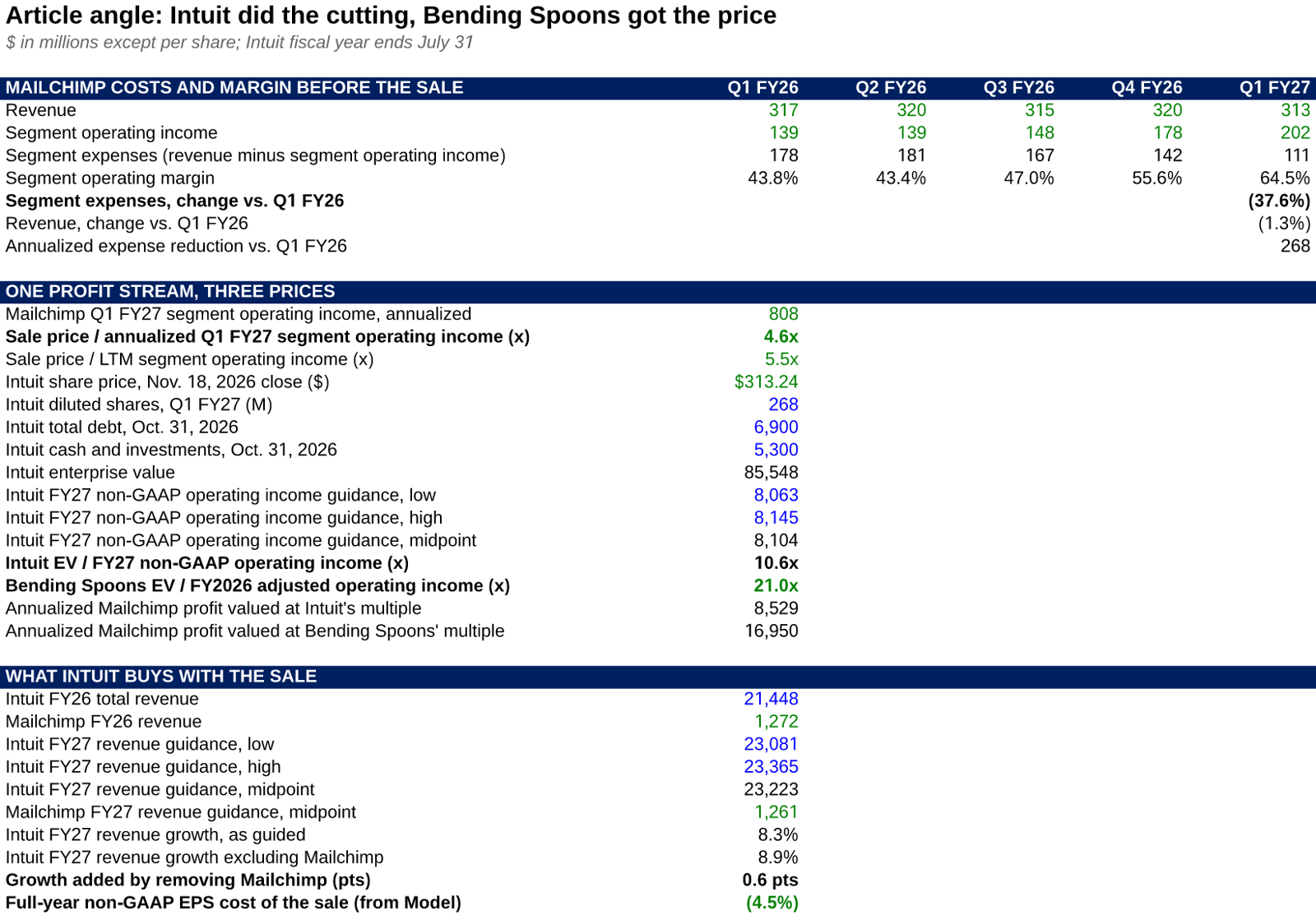
The price is 4.6 times Mailchimp's latest quarterly segment operating income of $202 million, annualized. Over the last four quarters, Mailchimp earned $667 million, putting the price at 5.5 times.
Mailchimp's margin by quarter
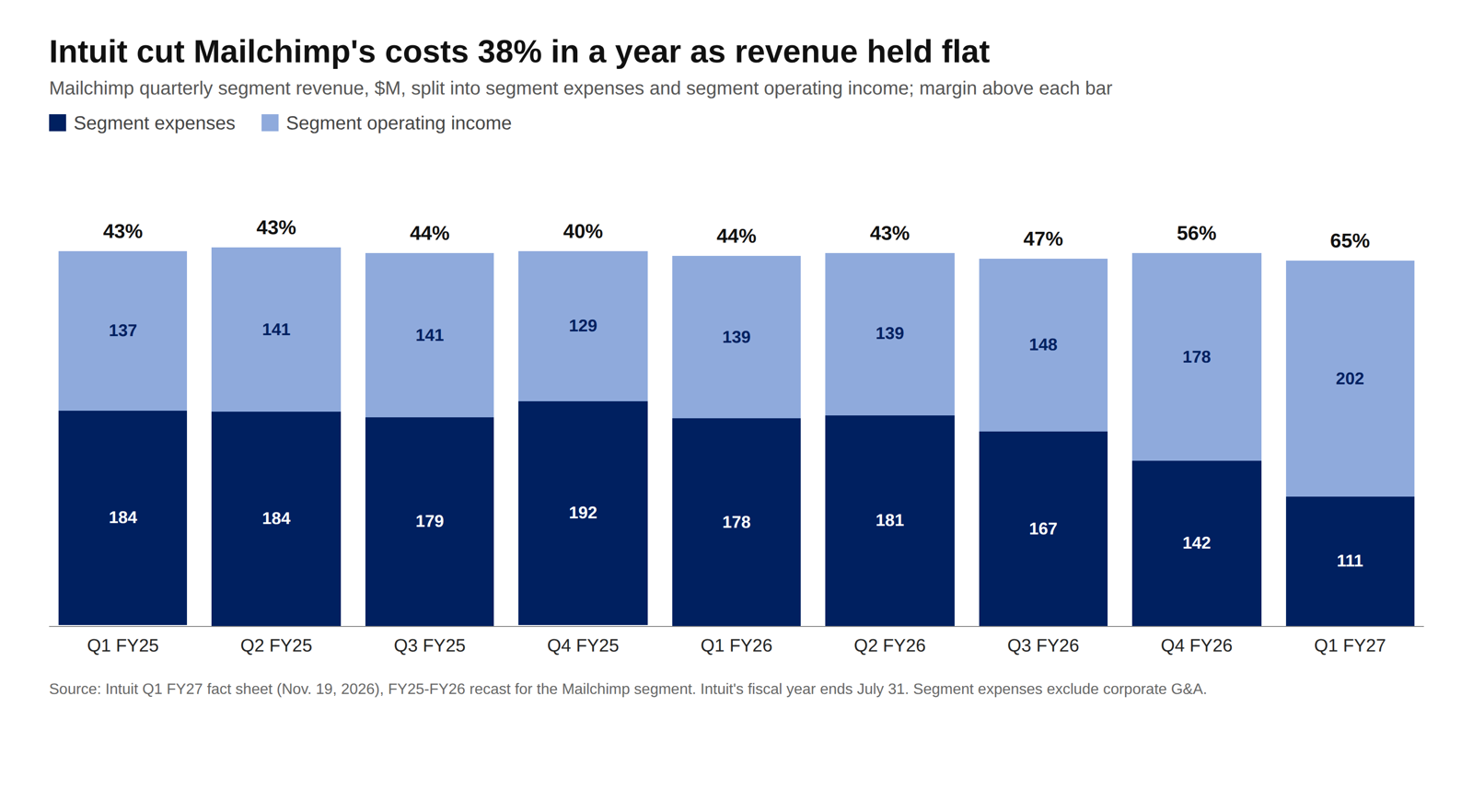
For six quarters through January 2026, Mailchimp's segment margin sat between 40% and 44%. It then rose to 47% in the April quarter, 56% in the July quarter and 64.5% in the October quarter.
Intuit began running Mailchimp as a separate segment on Aug. 1. CFO Sandeep Aujla said at a September briefing that the move was meant to give investors more transparency as Intuit tried to manage the unit for profitability, CNBC reported. Mailchimp's segment expenses cover product development, customer success, selling and marketing and direct costs; corporate G&A stays outside the segment, so segment profit overstates what the business earns alone.
Three prices for the same profit
The $808 million of annualized Mailchimp profit carries a different value depending on whose multiple is applied. Compound's estimates, using closing prices on Nov. 18, the last session before the announcement:
| Valuation basis | Multiple of operating income | Implied value of Mailchimp |
|---|---|---|
| Bending Spoons' purchase price | 4.6x | $3.68B |
| Intuit's own trading multiple | 10.6x | $8.5B |
| Bending Spoons' own trading multiple | 21.0x | $17.0B |
Intuit's multiple is its enterprise value of about $85.5 billion, from a $313.24 share price, 268 million diluted shares, $6.9 billion of debt and $5.3 billion of cash and investments, over the midpoint of its fiscal 2027 non-GAAP operating income guidance of $8.06 billion to $8.15 billion. Bending Spoons' multiple uses its $42.79 share price, $4.00 billion of net debt and 2026 adjusted operating income guidance of $1.58 billion to $1.60 billion, from its third-quarter release. Both company multiples include corporate costs that Mailchimp's segment profit leaves out, so the two higher values are upper bounds.
What Intuit gets for it
Removing Mailchimp lifts Intuit's guided fiscal 2027 revenue growth to 8.9% from 8.3%, based on its $23.08 billion to $23.37 billion revenue guidance and $21.45 billion of fiscal 2026 revenue. Intuit guides Mailchimp's own revenue to range from a 1% decline to flat this fiscal year.
Intuit said it will use the cash to repurchase shares in fiscal 2027 after the deal closes. At $313.24, $3.31 billion buys about 10.6 million shares, 4% of the diluted count. Compound's model still shows the sale cutting full-year non-GAAP EPS by about 4.5% against the $22.88 to $23.12 guidance, because the buyback retires less earnings than Mailchimp's after-tax segment profit adds. That is a high-end estimate: it counts the full segment profit as lost and ignores interest income and the Bending Spoons stake.
Intuit's guidance does not include the sale; the company said it will update guidance at close. We covered the quarter in Intuit's Q1 results.
What is left for Bending Spoons
Bending Spoons buys software businesses, reorganizes teams and overhauls technology to expand earnings, according to its deal announcement. At Mailchimp, much of the cost work is already done. Compound's model holds Mailchimp's adjusted operating margin at 65%, the level Intuit reached last quarter, after an assumed 6% of revenue for overhead Intuit carried centrally.
The risk is revenue. In August, Aujla said higher effective prices were offsetting increased client churn at Mailchimp, CNBC reported. Bending Spoons' portfolio grew 3% organically in the third quarter.
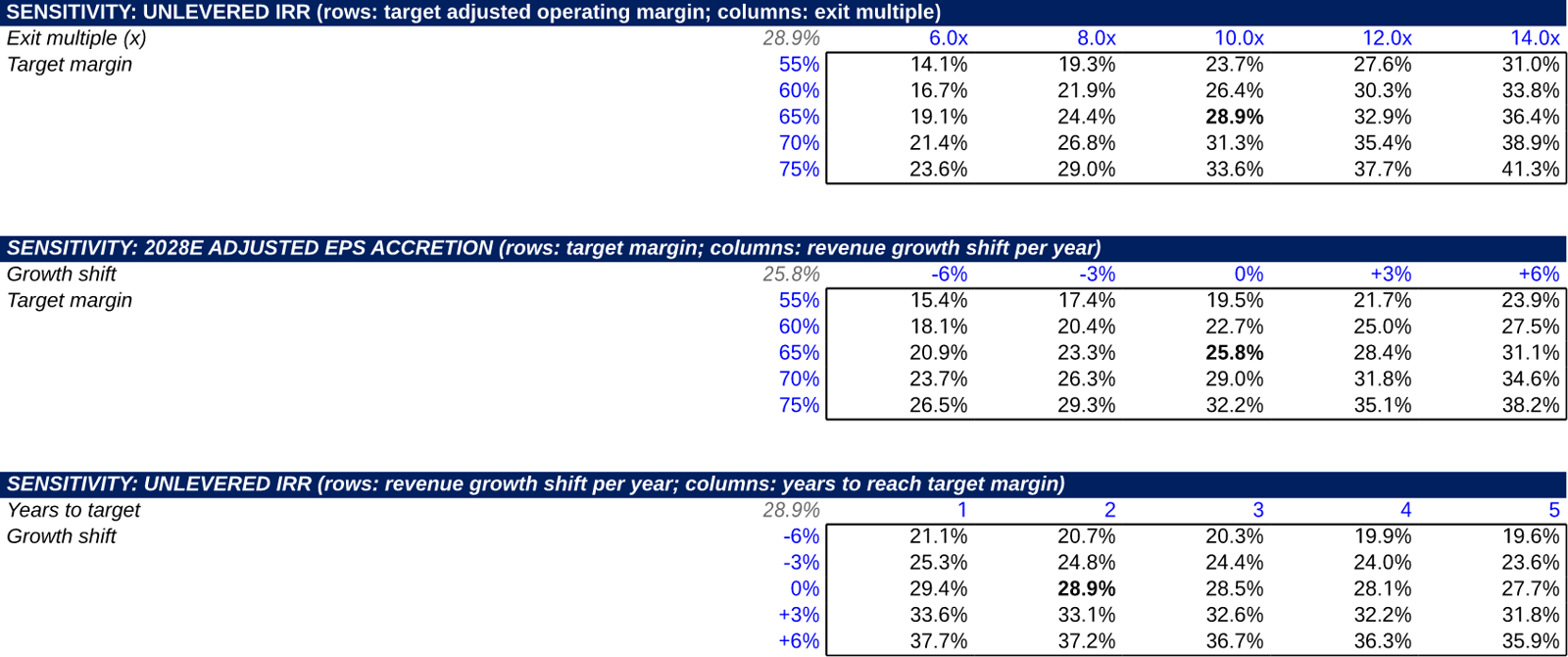
The purchase price leaves room for decline. In the base case, the deal returns about 29% a year to Bending Spoons before financing, assuming a 10x operating income valuation at the end of 2031. If revenue falls 6 percentage points a year faster than the base case, the return is about 21%. If the margin slips back to 55%, it is about 24%. With the $1.30 billion share sale at $40 announced the same day counted as funding, the model has the deal adding about 26% to Bending Spoons' 2028 adjusted EPS.
Deal model
We built this model in Compound. The Excel file has the cited inputs, the Mailchimp operating case, sources and uses, accretion, returns and three sensitivity grids built as Excel data tables. Assumptions are marked in blue.
 Bending Spoons / Mailchimp deal model (Excel)Cited inputs from Intuit and Bending Spoons, the Mailchimp case, accretion, returns and sensitivity tables.Download · Free
What to watch
- Nov. 20, 8:00 a.m. ET: Bending Spoons' third-quarter call, the first chance to hear its plan for Mailchimp's margin and churn.
- Early 2027: deal close, subject to regulatory approvals; Intuit updates its fiscal 2027 guidance then.
- By July 31, 2027: Intuit's fiscal year end, the window it set for buybacks with the cash proceeds.
More from Compound News
Intuit Q1 Earnings: $2.91 EPS vs $2.46 Consensus
Intuit's Q1 non-GAAP EPS of $2.91 beat the $2.46 consensus and our $2.57, and revenue of $4.354 billion came within $1 million of our forecast. A Q2 guide below consensus and a lower Credit Karma outlook sent shares down 13% after hours.
Read article →
Alibaba Q2 Earnings: $1.21 EPS vs $1.63 Consensus
Alibaba's September-quarter non-GAAP EPS of RMB8.10 per ADS missed consensus by 25.6% and our forecast by 8.6%, while revenue of RMB271.5 billion beat both. The miss came below adjusted EBITA, as our preview expected.
Read article →
Should you buy Anthropic stock on IPO day? 15 tech IPOs favor a five-month lock-up ladder
Anthropic priced at $83 a share. Across 15 big tech IPOs, buying 20% at the first-day close and the rest in four monthly buys starting five months in cost a median 16% less and beat a day-one purchase 12 times.
Read article →