Microsoft fixed 1,400 flaws last month, up from 170. Officials now tie the outages to that patch load
Banks and the NSA told Congress this week's US outages came from rushed fixes for AI-found flaws (unconfirmed), and the DNI pointed to security upgrades. We log every outage, its stated cause and cost, and model what an 8.2x jump in patches does to a patch team.

We built this outage tracker and patch-load model in Compound. Plug in your own team's numbers and see where the load breaks. Try Compound free, no credit card needed.
Microsoft's October security update fixed about 1,400 flaws, against about 170 a year earlier, The Wall Street Journal reported, as cited by TNW. That 8.2x jump is at the center of a new explanation for this week's run of US outages.
Wall Street executives and the NSA told members of Congress that the outages came from rushed fixes for flaws found by AI, three people familiar with the talks told The Washington Sun (unconfirmed). Director of National Intelligence Jay Clayton told Fox Business that the failures came from security upgrades that took longer than planned or did not come back as expected, TNW reported.
Not everyone agrees. Christiaan Beek of Rapid7 told Bloomberg he sees no public evidence that rushed security updates caused the outages. None of the companies involved has blamed an attack, and their stated causes differ.
Outages and stated causes

Microsoft blamed a technical defect, the FAA tied its ground stop to a contractor's wiring cutover and a router, Chase cited a software bug, Apple an internal update and the NSA routine maintenance. Our earlier models put Microsoft's SLA credits at about $257 million in the base case and lost airline revenue from the FAA stop at about $193 million.
Patch load math
We modeled what an 8.2x rise in fixes does to one large enterprise's patch team. The flaw counts are reported; the rest are illustrative assumptions we chose: 40% of fixes apply, each takes six engineer-hours to test and deploy, the team has 1,400 hours a month, and 0.5% of deployed fixes break something.
On those assumptions, the monthly workload rises from 408 hours to 3,360. The team runs at 240% of capacity and would need 72 days to clear one month of fixes, or 14 more engineers. Expected fixes that break something rise from 0.3 to 2.8 a month. If rushing doubles the breakage rate to 1%, that becomes 5.6.
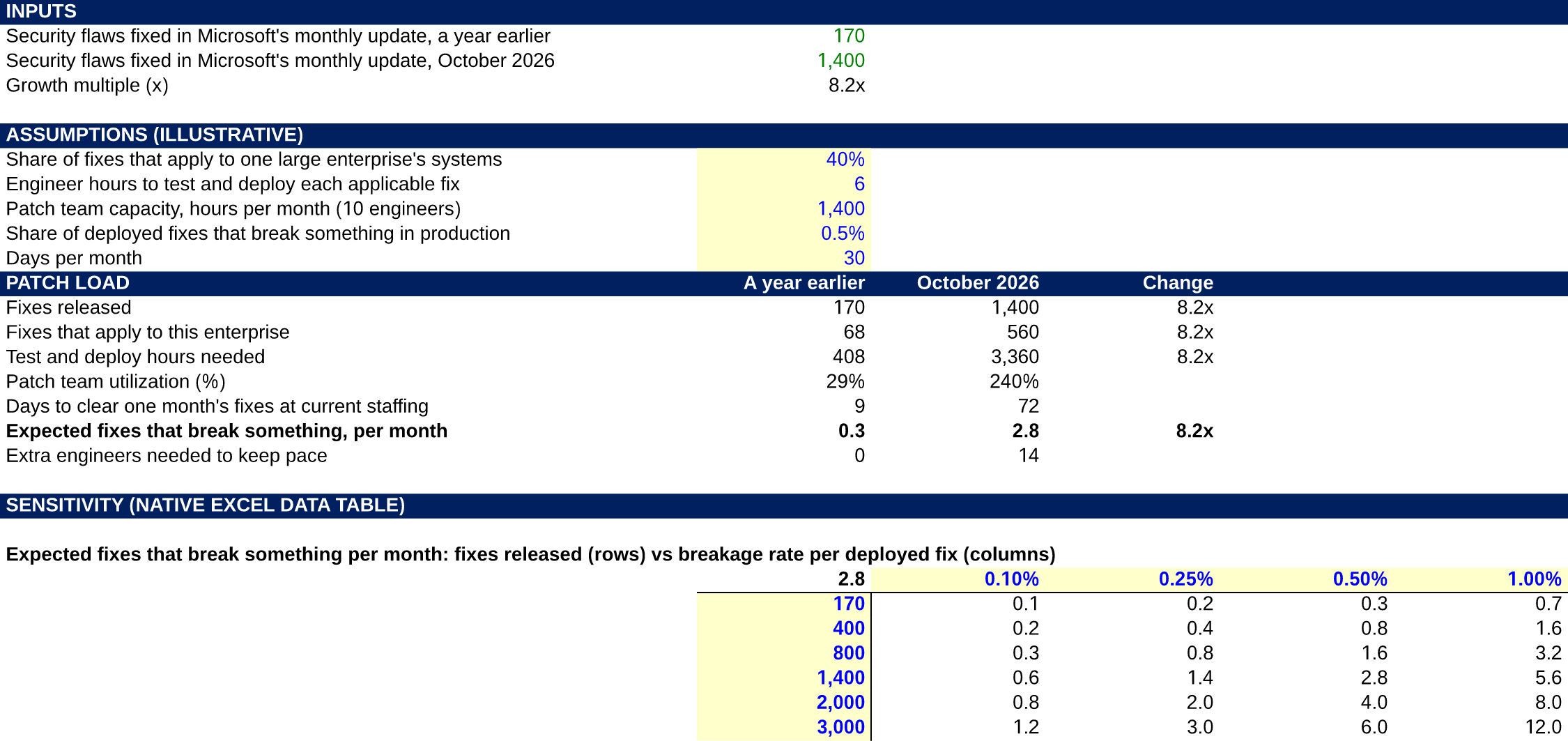
The point of the model is the shape, not the exact count: at a constant failure rate, breakage grows one-for-one with patch volume, and a team that cannot test everything either falls behind on security or ships less-tested fixes.
Download the model
 US outages: patch-load model and incident log (Excel)Patch workload, team capacity and expected breaking fixes at any monthly fix volume, with a native Excel data table, plus a log of this week's outages, stated causes and our cost estimates.Download · Free
Timeline
ROOT CAUSE Act introduced
Representatives Morgan Luttrell and Ritchie Torres introduced the bipartisan ROOT CAUSE Act, which would set up a board inside CISA to investigate major incidents, including faulty updates, Nextgov reported.
Banks and NSA point to rushed patches
The Washington Sun reported that Wall Street executives and the NSA told Congress the outages came from rushed fixes for AI-found flaws (unconfirmed).
Apple and NSA outages
Apple said an internal update caused outages across iCloud, Apple Pay and the App Store. The NSA said its classified network was degraded during routine maintenance.
Chase and other banks
Chase blamed a software bug for problems that also hit Bank of America, Wells Fargo and U.S. Bank customers.
FAA lifts nationwide ground stop
The FAA lifted a ground stop at every US airport after 4 hours and 21 minutes.
Microsoft 365 outage
Outlook and Microsoft 365 email went down for millions of users. Microsoft later blamed a technical defect.
What to watch
- Microsoft's December security update on Tuesday, Dec. 8, and whether its fix count tops October's 1,400.
- The FAA's report on the router failure behind the Nov. 13 ground stop.
- Hearings or committee action on the ROOT CAUSE Act.
More from Compound News

ByteDance would rent OpenAI models from Microsoft as its chip route narrows
ByteDance is in talks to spend about $500 million more on Azure for OpenAI models, as banks paused a $480 million Nvidia chip loan tied to it. Our model puts renting at about 5.5 times the per-token cost of owning the chips.
Read article →
Anthropic prices at $83 a share, $7 billion short of SpaceX's IPO record without an upsize
Anthropic priced its IPO at $83, above its $70 to $78 range, Bloomberg reported. With the greenshoe, the public offering raises $78.7 billion, short of SpaceX's $85.7 billion unless it was upsized about 9%. Fully diluted, $83 values Anthropic at $1.50 trillion, or 18.5x run-rate revenue.
Read article →
Snowflake Q3 Earnings Preview: $0.69 EPS vs $0.60 Consensus
Snowflake reports Wednesday after the close. Our model puts product revenue 3.5% above the guidance midpoint.
Read article →