Deal alerts from X: a model and deck on every deal Exec Sum posts
How a deal monitor on X turned the DoorDash / Instacart and Thrive / ADT headlines into merger and LBO models, IC-style decks and a team email, each within the hour
by Compound Team · October 29, 2026 · 7 min read
At 8:37am ET on 29 October, CNBC posted on X that DoorDash would buy Instacart for about $17 billion. At 9:39am the deal team had an email with a merger model, an 11-page deck and a view: support the deal at $65, because the price is fair and the risk is antitrust. At 11:22am Exec Sum posted that Thrive Holdings would take ADT private for $7.6 billion. By 1:46pm the team had a leveraged buyout model, a 14-page IC deck and a second view: back the deal at $10.00, but only if AI cuts ADT’s cost to serve and customer churn.
Nobody asked for either deal. Both came from a monitor we set up the evening before on our team agent.
How the monitor was set up
Deal news breaks on X first. Exec Sum, Litquidity, the newswires and a handful of reporters post a headline, and the filing follows within hours. We asked our team agent to watch those accounts and do the first pass on every deal:
Monitor the deal-focused finance accounts on X, starting with @Exec_Sum and @litquidity. Whenever a transaction is announced or credibly rumored, build a buyer-side model and a concise deck for the team and email them both.
Compound scheduled a scan of @Exec_Sum, @litquidity and a set of deal and newswire accounts every two hours from 7am to 9pm ET. Each deal worth modeling gets its own task: confirm the terms from the filing, build the model and comps, collect the bull and bear case from X, build the deck, and email everyone on the drive. A scan with no new deal sends nothing.
DoorDash / Instacart: a fair price with antitrust risk
The 9am scan picked up the CNBC post, and the task went straight to DoorDash’s 8-K and the joint release. The filing changed the picture from the headline. “$65 a share in cash and stock” is an election: $65.00 in cash, 0.3372 DoorDash shares, or a mix, with stock capped at 25%. At DoorDash’s $169.49 close the stock option was worth less than the cash (the ratio implies a $192.76 DoorDash price), so the downside case assumes every holder takes cash. The 8-K also gave the $13.0 billion JPMorgan bridge, “$500 million or more” of net synergies, and break fees of $650 million from Instacart and $1.25 billion from DoorDash if antitrust blocks the deal.
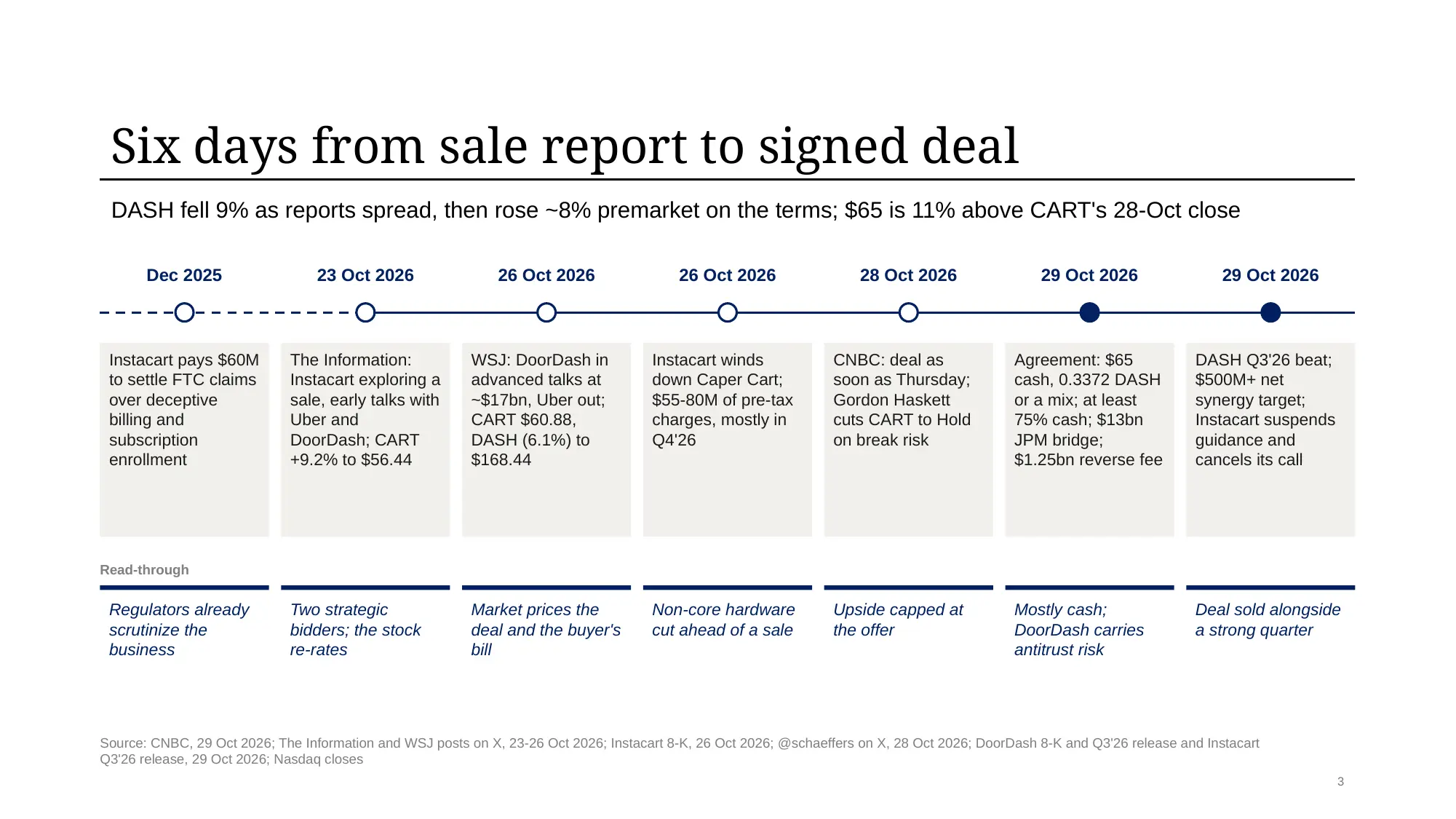
The deal was on X days before it was signed: The Information posted on 26 October that Instacart was exploring a sale and had held talks with DoorDash and Uber. The deck’s timeline reads each step from the first sale report to the signing for what it meant to the price:
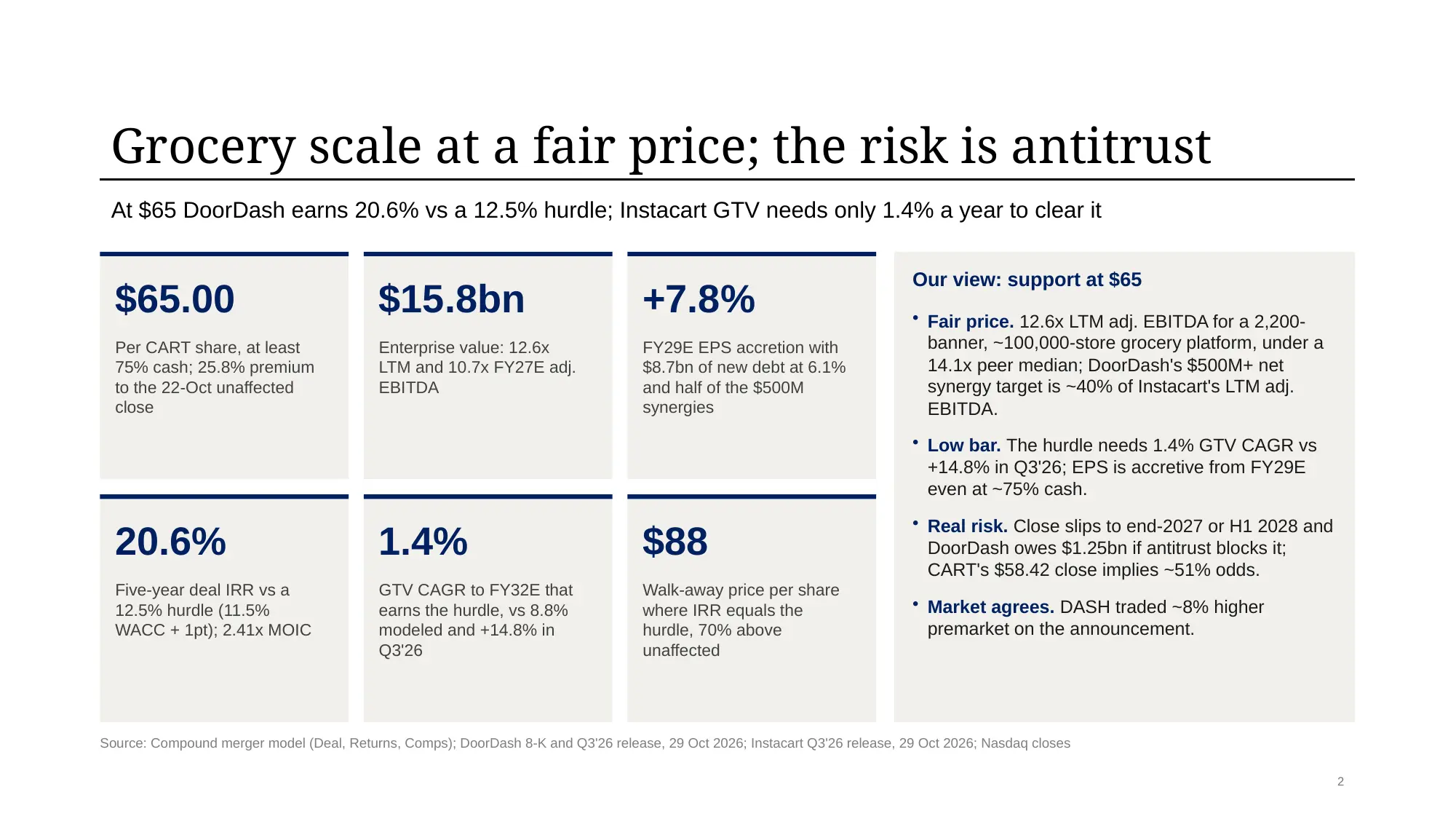
The deck opens with the answer, the six numbers behind it and the conditions for supporting it:
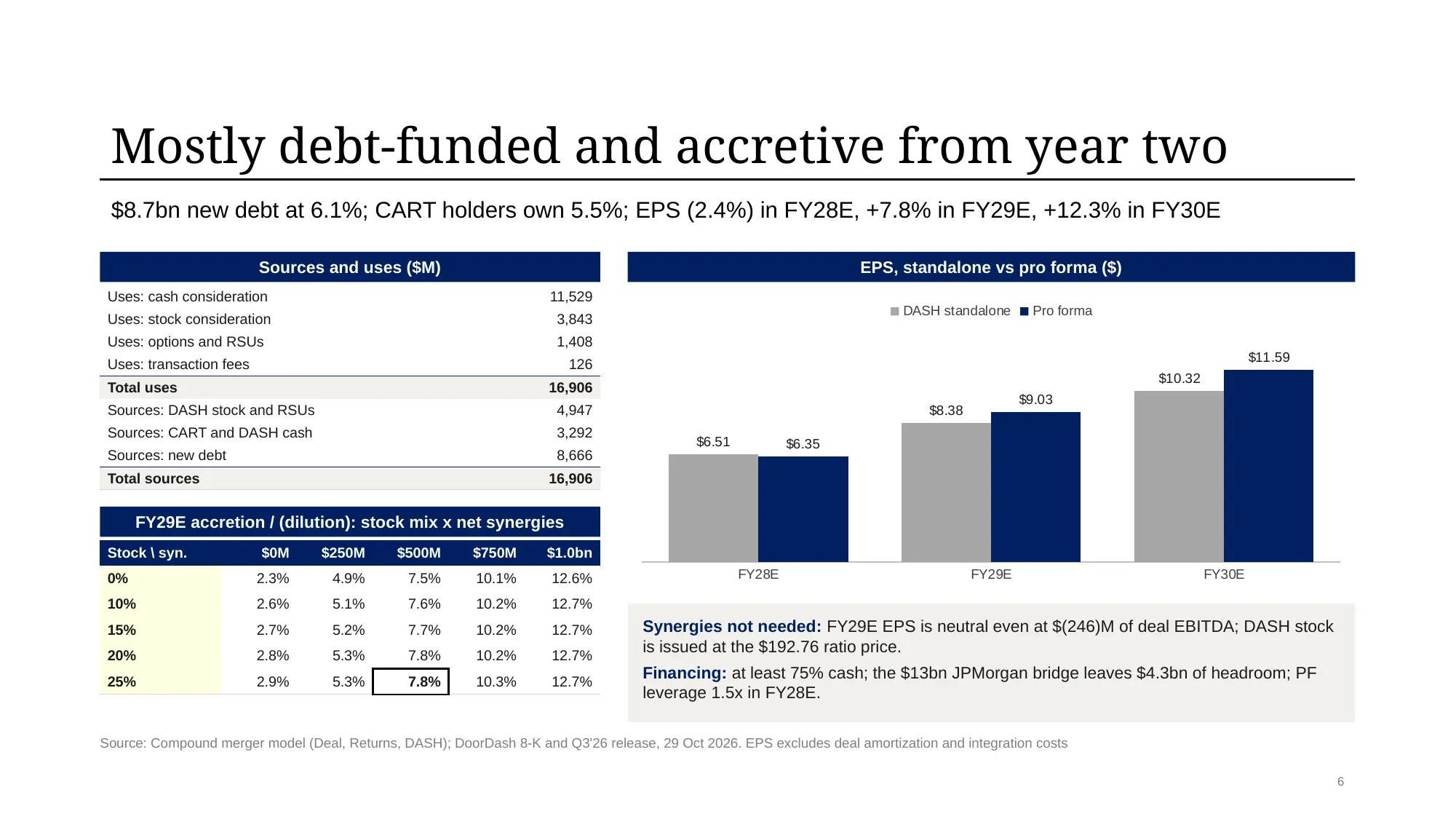
The model funds $16.9 billion of uses with $8.7 billion of new debt at 6.1%, $3.3 billion of cash and $4.9 billion of DoorDash stock. EPS is 2.4% lower in FY28E, then 7.8% higher in FY29E and 12.3% higher in FY30E. The accretion grid shows why the stock mix barely matters: FY29E is accretive even with no synergies at all.
| DoorDash / Instacart | Base case |
|---|---|
| Enterprise value | $15.8bn |
| EV / LTM adj. EBITDA | 12.6x reported; 13.6x on the comps basis vs. a 14.1x peer median |
| Five-year IRR | 20.6% (2.41x) vs. a 12.5% hurdle |
| GTV growth needed to clear the hurdle | 1.4% a year to FY32E (modeled 8.8%; Q3’26 grew 15%) |
| Upside / downside IRR | 37.1% / (2.5%) |
| Walk-away price | $87.92 a share |
Source: DASH_CART_Merger_Model.xlsx, Deal, Returns and Comps tabs. Hurdle is DoorDash’s cost of capital plus one point.
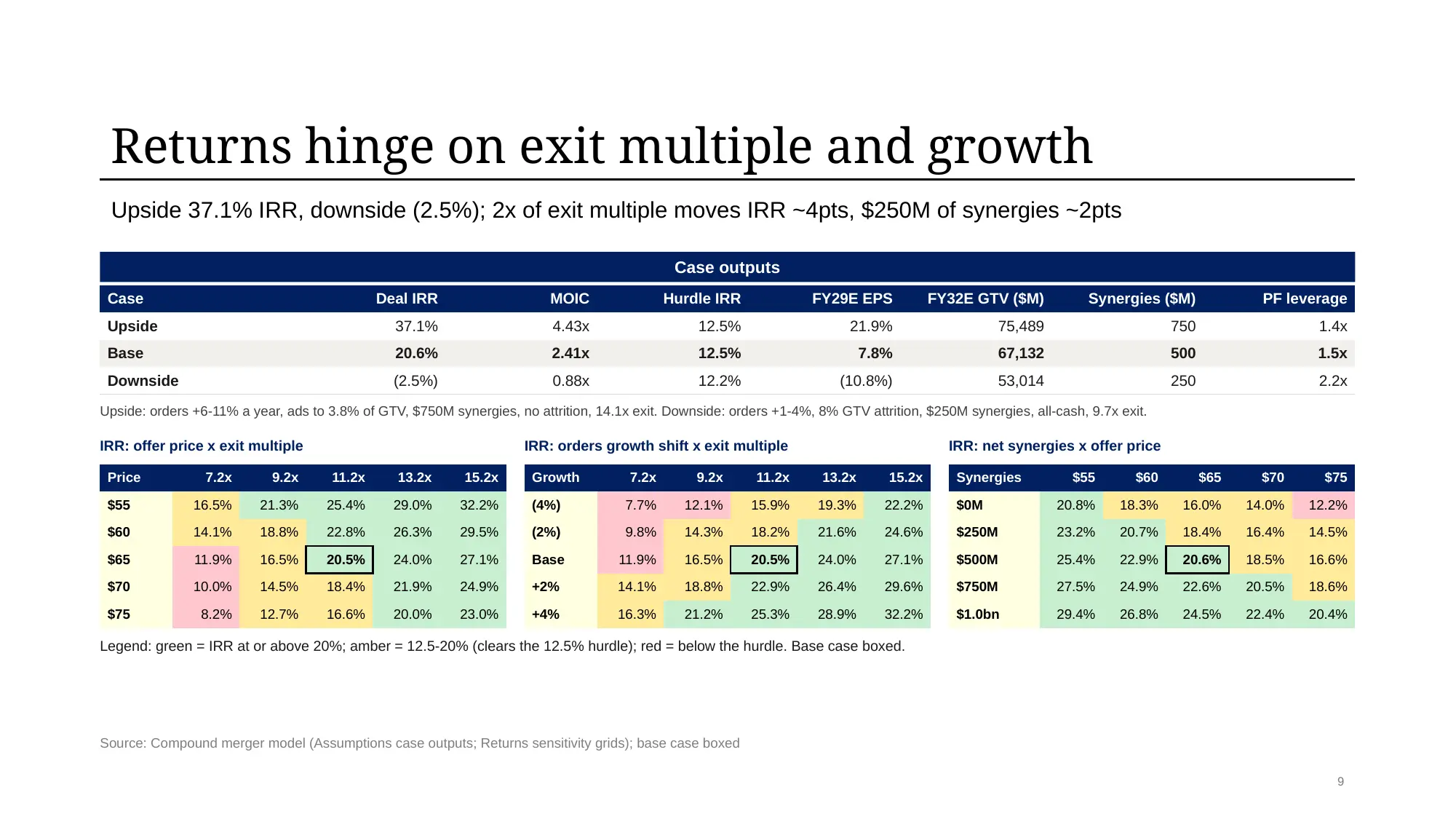
The sensitivity page tests the three variables a committee would push on: price, Instacart’s order growth and synergies. Each grid boxes the base case.
Thrive Holdings / ADT: cheap on EBITDA, fair on cash flow
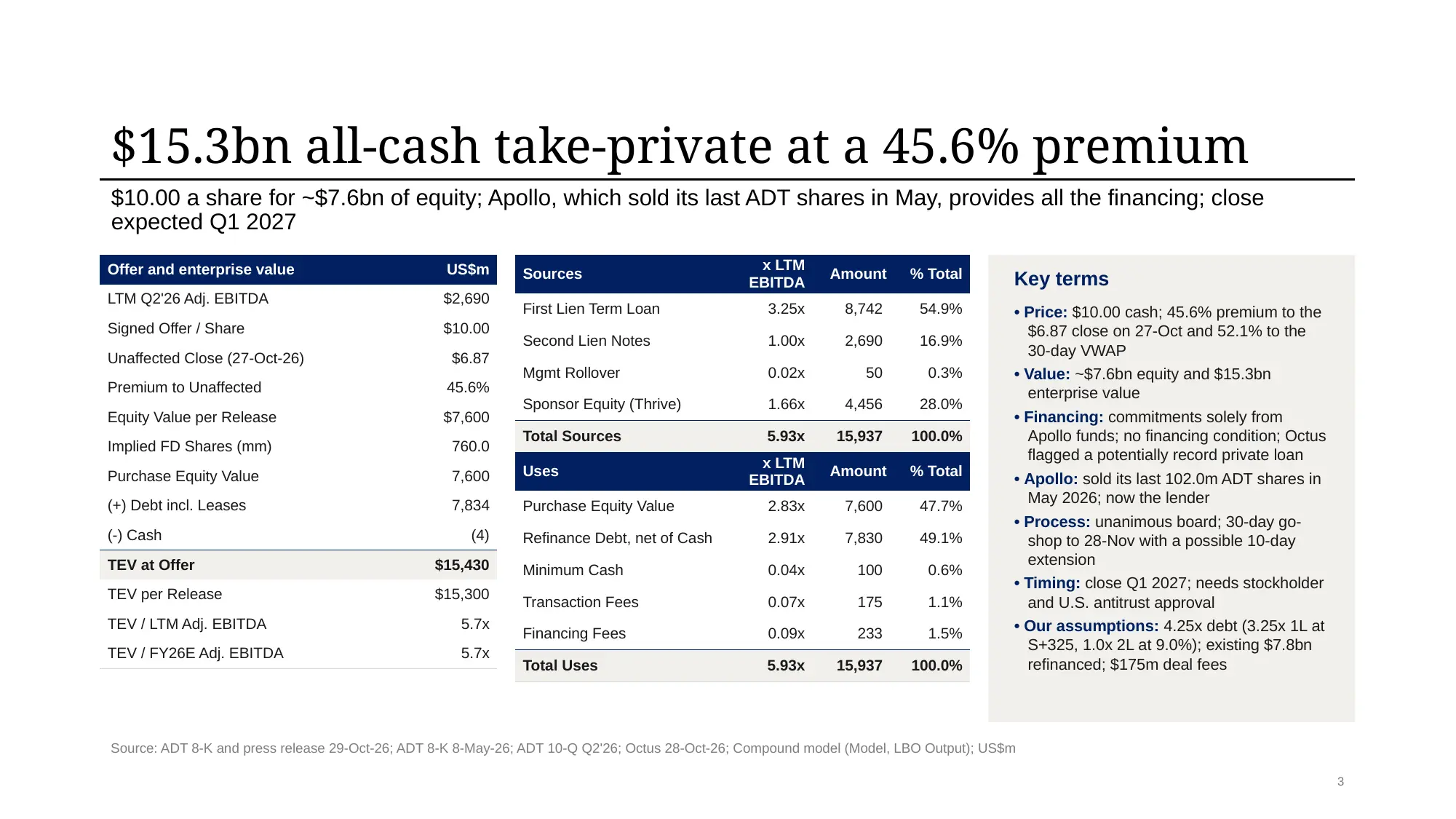
The X post said $7.6 billion. The first thing the task checked was what that number was. ADT’s 8-K puts equity value at $7.6 billion and enterprise value at $15.3 billion; at $10.00 a share the premium is 45.6% to the $6.87 unaffected close. Because this was a take-private, the task built an LBO, with Apollo’s financing package sized from the 8-K and the debt terms flagged as assumptions.
The operating build runs from ADT’s recurring monthly revenue and attrition through gross profit, adjusted EBITDA and subscriber acquisition costs, so the case is in the drivers and not in a margin assumption:
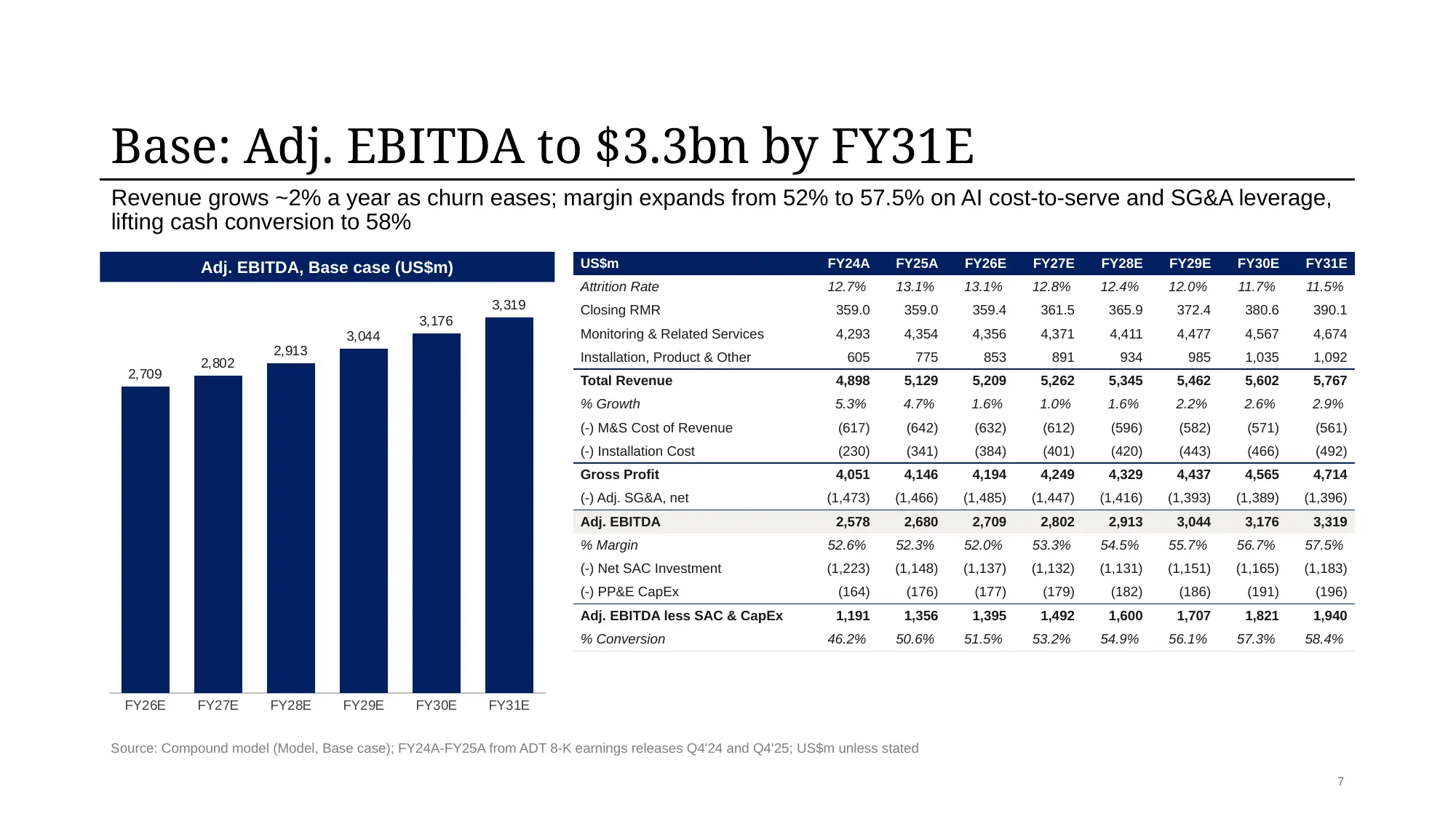
| Thrive Holdings / ADT | Base case |
|---|---|
| Entry TEV | $15.43bn, 5.7x LTM adj. EBITDA |
| Funding | $8.74bn first lien (3.25x), $2.69bn second lien (1.0x), $4.46bn equity |
| Five-year IRR (exit at 6.0x) | 21.2% (2.61x) |
| Ten-year IRR | 16.3% (4.53x) |
| Upside / downside IRR | 27.6% / 3.2% |
| Walk-away price | about $10.34 a share |
Source: ADT Thrive LBO.xlsx, LBO Output and Model tabs. Financing terms and Thrive’s 20% hurdle are assumptions; neither is disclosed.
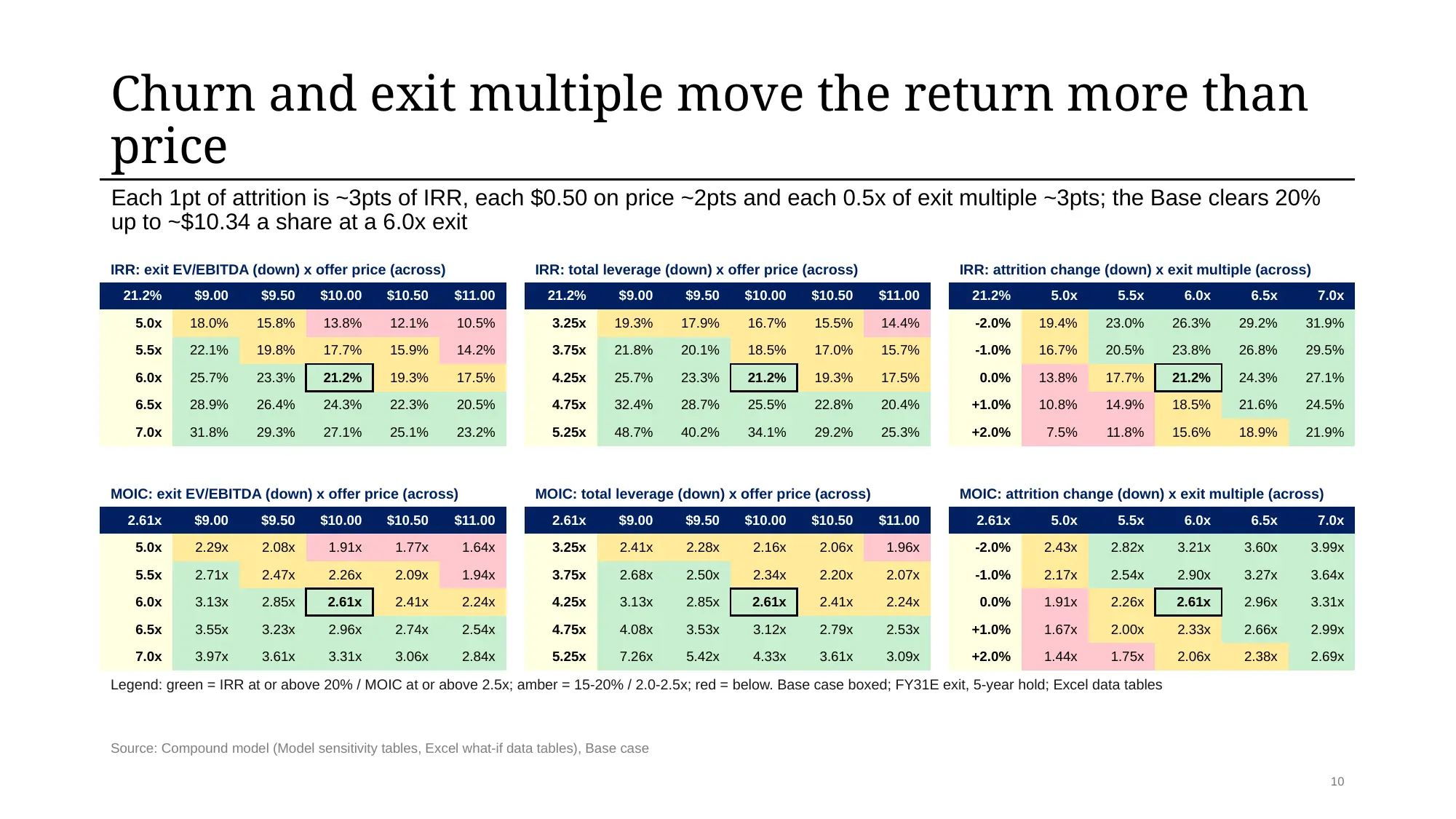
Thrive Holdings is permanent capital, so the model runs a ten-year hold next to the usual five. The longer hold gives up IRR for multiple of money, which is the trade a permanent-capital owner makes. The sensitivity page shows what actually moves the return: each point of attrition is worth about three points of IRR, more than any change in price.
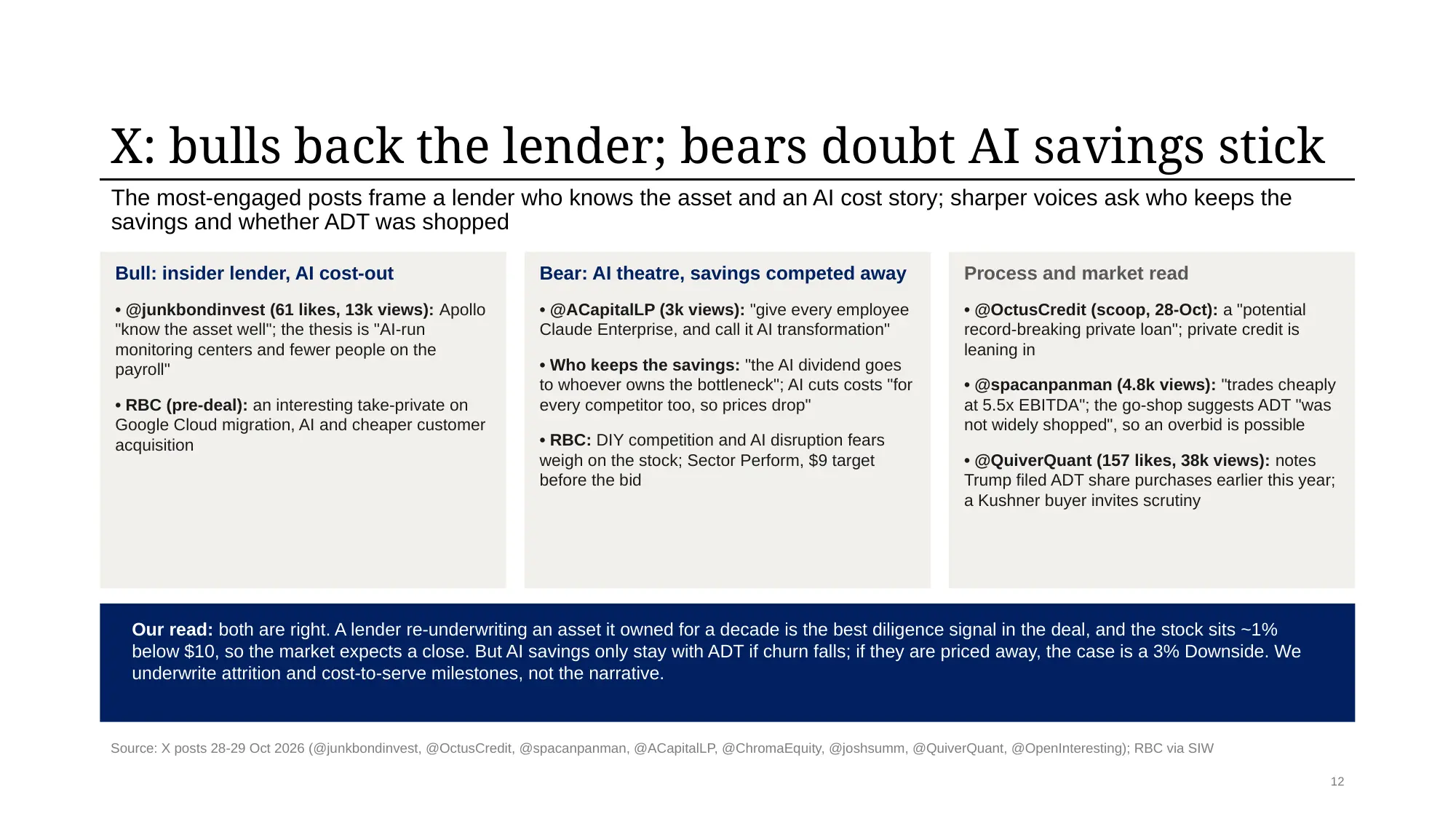
The deck also carries the conversation on X, sorted from the buyer’s side into bull, bear and process reads and attributed to each account. That slide is where the monitor earns its keep: the bulls are quoting a plan for “AI-run monitoring centers,” and the bears are asking whether those savings stay with ADT or get competed away to customers. That question is the same one the model’s attrition and cost-to-serve lines test.
What lands in the inbox
Each email leads with the view in one sentence, then the terms from the filing, the base case, what you have to believe, the bull and bear case from X, and the caveats. The caveats matter. The DoorDash email says Instacart has withdrawn guidance, so every operating driver is an assumption. The ADT email says ADT reports Q3 on 3 November and the model does not have it yet. Every figure links back to the filing, the X post or the model it came from.
Since the evening it was set up, the monitor has covered five deals in four emails: Marvell / Lumentum, Wendy’s and Dine Brands, DoorDash / Instacart and Thrive / ADT.
Prompts to route on Compound
The prompt above can be routed on Compound as written, to your own agent or a team agent. To narrow it to a sector, name the sector and the accounts that break its news. Three examples, each with a real post it would have caught:
Semiconductors and AI infrastructure
Track @SemiAnalysis_, @theinformation and @Exec_Sum on X for deals, capacity contracts and financings in semiconductors and AI infrastructure. For each one, build a model and a short deck and email the team.
Software and internet
Track @theinformation and @Exec_Sum on X for sale processes, M&A and fundraises at software and internet companies. For each one, build a model and a short deck and email the team.
Restaurants and consumer brands
Track @Exec_Sum and @litquidity on X for take-privates and M&A in restaurants and consumer brands. For each one, build an LBO and a short deck and email the team.
Compound searches every public post on X by keyword, account and date, and checks what a post says against SEC filings, transcripts and market data before it builds anything. That check is how a $7.6 billion headline became a $15.3 billion enterprise value before it reached the model. For more on reading X alongside filings, see our Twitter research example on the Anthropic S-1.