Introducing PE Bench
AI agents doing a private equity analyst's work, from data room to IC memo
by Compound Team · October 19, 2026 · 10 min read
- Compound
- Best other agent shown
- Claude Code
- Codex
- Gemini
- Muse
PE Bench tests whether an AI agent can do the work of a private equity analyst on a live deal. Each case is one deal, and every task in it refers to that same deal. We give the agent the deal’s documents, messy and realistic (legal agreements, financials in PDFs, a CIM), and ask for the full set of work an analyst produces on it: diligence cuts, an investment model, and the IC memo and deck. Because every deliverable comes from the same deal, we can check the memo against the agent’s own model.
Each case is either a take-private of a public company, built from its filings, or the diligence of a private company, built from its data room, and every task comes with only the short brief an analyst would get. In the private-company data rooms the documents contradict each other in places, so the agent has to decide which numbers to believe. This benchmark was built by former private and growth equity investors.
Below are three of the 58 prompts in this benchmark:
Bridge Project Voltaic’s FY25 reported result to adjusted EBITDA for pricing from a buyer’s perspective, using the data room. Put it in a workbook we can send to the seller’s advisers.
Attached is our Cardinal Vision operating and LBO model, rolled from the Lakeshore precedent, and the data room. The investment committee wants its own case before the next meeting. Add an Investment Committee case as a fourth case on the Assumptions tab, beside Base, Upside and Downside, and make it the live case […] Keep the model live. […] This should be IC standard.
Using 01 Filings/ and 02 Deal Terms/, build the sources and uses and the pro forma capitalisation at close for the Casella take-private in Excel, including how both share classes and the rollover are treated. This should be IC standard.
This is the first batch of PE Bench. We intend to cover more use cases and types of deals over time. Scores on the PE Bench leaderboard will follow each release.
Why we built PE Bench
Existing finance benchmarks for AI ask a set of questions, or for a set of Excel models, and grade each answer against a reference. They are useful, but they rank models on a shared harness (the same agent software wrapped around every model) and end at an answer or a spreadsheet. PE Bench runs each agent as it ships, Compound and the model vendors’ own agents (Claude Code, Codex, Gemini CLI, Muse), each with its own tools and settings.
PE Bench goes deep on the private equity workflow, in deal environments that are realistic and messy. The agent works from hundreds of documents across Excel, PowerPoint, Word and PDF filings, some of them scanned, where figures in one document often disagree with another, so the agent has to work out which numbers to trust. It cuts the data the way an analyst does, with cohort analysis, a quality-of-earnings bridge and a working capital peg, and builds the financial model one step at a time, from compiling historicals through the operating model and debt schedule to returns. It then writes the IC memo in Word and the deck in PowerPoint, using the numbers from its own model.
Finally, we test something most benchmarks skip, which is working inside a model and templates someone else built. In Lever the agent has to roll a populated model from a prior deal onto a new one and keep it live. In Sentevo it refreshes a precedent LBO and writes the memo and deck in the firm’s templates. This is more demanding than populating a blank template, and it reflects much of an analyst’s day-to-day work.
In practice, we believe PE Bench captures the subtle differences in output quality that a partner sees between a mediocre analyst and an outstanding one, and that current benchmarks miss.
The Compound harness
Compound draws on frontier lab models and own custom models, and the mix changes as models improve. We are opinionated about routing: which model takes which part of a task, and how their outputs are combined into one deliverable. Even choosing the right model for one task is hard: the answer depends on the work, the documents and the cost, and it changes every time a lab ships a new model. That is too much to ask of a user and instead Compound owns that responsibility. Drawing on many labs gives Compound Pareto-optimal points that no single lab’s models can reach. Around those models runs a multi-agent harness we designed from scratch and verify empirically on realistic finance evals like this one. The harness benchmarked here is exactly what you get in the Compound product.
The harness also includes custom tools, including Compound Office, that support the models. Compound edits Excel, Word and PowerPoint files directly and recalculates workbooks in its own spreadsheet engine, so a deck built on a model’s outputs carries the model’s live numbers, including figures that LibreOffice cannot compute. It reads company and market data through first-party integrations rather than fetching web pages, and it cites primary sources such as SEC filings rather than secondhand news. In practice much of the gap between agents on PE Bench comes from tools like these: a model cannot tie a memo to a model it cannot construct, or cite a filing it never retrieved.
Overall Performance vs. Cost Comparison
How we grade
We grade the deliverables with the same standards of precision and output quality expected by institutional finance firms: the numbers tie, formulas are live and the cases switch from one selector, each figure traces to the document it came from, the memo’s numbers match the model, issues the seller did not raise are flagged, and the deck follows the house template.
Each deliverable gets dozens of checks, run against the files the agent hands back. The checks are written for each task, not drawn from a common list, and each carries its own points: the judgement calls that would move the price weigh most, mechanics such as sourcing and layout less. A task’s score is the share of its points the deliverable passes.
To show what that looks like, here is one of the 58 tasks, the Voltaic operating model. Its brief (Ironvale is the company behind Project Voltaic):
Build me an operating model for Ironvale off the data room: drivers to EBITDA and EBIT, historicals through FY25 and a forecast to FY30. Include one toggle that switches the forecast between management’s case and your buy-side case. Leave the model set to the buy-side case, and tell me where you land against management’s plan. Put the model in Excel.
Four of its checks, marked on our reference answer:
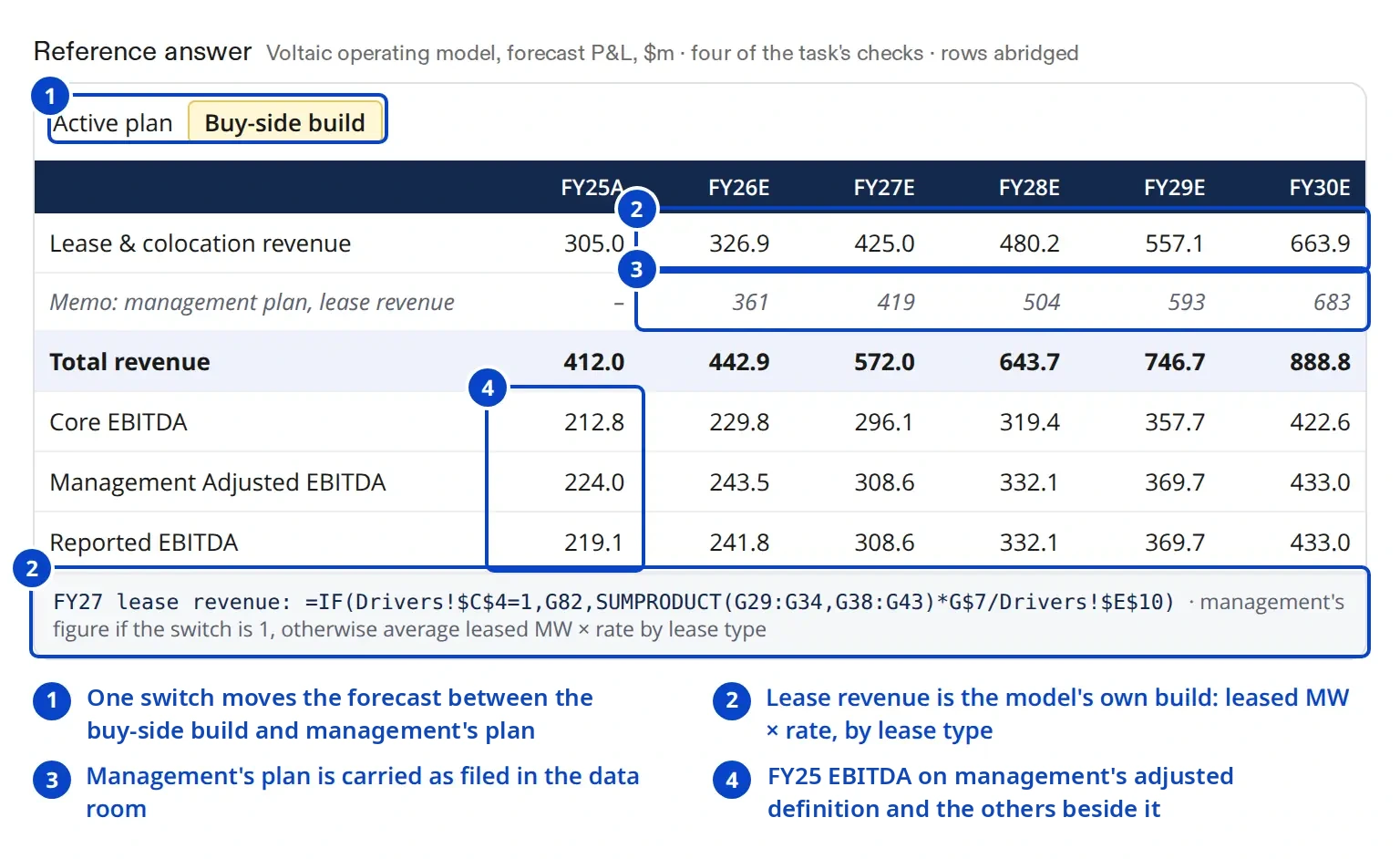
The task has 30 checks worth 800 points between them, and these four carry 224. The heaviest on the task, at 112, is the second: whether forecast lease revenue is the analyst’s own build rather than management’s numbers. Between them the checks cover the model’s mechanics, its ties to the data room and the analyst’s judgement. They belong to this task alone; every other task has its own, written for its deal and deliverable.
For 50 of the 58 tasks we built a reference answer of the kind a good analyst would send a partner, and each one scores 100% on its own task’s checks under the grader behind the published scores. To keep grading neutral across agents, any defensible convention the brief leaves open is accepted, figures are found wherever the agent put them, and a workbook the agent saved without calculating is recalculated before we read it.
Every agent, Compound included, gets one hour of wall-clock time for each prompt in a task, so a task whose brief comes in three turns gets three hours. A task that runs past its limit scores 0, whatever the agent delivered by then. Deal work runs to deadlines: an analyst is expected to turn a deliverable around within the working session, and an answer that arrives after the meeting counts for nothing. On this release the limit mostly affects the slowest agent, Gemini 4 Argon, which runs past it on several tasks, while both Compound settings finish every task within it. We may later publish a second score with a longer limit.
Each model runs in its own lab’s agent harness, the one it is most likely tuned for, to give it its best shot: the Claude models in Claude Code, the GPT models in Codex CLI, the Gemini models in Gemini CLI and the Muse models in Muse CLI, while Compound runs through the Compound product. Every harness runs headless with auto-approval, with its own shell, file and web tools and its lab’s default reasoning effort (except Gemini, which we ran at medium thinking), and every one gets the same task prompt, instructions and document skills. The exact settings and command lines are in docs/running-agents.md.
One room, Voltaic, is published in full to show what the tasks involve. It is left out of the overall score. The other four rooms stay private.
PE Bench v1 data rooms
Later batches will add more types of deals and more of the work a deal team does.
| Deal | Company | Source material | Distinguishing focus | Tasks |
|---|---|---|---|---|
| Sentevo | Private software business (fictional) | Private data room: 96 documents (61 Word, 25 Excel, 9 PowerPoint, 1 other) | Challenging a seller’s aggressive numbers; working to the firm’s templates | 14 |
| Voltaic | Private data centre platform (fictional) | Public data room: 158 documents (118 PDF, 33 Excel, 7 other) | Finding adjustments the seller did not raise | 12 |
| Lever | Private physician practice group (fictional) | Private data room: 118 documents (57 PDF, 35 Excel, 18 Word, 8 PowerPoint) | Working inside an existing model | 9 |
| Planet Fitness | Public gym franchisor (real) | Public filings: 30 documents (12 SEC filings, 11 earnings releases, 6 call transcripts, 1 investor deck) | Building a take-private from public filings | 10 |
| Casella Waste | Public waste services company (real) | Public filings: 29 PDF documents | Modelling a buy-and-build | 13 |
What each room tests
| Deliverable | Voltaic | Sentevo | Planet Fitness | Casella Waste | Lever |
|---|---|---|---|---|---|
| Historicals & KPIs | ✓ | ✓ | ✓ | ✓ | ✓ |
| Quality of earnings / EBITDA bridge | ✓ | ✓ | ✓ | ✓ | |
| Working capital peg | ✓ | ✓ | ✓ | ||
| Revenue quality (cohorts) | ✓ | ✓ | ✓ | ||
| Diligence findings | ✓ | ✓ | ✓ | ✓ | ✓ |
| Operating model | ✓ | ✓ | ✓ | ✓ | ✓ |
| Debt schedule | ✓ | ✓ | ✓ | ✓ | ✓ |
| Sources & uses | ✓ | ✓ | ✓ | ✓ | |
| Integrated LBO | ✓ | ✓ | ✓ | ||
| LBO in a supplied model | ✓ | ✓ | |||
| Returns & waterfall | ✓ | ✓ | ✓ | ✓ | |
| Sensitivity tables in an existing model | ✓ | ✓ | |||
| Comparables & precedents | ✓ | ✓ | ✓ | ✓ | ✓ |
| Price analysis (ability to pay) | ✓ | ✓ | |||
| Sum-of-the-parts | ✓ | ||||
| IC memo (Word) | ✓ | ✓ | ✓ | ✓ | ✓ |
| IC deck (PowerPoint) | ✓ | ✓ | ✓ | ✓ |
What the output looks like
Voltaic: Quality of Earnings / EBITDA Bridge
The seller adds back $4.8m of sale costs. Opus 5.5 and GPT-6 Astra both accepted this as an add-back. Compound rejected $2.9m of that portion, as that amount was spent before the Board authorised a strategic review. At the deal’s 21.0x entry multiple, that is about $60m of price.
Sentevo: Comparables and Precedents
Opus 5.5 types in market capitalization and enterprise value from stockanalysis.com, and GPT-6 Astra types in each enterprise value as a constant. Compound builds each EV from share price and share counts, then debt, non-controlling interests and cash from each peer’s latest reported balance sheet.
Casella: Historicals & KPIs
GPT-6 Astra only shows unadjusted EBITDA of $391m, while Opus 5.5 and Compound show company-reported Adjusted EBITDA as well, for a more complete picture.
Sentevo: IC Deck
GPT-6 Astra only runs one plan, $677.3m of FY30 EBITDA in every panel, and only changes the exit multiple across the different cases. Compound and Opus 5.5 build out three operating cases.
Sentevo: IC Deck (Formatting)
Compound adheres to the IC deck template more closely than GPT-6 Astra across the deck, and more closely than Opus 5.5 on the slides below, where it keeps the template’s layouts, charts and callouts and updates them based on the new deal.
Compound keeps the six metric tiles, the bar chart and the drivers text. Opus 5.5 uses two charts and text boxes; GPT-6 Astra a line chart and free text.
For model developers
PE Bench has 5 rooms and 58 tasks over hundreds of documents in PDF, Excel, Word and PowerPoint, and every task is graded on the files the agent delivers (xlsx, docx, pptx), not on a text answer. Grading is automated: each task has a rubric of dozens of checks. Most checks are code that reads the delivered files, and checks that read prose ask an LLM judge. Every published score is pinned to one grader version. Most tasks (50 of 58) have a reference answer, which has to score 100% on its own task’s checks before a grader version is used for published scores.
The best agent scores about 80% on the private rooms.
Only Voltaic is public, as a gated download. The other four rooms are held out and have never been published. For evaluation or training access beyond the open room, contact pe-bench@getcompound.ai.
Getting the data
Voltaic is the open room: its code is released under Apache-2.0 and its data under CC-BY-4.0, as a gated download. To run an agent or model on PE Bench, request the data; for anything else, email pe-bench@getcompound.ai.
GitHub repository: GetCompoundAI/pe-bench. Hugging Face dataset: CompoundAI/pe-bench.