Deutsche Bank reported $582 million in suspicious Epstein transactions, leaked files show
An internal Deutsche Bank document in the “Inside Deutsche Bank” leak lists 21 suspicious activity reports on $581.9 million of Epstein-linked transactions from 2013 to 2019, more than double what Senate investigators found. Our map traces the bankers who brought Epstein in and kept him, the money in and out, and the investigations ahead.

Deutsche Bank filed 21 suspicious activity reports covering about 3,000 transactions worth $581.9 million tied to Jeffrey Epstein or his companies between October 2013 and May 2019, according to an internal document from the bank's U.S. Financial Crimes Intelligence Unit. Financial Mail published it Tuesday as part of “Inside Deutsche Bank,” a review of more than 15 million leaked files by more than 230 journalists from some 50 news organizations. The Financial Times put the count at around 3,200 transactions, IBTimes reported.
That is more than double the more than $250 million in suspicious wire transfers that Sen. Ron Wyden's staff found Deutsche Bank had flagged after Epstein's July 2019 arrest. The leaked total also counts checks and transactions involving other banks, Forbes reported, citing the FT. The two figures cover different sets of transactions and should not be added together.
Deutsche Bank has paid $225 million over Epstein: a $150 million New York penalty in 2020 that also covered two unrelated correspondent-banking cases, and a $75 million settlement with victims in 2023. The bank told Financial Mail it “acknowledges its error of onboarding Epstein in 2013 and regrets our historical connection with him.” Its shares fell more than 6% in early Frankfurt trading Tuesday, CNBC reported, and its NYSE-listed shares closed at $33.88, down 5.5%.
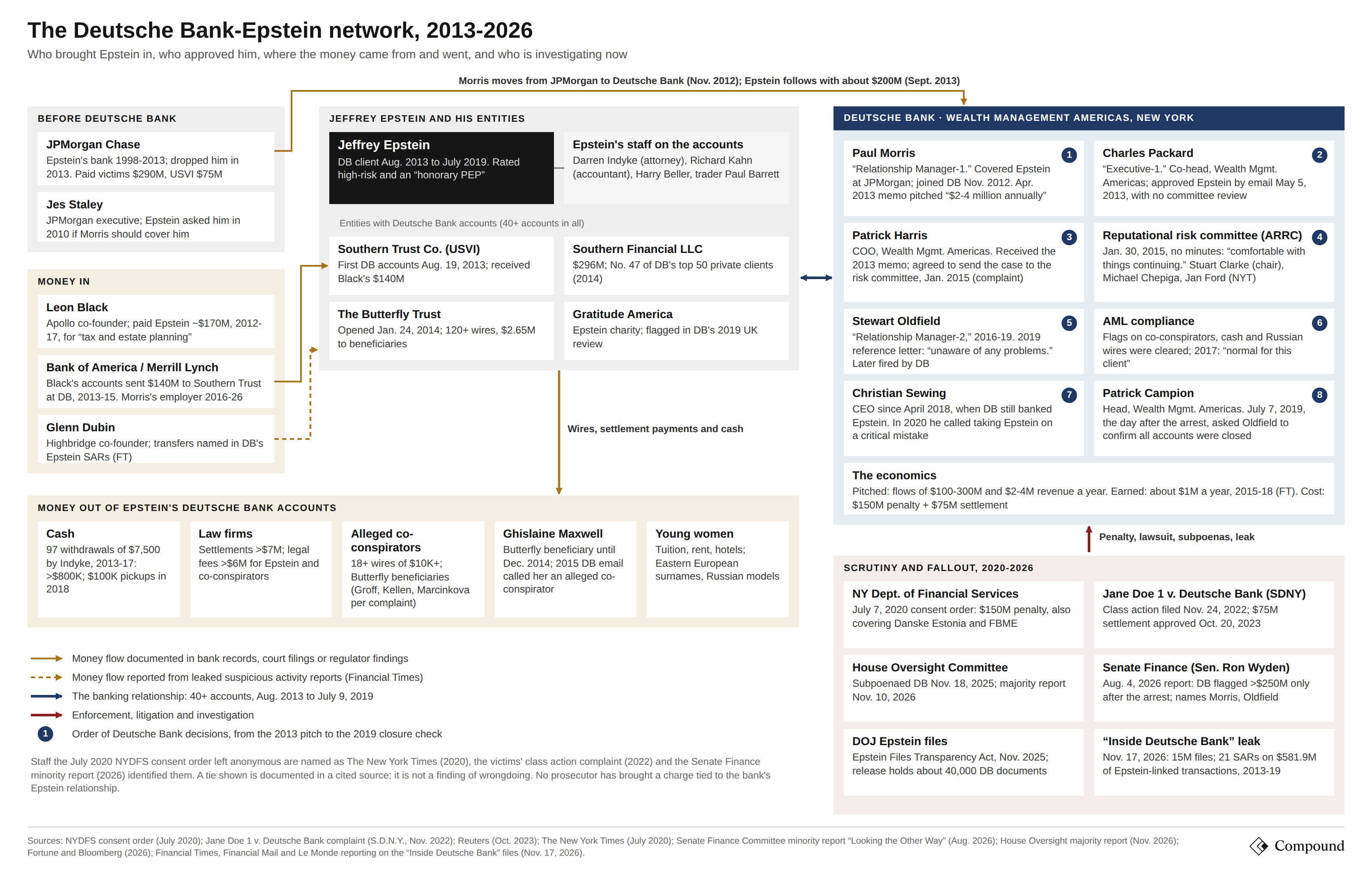
Deutsche Bank's Epstein relationship, 2013-2026. Staff the 2020 New York consent order left anonymous are named as The New York Times, the victims' class action complaint and the Wyden report identified them. A tie shown is not a finding of wrongdoing. The full-resolution map is free to download below.
Who brought Epstein in
Paul Morris had helped manage Epstein's account at JPMorgan, where Epstein banked from 1998 to 2013. Morris joined Deutsche Bank's wealth unit in November 2012 and brought Epstein in, according to The New York Times, which matched Morris to “Relationship Manager-1” in the New York consent order.
In April 2013 Morris sent a memo on Epstein to Charles Packard, co-head of wealth management in the Americas, and Patrick Harris, its chief operating officer, according to the victims' complaint. The memo listed Epstein's 2008 plea and 17 out-of-court civil settlements. Morris's email projected “flows of $100-300 [million] overtime (possibly more) w/ revenue of $2-4 million annually.”
On May 5, 2013, Packard wrote back that the head of AML compliance and the Americas general counsel saw no need for a reputational risk review: “we can move ahead so long as nothing further is identified through KYC and AML client adoptions.” The bank told regulators it has no other record of that conversation. Its reputational risk committee did not meet on the onboarding.
The first accounts opened Aug. 19, 2013, for Southern Trust Company and Southern Financial LLC, Epstein companies in the U.S. Virgin Islands. Epstein, his entities and associates eventually opened more than 40 accounts. The bank rated him high-risk and an “Honorary PEP,” or politically exposed person, because of his political connections.
In September 2013 Morris wrote to Packard: “Epstein sending over about $200(million) from JP, told them Friday.” Packard replied: “Great news! Congrats Paul.” A 2014 list of the bank's 50 largest private clients ranked Southern Financial 47th with $296 million, according to Wyden's report.
Who kept him on
In January 2015 compliance officers escalated new court rulings and press reports about Epstein. Packard and Morris met him at his Manhattan home on Jan. 22. The reputational risk committee met Jan. 30 and kept no minutes. A member emailed afterward that the committee was “comfortable with things continuing” and that another member had “noted a number of sizable deals recently.”
The Times identified the attendees as Stuart Clarke, chief operating officer for the Americas, who chaired the meeting; Michael Chepiga, acting Americas general counsel; and Jan Ford, head of compliance for the Americas. Ford's follow-up email said the bank would “continue business as usual with Jeff Epstein.”
The committee attached three conditions, which were never passed to the whole relationship team. In March 2017 a monitoring analyst cleared payments to a Russian model and a Russian publicity agent: “this type of activity is normal for this client.” In May 2018 the explanation for wires to women at a Russian bank came back as “SENT TO A FRIEND FOR TUITION FOR SCHOOL,” and the payment was cleared.
A 2015 bank email described Ghislaine Maxwell as an alleged “co-conspirator in Epstein's illegal activities” but cleared a trust arrangement that listed her as a beneficiary, Financial Mail reported.
Where the money came from
Leon Black's accounts at Bank of America paid Epstein about $170 million between 2012 and 2017, and $140 million of it went into Epstein's Southern Trust accounts at Deutsche Bank in 2013-15, the Wyden report found. Bank of America flagged $156 million of the payments in a suspicious activity report on Feb. 7, 2020.
A 2015 Deutsche Bank email thread covered Black's family office funding an account with Epstein holding authority to transact on Black's behalf, Bloomberg reported from Justice Department files. Black's lawyer told the FT that Black paid Epstein only for “tax and estate planning advice,” Forbes reported.
The FT said the flagged transactions also involved hedge fund billionaire Glenn Dubin of Highbridge Capital Management. A Dubin spokesperson said “Glenn Dubin never invested with or sought financial advice from Jeffrey Epstein.”
Where the money went
Darren Indyke, Epstein's lawyer and the order's “Attorney-1,” per Wyden's staff, made 97 withdrawals from the bank's Park Avenue branch from 2013 to 2017, each for $7,500, the bank's limit for third-party withdrawals. He took out more than $800,000 in all. In May 2014 he asked how often he could withdraw cash “without creating some sort of alert”; the coordinator who relayed the question later said she understood it to be about the $7,500 limit. Indyke told the House Oversight Committee he cashed checks below the reporting threshold but denied trying to avoid it. He has not been charged.
Richard Kahn, Epstein's accountant, arranged a $100,000 withdrawal in January 2018 and asked for all of it in $100 bills, Fortune reported.
Epstein's Butterfly Trust opened Deutsche Bank accounts on Jan. 24, 2014. Its beneficiaries included three alleged co-conspirators and women with Eastern European surnames, New York regulators found; the victims' complaint names the three as Lesley Groff, Sarah Kellen and Nadia Marcinkova. Epstein used the trust and other accounts to send more than 120 wires totaling $2.65 million to beneficiaries. Maxwell was an original beneficiary until trustees removed her on Dec. 9, 2014, Fortune reported.
Regulators also counted settlement payments of more than $7 million and legal fees of more than $6 million. The House Oversight majority report, citing the bank's presentation to federal prosecutors, lists $116,014 in tuition paid to the New School from 2014 to 2019 for a woman who “appears to be a Russian model” and was a Butterfly Trust beneficiary.
A seven-month exit
After the Miami Herald's November 2018 reporting, the bank told Epstein by letter on Dec. 21, 2018, that it would close his accounts. His team had until the end of February 2019 to move the money and then got extensions, Fortune reported. In spring 2019 a staffer sent two foreign banks recommendation letters for Epstein's investment companies. One said the banker was “unaware of any problems relating to the operation or use of [the] accounts”; Wyden's report names that banker as Stewart Oldfield, who had taken over the accounts in 2016.
On May 10, 2019, Oldfield wrote to colleagues: “I think some of the accounts are zero balance but still open.” Epstein was arrested July 6. The next day Patrick Campion, head of wealth management in the Americas, asked Oldfield to confirm all accounts were closed. The last ones closed July 9.
In one 2019 filing the bank retroactively flagged 1,140 wire transfers totaling $147 million. Wyden's staff concluded that Epstein did business at Deutsche Bank for almost six years without a real-time suspicious activity report.
Suspicious activity counts
| Figure | What it counts | Source |
|---|---|---|
| $581.9 million | Transactions in 21 suspicious activity reports, Oct. 2013 to May 2019 | Deutsche Bank internal document, via Financial Mail |
| More than $250 million | Wire transfers the bank flagged after the 2019 arrest | Senate Finance minority report, from reports reviewed at Treasury |
| $147 million | 1,140 wire transfers in one 2019 filing | Senate Finance minority report |
The leaked total includes checks and transactions involving other banks, which Wyden's count of wires does not. Neither total means every transaction was criminal.
Where the bankers went
| Person | Role at Deutsche Bank | Since |
|---|---|---|
| Paul Morris | Relationship manager, 2012-2016 | Joined Bank of America's Merrill Lynch in 2016 and left in 2026, per Wyden. Not accused of a crime |
| Charles Packard | Co-head, wealth management Americas | Joined Bridgewater Associates (NYT, 2020) |
| Stewart Oldfield | Relationship manager, 2016-2019 | Fired by Deutsche Bank over alleged lack of diligence; left Third Lake Associates in April 2026 (Moneycontrol) |
| Jan Ford | Head of compliance, Americas | Still at the bank in July 2020 (NYT) |
| Christian Sewing | Chief executive since April 2018 | Told staff in July 2020 that taking Epstein on was a critical mistake |
Wyden's report put Morris and Oldfield on a list of 13 bankers whose conduct merits investigation by prosecutors and regulators. Deutsche Bank and JPMorgan declined to give Wyden's staff the transcript of Morris's deposition in the victims' lawsuit.
Penalties, lawsuits and investigations
- July 7, 2020: New York's Department of Financial Services fined Deutsche Bank $150 million, covering Epstein and two correspondent-banking cases, the first regulator action over Epstein.
- July 13, 2020: The New York Times named the bankers the consent order left anonymous.
- Nov. 24, 2022: Jane Doe 1 sued Deutsche Bank in Manhattan federal court on behalf of Epstein victims.
- March 2023: U.S. District Judge Jed Rakoff ruled the suit could proceed, Time reported.
- Oct. 20, 2023: Rakoff gave final approval to the bank's $75 million settlement, Reuters reported. The bank did not admit wrongdoing.
- Nov. 18, 2025: House Oversight Chairman James Comer subpoenaed Deutsche Bank for Epstein's financial records.
- Nov. 19, 2025: The Epstein Files Transparency Act became law. The Justice Department's release holds about 40,000 Deutsche Bank documents, Bloomberg reported.
- Aug. 4, 2026: Wyden released his report on JPMorgan, Deutsche Bank and Bank of America, the end of a four-year investigation.
- Nov. 10, 2026: The House Oversight majority report said Epstein's network required JPMorgan Chase and Deutsche Bank “to choose profit and client introductions over clear red flags.”
- Nov. 17, 2026: The “Inside Deutsche Bank” files were published. German Finance Minister Lars Klingbeil asked the bank for “full transparency” on past control failures, DW reported.
What to watch
- January 2027: Democrats take control of Congress. Incoming Senate Finance chair Wyden said, “I have a list of Wall Street bankers who need to answer questions,” Politico reported. Incoming House Oversight chair Robert Garcia has vowed his own investigation, The Hill reported.
- The Epstein Wall Street Records Act, introduced in October, would require the Federal Reserve and the SEC to investigate banks and executives linked to Epstein.
- The whistleblowers also gave the files to the Justice Department and FinCEN, and could be eligible for a reward if the U.S. prosecutes, Le Monde reported.
- New York's 2020 order lets the regulator act on Epstein-related conduct Deutsche Bank did not disclose. The order dates the relationship to December 2018; the accounts stayed open until July 9, 2019.
 Deutsche Bank-Epstein relationship map (PDF)The full-resolution map above, with the people, entities, money flows and investigations, and its sources.Download · Free
More from Compound News

California bans Waymo from freeways; our model puts the cost at $1.5 billion to $9.8 billion
California's DMV barred Waymo's driverless cars from all state freeways as of Nov. 11 after repeated construction-zone incursions. Waymo paused freeway rides nationwide. Compound's DCF model prices the hit at $1.5 billion if the ban lifts by mid-2027.
Read article →
Finance AI Vendors Hold 18% of the Seat Market and 0.3% of Finance Payrolls
Finance AI vendors book about $9.9 billion a year: roughly 18% of a $54 billion seat-based market, but 0.3% of the $3.4 trillion finance pays its workers. Our BLS and BEA-based model puts the middle case at $143 billion, 6.9% penetrated.
Read article →
What's causing the Chase, Bank of America and Wells Fargo outages
Chase customers filed more than 4,600 Downdetector reports by 1:50 p.m. ET on Nov. 16 as Bank of America, Wells Fargo and U.S. Bank also saw spikes. Chase blamed a technical bug, not a cyberattack. Here is what is known about the cause, updated live.
Read article →