California bans Waymo from freeways; our model puts the cost at $1.5 billion to $9.8 billion
California's DMV barred Waymo's driverless cars from all state freeways as of Nov. 11 after repeated construction-zone incursions. Waymo paused freeway rides nationwide. Compound's DCF model prices the hit at $1.5 billion if the ban lifts by mid-2027.
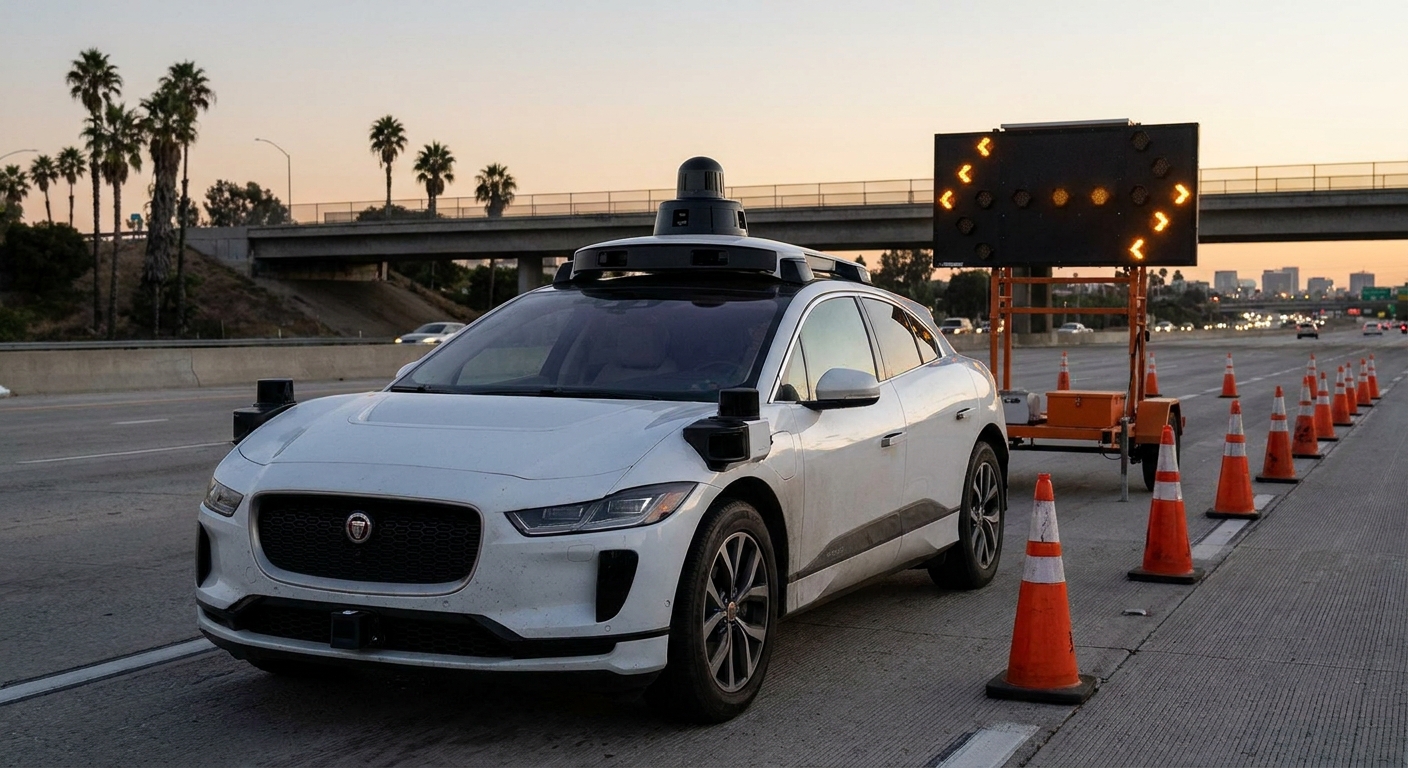
California's Department of Motor Vehicles has barred Waymo from operating or testing its driverless vehicles on all California freeways. The order took effect Nov. 11 and was made public Tuesday, Nov. 17, TechCrunch reported. The DMV said Waymo's freeway operations pose "an imminent hazard to public safety" because of "recurring incursions" into active construction zones.
Waymo said it has also paused freeway rides in its other markets while it reviews performance. Its service keeps running on surface streets, where it is "serving over half a million trips each week," spokesperson Dana Gallagher told TechCrunch.
In Compound's valuation model, a ban that lifts by mid-2027 cuts Waymo's equity value by $1.5 billion, or 5.9%, against a no-ban case. A ban that runs through 2028 and slows expansion cuts it by $9.8 billion, or 39%. The Excel model is free to download below.
What the DMV ordered
The restriction bars Waymo from "operating or testing its driverless vehicles on all California freeways," DMV spokesperson Jonathan Groveman said, according to the Associated Press. It applies to both Waymo's deployment permit and its driverless testing permit, Patch reported.
The DMV cited two incidents. On Nov. 5, three Waymo vehicles entered an active construction closure on U.S. Route 101 near Burlingame. On Nov. 6, a Waymo tried to pass California Highway Patrol cars running a traffic break on Interstate 280 in San Francisco, near Ocean Avenue, the San Francisco Chronicle reported. Video of the I-280 incident circulated widely on social media, AP said.
The DMV said the incursions came "despite a prior restriction and corrective actions implemented following similar incidents that occurred on May 18, 2026." Waymo said the November incidents caused no injuries or collisions.
The order has no end date. It stays in place until Waymo "demonstrates to the Department that it has taken effective corrective actions," Groveman said. Waymo must submit evidence that its vehicles can detect construction zones, emergency vehicles and other roadway conditions, and the DMV will then decide whether freeway service can resume, according to Patch.
Timeline
- Aug. 2024. Waymo was testing on California freeways by at least this date, The Verge reported.
- Nov. 2025. Freeway rides opened to public passengers. Before the pause, Waymo offered them in five markets: the San Francisco Bay Area, Los Angeles, Phoenix, Miami and Austin, CNN reported.
- April 28, 2026. The DMV adopted rules that let it impose targeted operating restrictions on autonomous vehicles, according to Patch.
- May 18. Seven Waymo vehicles drove between cones into active freeway construction lanes in the Bay Area, according to a federal recall filing. Waymo's safety committee restricted freeway operations the next day.
- June 17. Waymo filed a software recall with the National Highway Traffic Safety Administration covering 3,871 fifth-generation driving systems capable of driverless freeway operation, Patch reported.
- July 29. Waymo began restoring freeway service, starting in Phoenix, after software updates for construction zones.
- Nov. 5 and Nov. 6. The U.S. 101 Burlingame closure incident and the I-280 CHP traffic-break incident.
- Nov. 11. The DMV restriction took effect.
- Nov. 17. The order became public, and Waymo confirmed it had paused freeway rides in all markets.
Separately, NHTSA said last week it is examining whether a December 2025 Waymo recall fixed the robotaxis' failure to stop for school buses, Wired reported.
What the ban costs Waymo
The direct cost falls on longer trips. Freeways cut Peninsula rides that used to take 45 minutes to more than an hour, TechCrunch said. Without them, riders effectively cannot hail a Waymo to San Francisco International Airport, the Chronicle reported. Longer surface-street routes also raise fares, The Verge said. Waymo rides in the Bay Area already averaged $19.69 against $17.47 for Uber in an Obi survey from Nov. 27 to Jan. 1, TechCrunch reported.
Waymo's revenue base is still small. Alphabet's Other Bets segment, which holds Waymo and other units, reported third-quarter revenue of $372 million and an operating loss of $2.05 billion, according to Alphabet's earnings release. Waymo raised $16 billion at a $126 billion post-money valuation in February, Waymo said, and closed a $5 billion term loan in October, its first debt.
Waymo had about 4,000 robotaxis in September, TechCrunch reported. It plans 8,000 by the end of 2026 and 20,000 by the end of 2027, Semafor reported (unconfirmed; Waymo declined to comment). Co-CEO Tekedra Mawakana set a goal of more than 1 million paid trips per week by the end of 2026, twice the current rate.
Compound's valuation model
The model builds revenue from weekly paid rides and average fare, subtracts variable and fixed costs, and buys vehicles to meet demand at 125 rides per vehicle per week, the current ratio of rides to fleet. It discounts unlevered free cash flow through 2041 at a 10% placeholder discount rate, with 3% terminal growth. Inputs we chose rather than sourced are marked as assumptions in the file.
The ban enters in two places. While it is in force, Waymo loses 40% of the revenue from freeway trips, which we assume are 12% of trips in the five freeway markets and carry twice the average fare. Those markets are assumed to hold 75% of rides. A longer ban also slows expansion: 5 points off 2027 ride growth if the ban lifts by mid-2027, and 20 points off 2027 and 10 points off 2028 if it runs through 2028.
| Scenario | Equity value | 2027E revenue | Change vs. no ban |
|---|---|---|---|
| No ban | $25.0B | $941M | n/a |
| Ban lifted mid-2027 | $23.5B | $895M | -$1.5B (-5.9%) |
| Ban through 2028 | $15.2B | $826M | -$9.8B (-39.1%) |

The scenario table in the model is an Excel data table on the scenario switch.
Most of the damage in the longer case comes from slower growth, not from lost freeway fares. Direct lost revenue is $33 million in 2027 in the mid-2027 case. The slower ramp compounds through every later year of the forecast.
Our base case, with the ban lifted by mid-2027, puts equity value at $23.5 billion, 81% below the February post-money valuation. Using a 20x exit EBITDA multiple instead of perpetuity growth gives $54.8 billion. Across discount rates of 9% to 11% and terminal growth of 2.5% to 3.5%, the perpetuity value ranges from $15.9 billion to $35.5 billion. Closing the gap to $126 billion takes faster ride growth, lower costs per ride or revenue beyond U.S. ride-hailing, such as licensing, which this model leaves out.
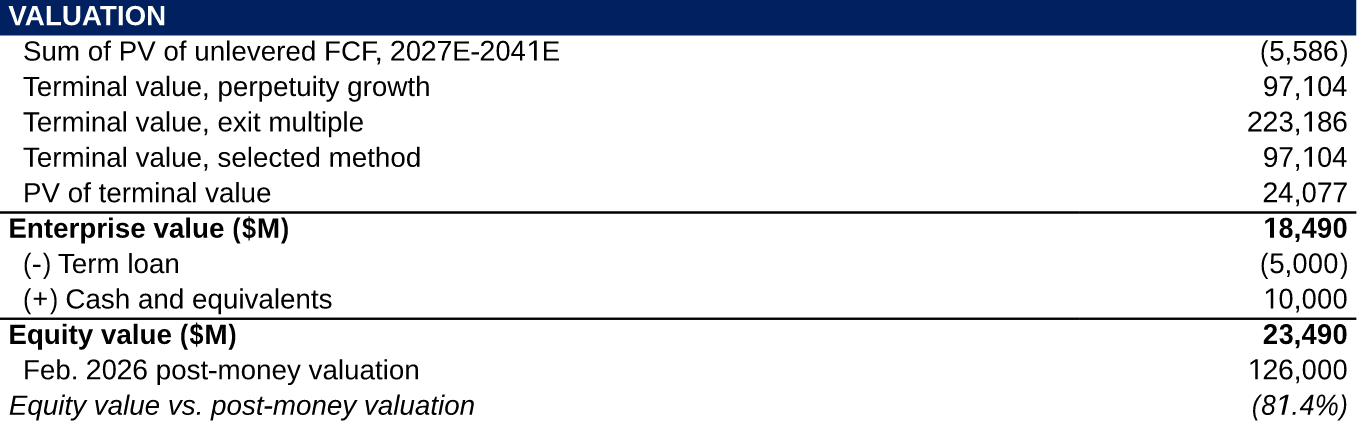
The valuation bridge from enterprise value to equity value.
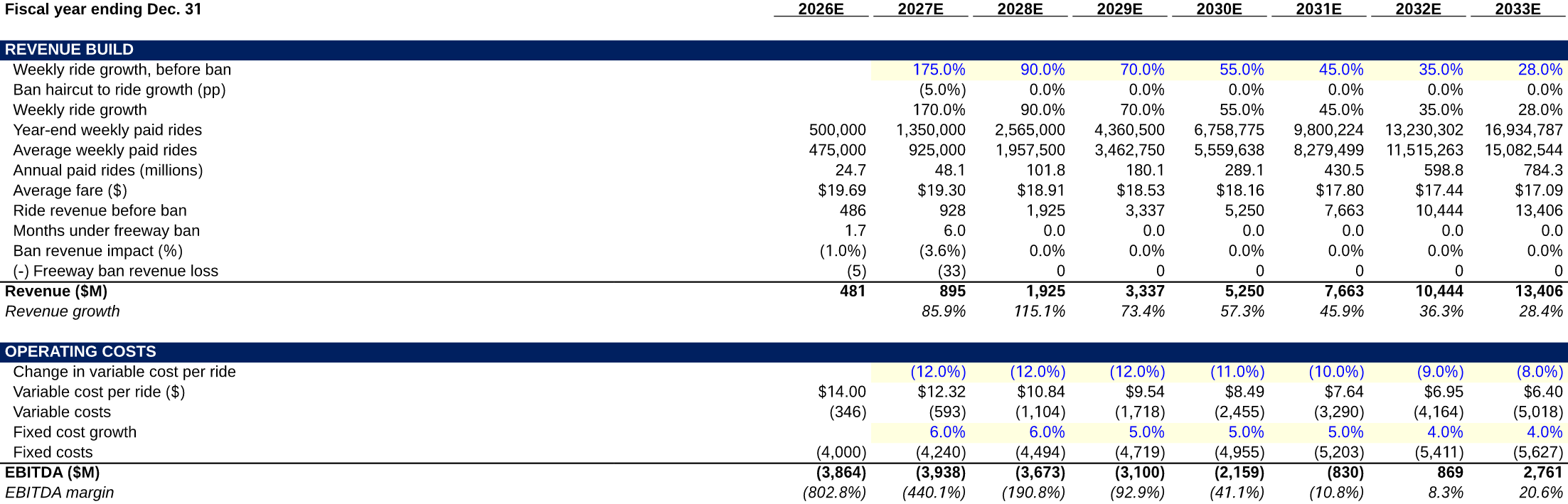
The revenue build and operating costs, 2026E to 2032E.
What to watch
- Waymo's corrective-action filing with the DMV. The order has no expiration date, and regulators will review the evidence before any freeway rides resume in California.
- Freeway rides outside California. The nationwide pause is voluntary. Waymo may keep testing on non-California freeways with safety operators, Wired reported.
- NHTSA's school bus review. A second open federal question on whether a Waymo software fix worked.
- The 1 million weekly rides goal by Dec. 31, 2026. Waymo reported over half a million on Nov. 17.
 Waymo valuation model with freeway ban scenarios (Excel)DCF through 2041: ride and fare build, fleet and capex, unlevered free cash flow, three freeway ban scenarios and WACC sensitivity grids as native Excel data tables.Download · Free
More from Compound News

Finance AI Vendors Hold 18% of the Seat Market and 0.3% of Finance Payrolls
Finance AI vendors book about $9.9 billion a year: roughly 18% of a $54 billion seat-based market, but 0.3% of the $3.4 trillion finance pays its workers. Our BLS and BEA-based model puts the middle case at $143 billion, 6.9% penetrated.
Read article →
Legal AI has sold 10% to 13% of its seat market. Legal spend is $1.1 trillion
Legal AI vendors run at about $1.67 billion a year, 13% of a $12.6 billion seat-based market and 10% of a labor-value build. Against the $1.13 trillion spent on legal work outside China, it is 0.15%.
Read article →
Compound forecasts Nvidia Q3 revenue of $112.1 billion, above the $109.0 billion consensus
Nvidia reports Tuesday, its first quarter since Jensen Huang resigned. Our model puts revenue 2.9% above consensus and EPS at $2.58 against $2.48. China-headquartered customers were 8.2% of Q2 revenue.
Read article →