Compound forecasts Nvidia Q3 revenue of $112.1 billion, above the $109.0 billion consensus
Nvidia reports Tuesday, its first quarter since Jensen Huang resigned. Our model puts revenue 2.9% above consensus and EPS at $2.58 against $2.48. China-headquartered customers were 8.2% of Q2 revenue.
Nvidia reports fiscal third-quarter results on Tuesday, Nov. 17, at about 1:20 p.m. PT, with the call at 2 p.m. PT, according to the company's Nov. 12 8-K. It is the first report since Jensen Huang resigned as CEO on Nov. 12. CFO Colette Kress is interim CEO.
Compound's model forecasts Q3 revenue of $112.1 billion, 3.8% above Nvidia's $108.0 billion guidance midpoint and 2.9% above the FactSet consensus of $109.0 billion. We forecast non-GAAP EPS of $2.58 against a consensus of $2.48.
The stock closed at $156.14 on Nov. 16, down 28.4% from $217.94 on Oct. 27, before the first reports tying Huang to a Megaspeed executive (our live timeline has the sequence). Options imply a move of about 9.5% after the report, StreetAccount reported.
We built an 11-page earnings preview deck on the model, in the format of our Nike Investor Day memo. The slides below come from it, and the deck, the model and a China one-pager are free to download at the end.
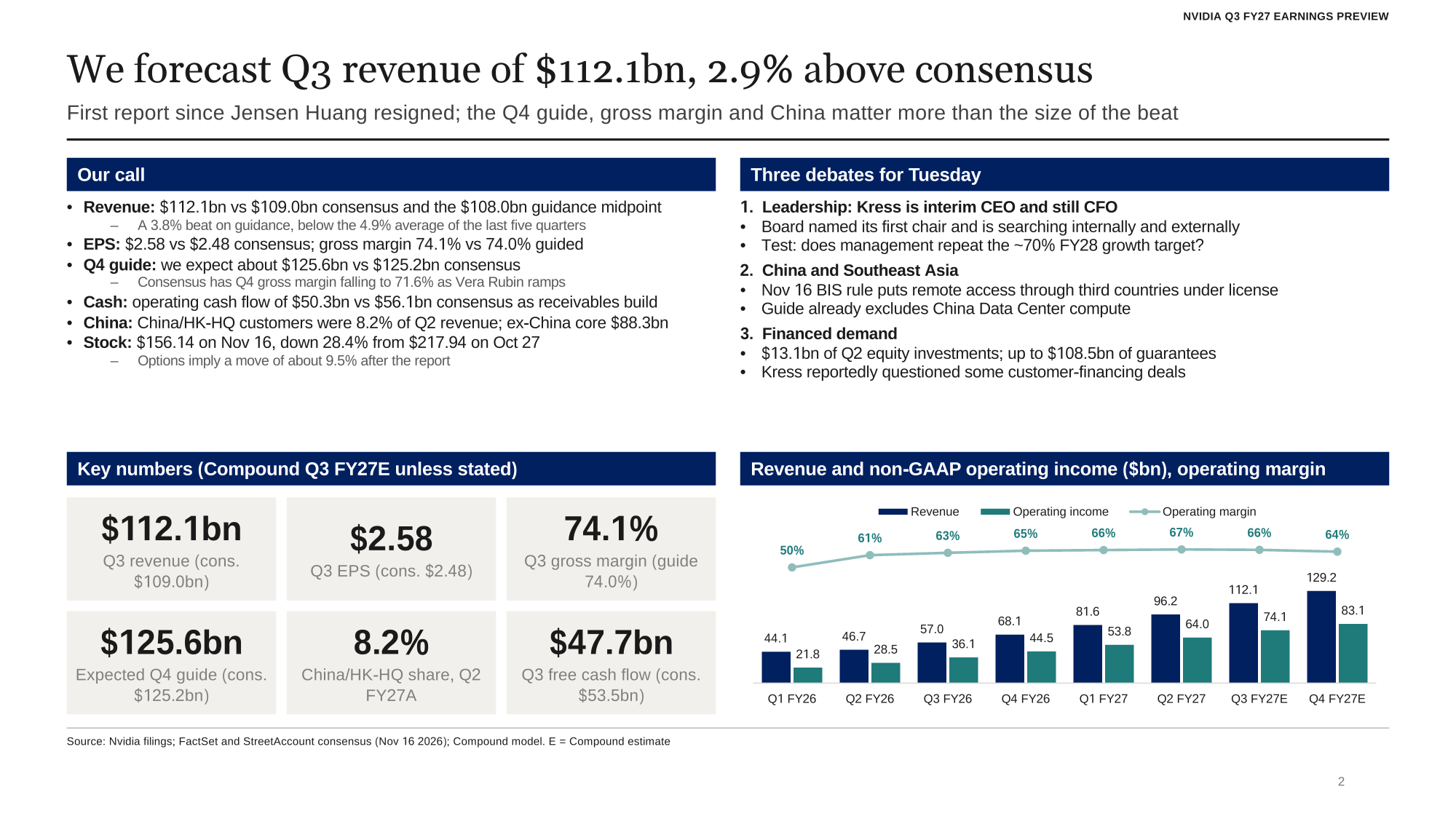
Executive summary: our call against consensus and the three debates for Tuesday.
Forecast vs consensus
| Q3 FY27 | Guidance | Consensus | Compound | Compound vs consensus |
|---|---|---|---|---|
| Revenue | $108.0B | $109.0B | $112.1B | +2.9% |
| Data Center | n/a | $101.9B | $104.7B | +2.8% |
| Hyperscale | n/a | $53.5B | $55.5B | +3.8% |
| AI Clouds, Industrial & Enterprise | n/a | $49.0B | $49.2B | +0.4% |
| Edge Computing | n/a | $7.5B | $7.4B | -0.8% |
| Gross margin | 74.0% | 74.0% | 74.1% | +0.1 pt |
| Operating expenses | $9.0B | $9.0B | $8.95B | -0.6% |
| Operating income | n/a | $71.7B | $74.1B | +3.3% |
| EPS | n/a | $2.48 | $2.58 | +4.4% |
Consensus is the FactSet mean as of Nov. 16; segment, margin and operating expense consensus is from StreetAccount. Non-GAAP figures are on Nvidia's current basis, which includes stock-based compensation from fiscal 2027.
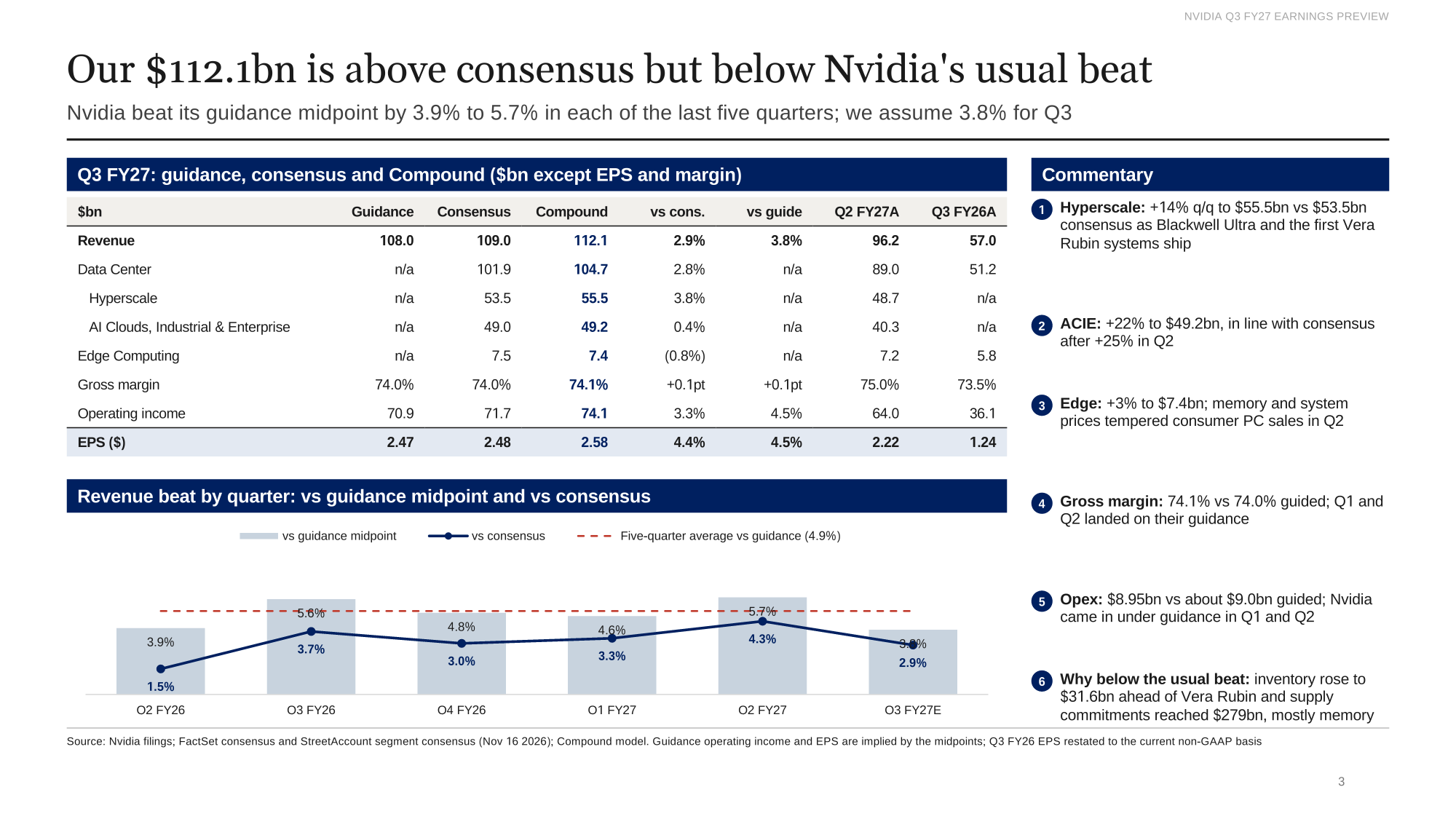
Nvidia beat its guidance midpoint by 3.9% to 5.7% in each of the last five quarters; we assume 3.8%.
How we built the forecast
The model grows each market from its second-quarter level. Hyperscale grows 14% to $55.5 billion, after 13% in Q2. AI Clouds, Industrial & Enterprise (ACIE) grows 22% to $49.2 billion, after 25%. Edge Computing grows 3% to $7.4 billion; Nvidia's Q2 CFO commentary said elevated memory and systems prices tempered consumer PC sales.
Nvidia beat its revenue guidance midpoint by 3.9% to 5.7% in each of the last five quarters, an average of 4.9%. Our 3.8% sits below that range for two reasons in Nvidia's own filings. Inventory rose to $31.6 billion in Q2 "as we prepare for the introduction of Vera Rubin in the third quarter." Supply commitments rose from $119 billion to $279 billion, "primarily related to the procurement of memory." A product transition and tight memory supply both leave less room for upside.
We put gross margin at 74.1%, against guidance of 74.0% plus or minus 50 basis points, and operating expenses at $8.95 billion against guidance of about $9.0 billion. Nvidia came in under its operating expense guidance in both earlier quarters of fiscal 2027. Revenue has beaten consensus in each of the past 20 quarters, StreetAccount reported.
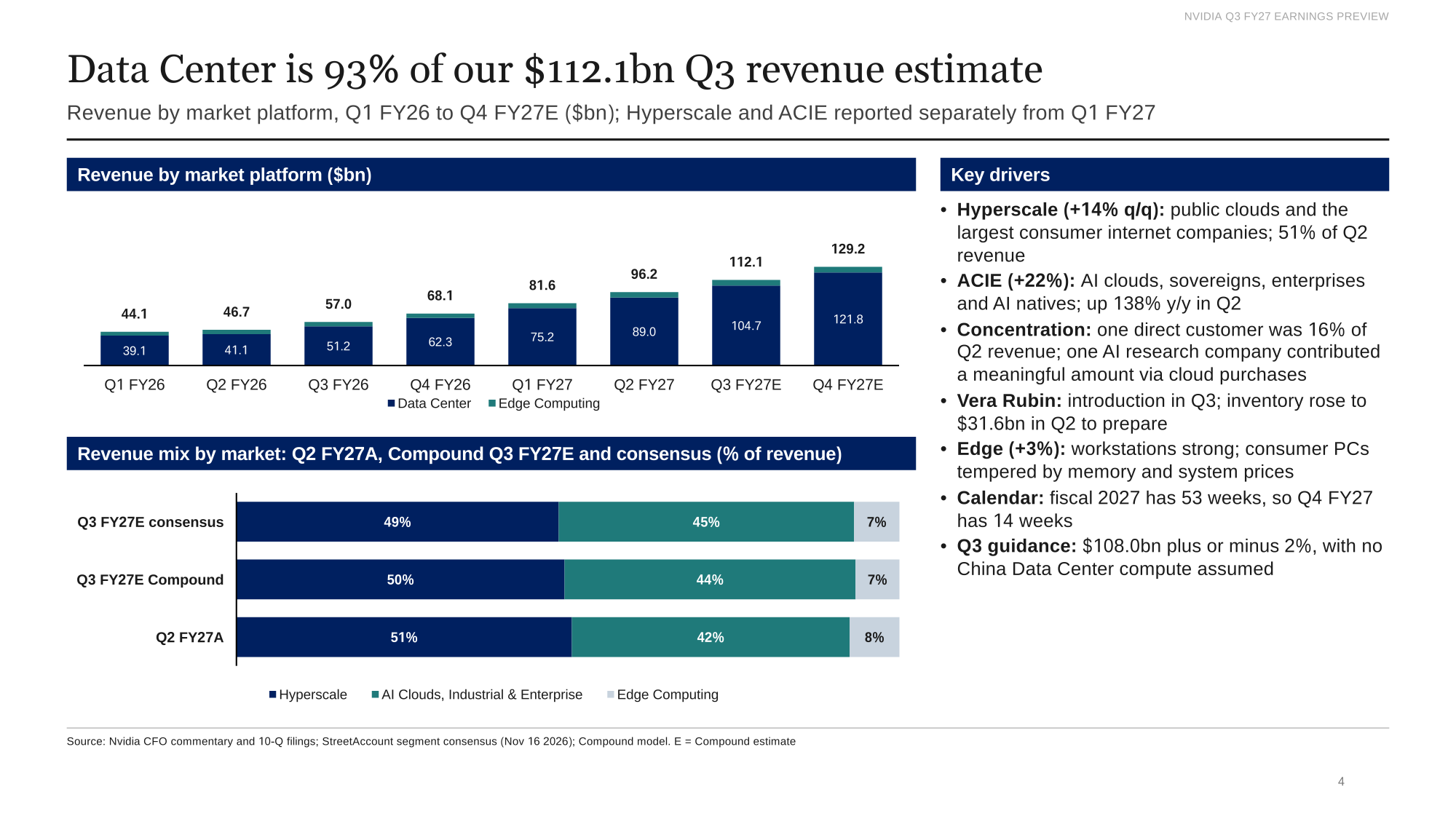
Data Center is 93% of our Q3 estimate; Q4 FY27 has 14 weeks because fiscal 2027 runs 53 weeks.
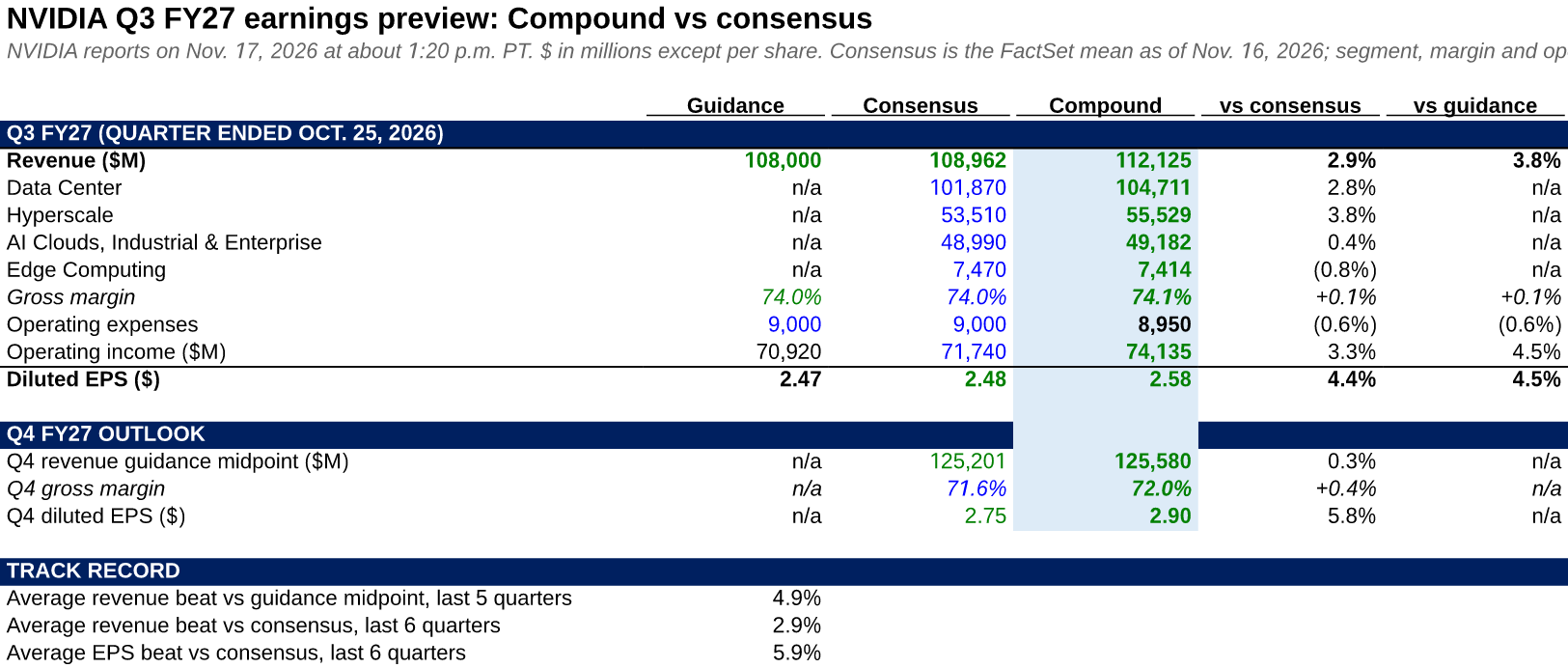
The Preview tab of the Excel model, which links every estimate to its drivers.
Q4 guidance
Consensus for fourth-quarter revenue is $125.2 billion, per FactSet. In the last two quarters Nvidia guided the next quarter 11.5% and 12.2% above the revenue it had just reported. Applying 12% to our Q3 estimate gives a guidance midpoint of about $125.6 billion, in line with consensus. StreetAccount's consensus has Q4 gross margin at 71.6%, against 74.0% guided for Q3.
StreetAccount also noted that management previously guided fiscal 2028 revenue growth of about 70%, against consensus of 68.6%, and that previews expect a reiteration.
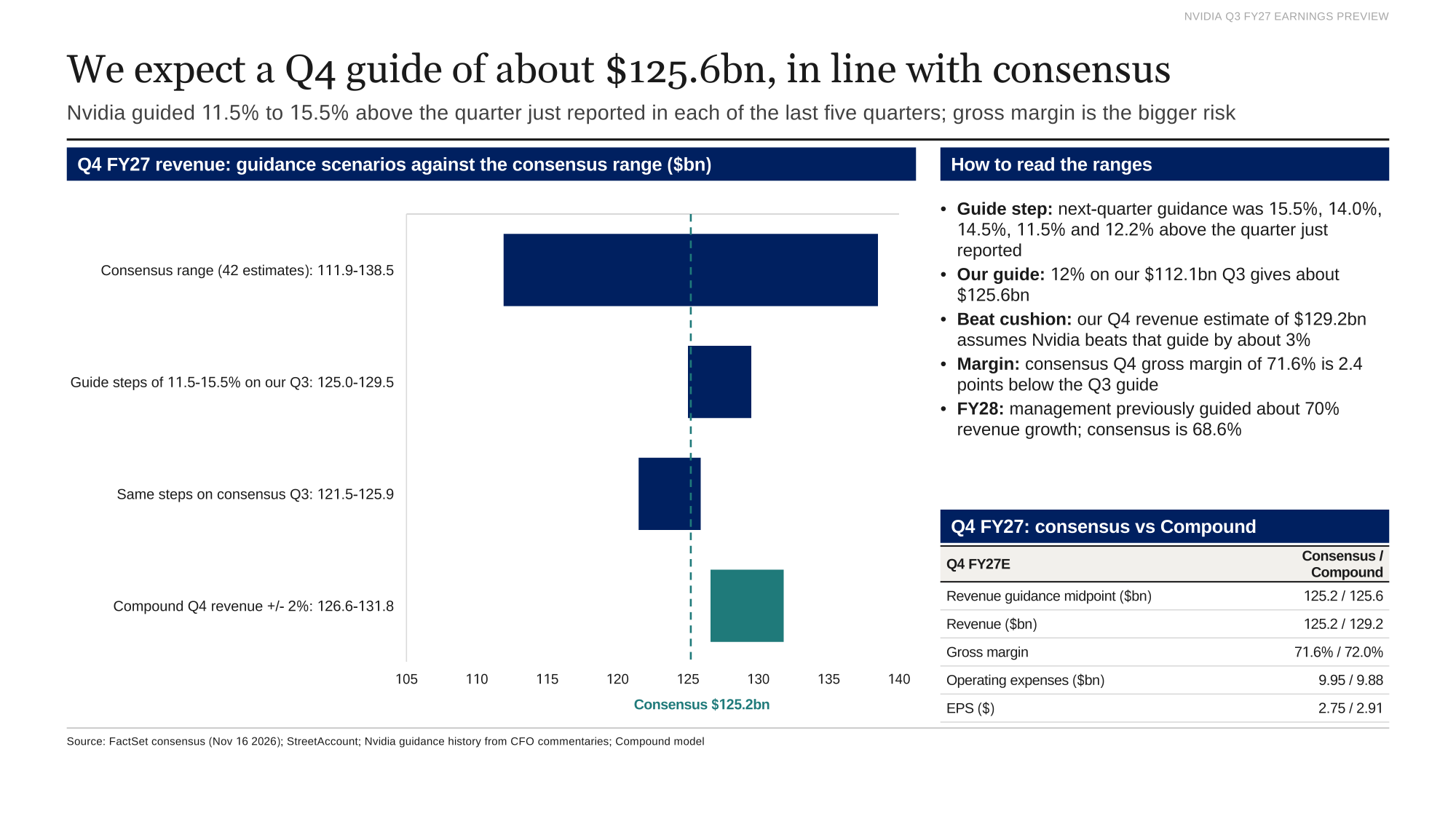
Guidance scenarios against the consensus range for Q4 revenue.
Cash flow
We forecast Q3 cash from operations of $50.3 billion and free cash flow of $47.7 billion, against StreetAccount consensus of $56.1 billion and $53.5 billion. Receivables and inventory absorbed $28.1 billion of cash in Q2, when days sales outstanding rose to 60 from 45 on extended payment terms for large, multi-quarter agreements, Nvidia said. We hold receivables near 58 days and inventory near 120 days.
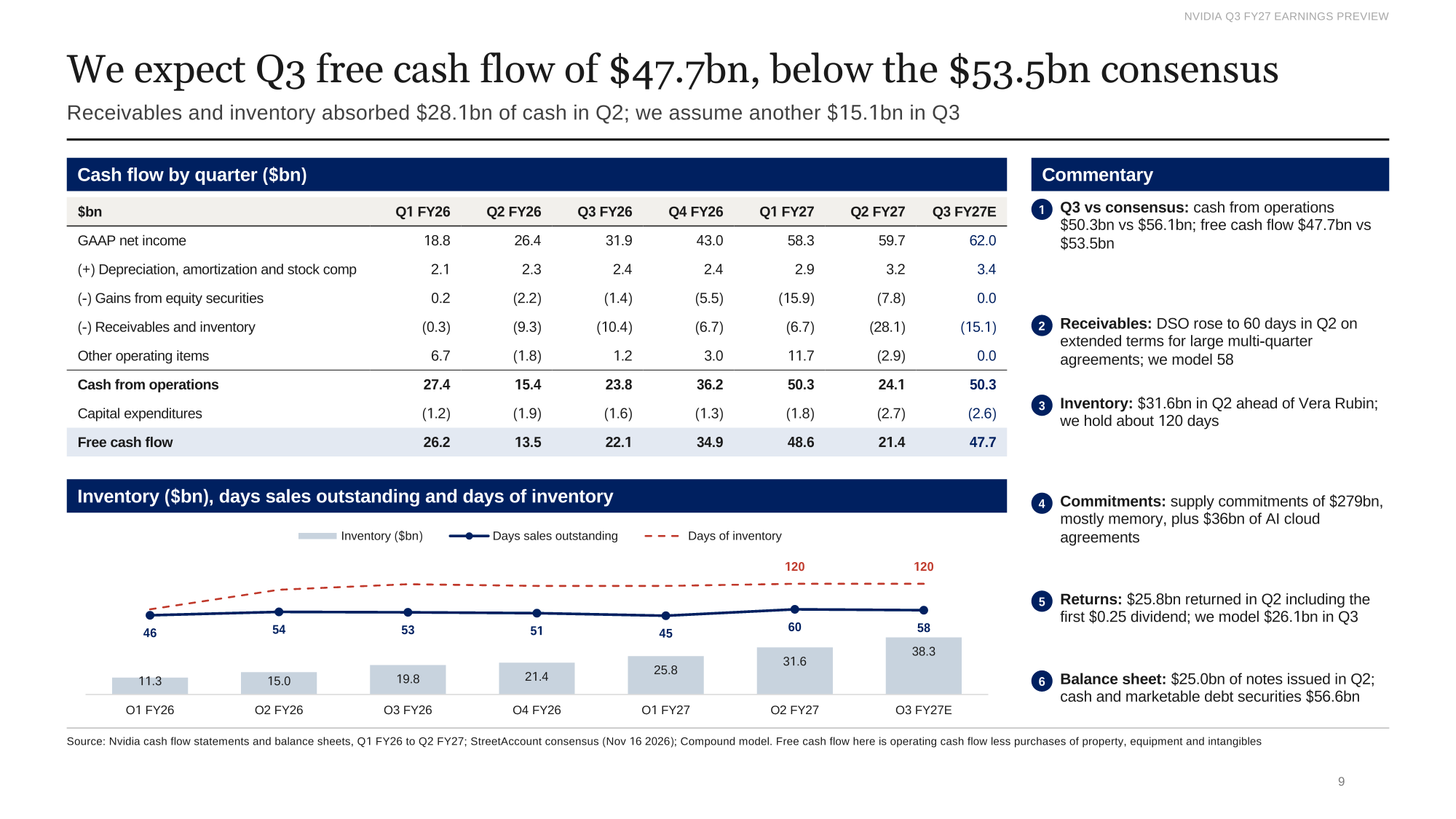
Working capital is why our cash flow sits below consensus.
How much of Nvidia's revenue is China
Nvidia reported $7.88 billion of Q2 revenue from customers headquartered in China, including Hong Kong, 8.2% of the total, according to its Q2 10-Q. That was up from $3.99 billion a year earlier and $4.55 billion in Q1.
Little of it is the data center chips the export rules target. Shipments of Hopper products to China were less than 1% of Data Center revenue in Q2, which caps them at about $0.89 billion, and H200s shipped under US licenses carry a 25% tariff that Nvidia says it has not passed on. Nvidia's Q3 outlook assumes no Data Center compute revenue from China.
The other $7.0 billion is harder to place. Nvidia assigns revenue to the country where the direct customer is headquartered and says "the end customer and shipping location may be different." The 10-Q also says a substantial portion of its products are warehoused in and distributed from Hong Kong, so gaming and workstation cards sold through Hong Kong distributors count as China wherever they end up.
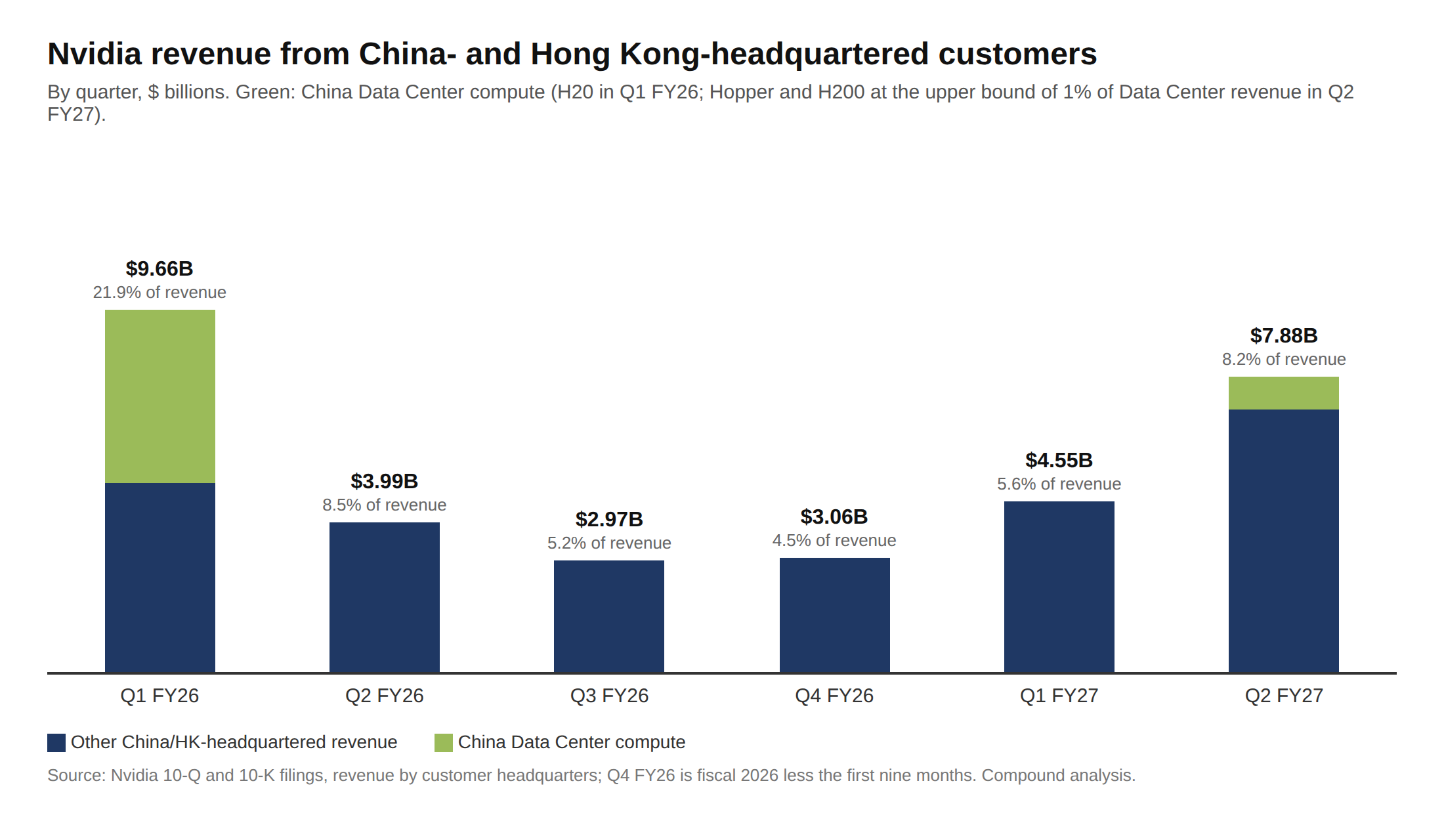
In Q1 of fiscal 2026, China-headquartered customers were 21.9% of revenue, including $4.6 billion of H20 sales, according to Nvidia's Q1 FY26 CFO commentary, before the US required licenses for the chip.
What to strip out of the recurring base
Nvidia has little contracted recurring revenue. Remaining performance obligations on contracts longer than one year were $3.2 billion at the end of Q2, about 3% of one quarter's revenue. The repeat business is hardware bought again each quarter by the same customers, so the useful question is which revenue could stop for reasons other than demand. We built three tiers from Q2 revenue of $96.2 billion:
- Guidance basis, $95.3 billion (99.1%): removes China Data Center compute at its 1% ceiling. Nvidia already guides this way.
- Excluding China-headquartered customers, $88.3 billion (91.8%): also removes the other $7.0 billion from China and Hong Kong. Annualized, that is $353 billion, our preferred run rate.
- Southeast Asia stress case, $85.2 billion (88.5%): also removes $3.1 billion of possible Southeast Asian exposure, in three parts we size with assumptions: half of the $1.28 billion from customers headquartered outside the US, Taiwan and China; 20% of the Taiwan-headquartered revenue that does not go to US or European end customers (Nvidia estimated 76% did in fiscal 2026, per its 10-K); and 2% of the $60.1 billion from US-headquartered customers, for US clouds and server makers that serve Chinese users from the region.
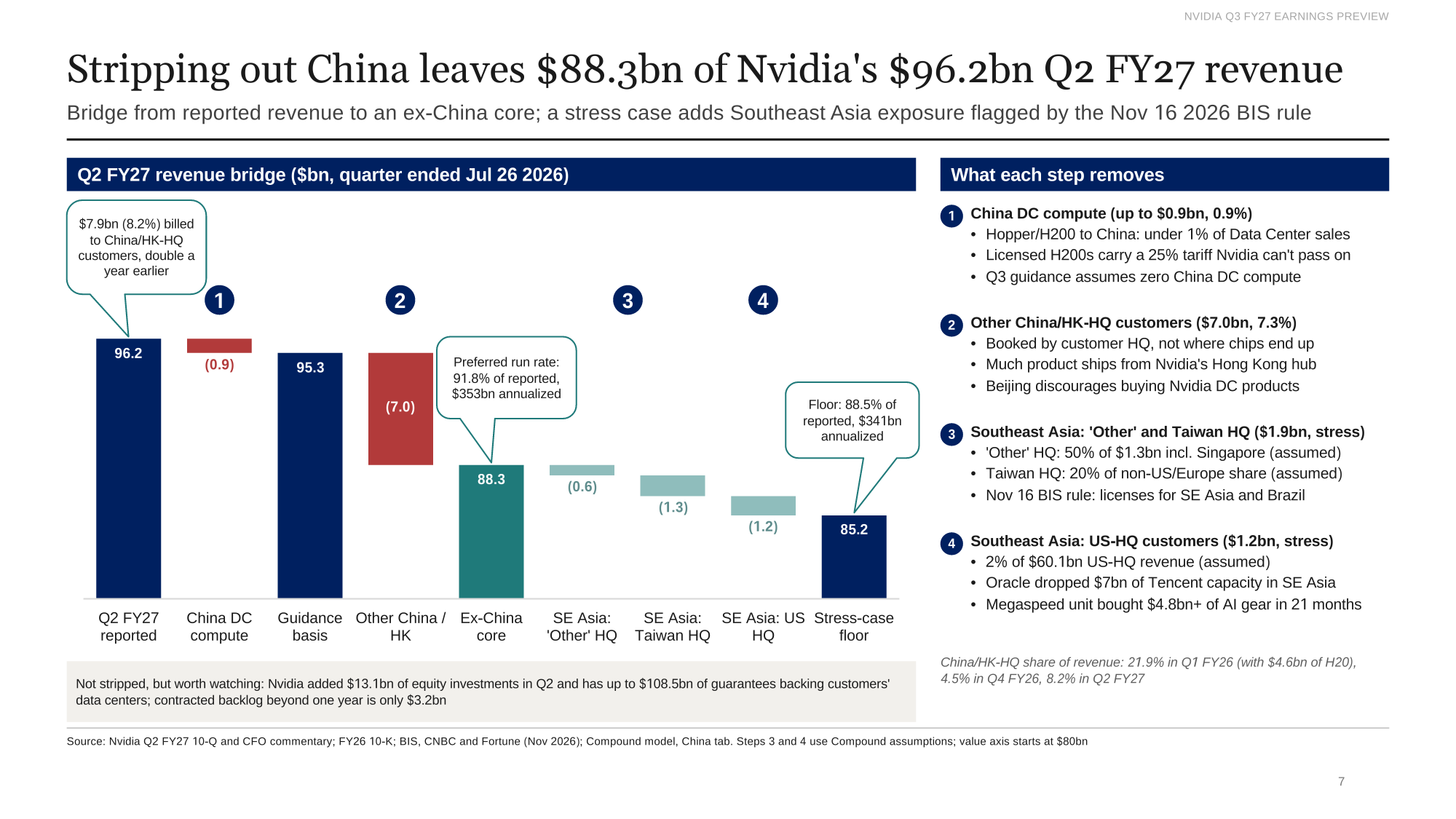
The China bridge, also available as a one-page PDF below.
Southeast Asia is hard to see in Nvidia's disclosure. A Singapore-headquartered buyer such as Megaspeed would sit in the 'Other' region, which totaled only $1.28 billion in Q2. Systems bought through Taiwanese server makers or US companies land in those lines instead. CNBC, citing New York Times trade records, reported that Megaspeed's Malaysian unit Speedmatrix bought at least $4.8 billion of AI equipment, including systems with Nvidia chips, between June 2024 and February 2026, roughly $0.7 billion a quarter. Fortune, citing the FT, reported that Oracle canceled a $7 billion deal to give Tencent access to 100,000 AI chips in Southeast Asian data centers.
The Bureau of Industry and Security said on Nov. 16 that its interim final rule ensures restrictions "cannot be circumvented through remote computing arrangements involving data centers in third countries." CNBC reported that the rule requires a license to export advanced semiconductors to Indonesia, Malaysia, Singapore, Thailand and Brazil.
One more item is a flag rather than a deduction. Nvidia added $13.1 billion of non-marketable equity investments in Q2, equal to 32.5% of ACIE revenue that quarter, and its guarantees carry a maximum exposure of $108.5 billion, $105 billion of it for an SB Energy campus in Ohio that will host OpenAI. Nvidia's Q2 commentary says it has entered into arrangements that help select customers secure land, power and data center capacity. StreetAccount, citing reports, said Kress had questioned some of those deals.
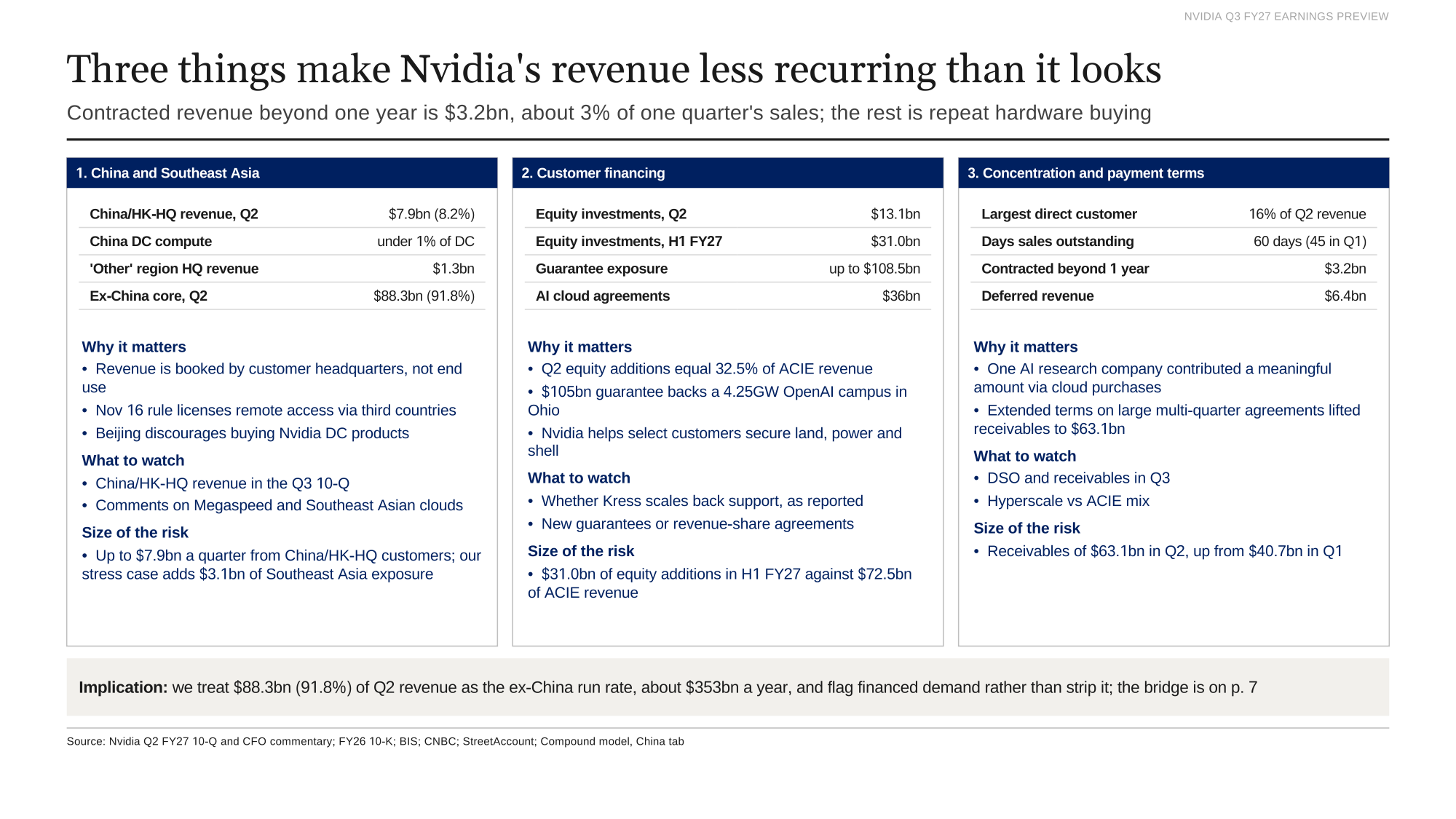
Three things that make Nvidia's revenue less recurring than it looks.
What to watch on Tuesday
- Q4 revenue guidance against the $125.2 billion consensus and our $125.6 billion.
- Q4 gross margin guidance against 71.6% consensus.
- China-headquartered revenue in the Q3 10-Q, which Nvidia filed on the day of the release in each of the last two quarters.
- Any comment on the Nov. 16 remote-access rule and on Megaspeed.
- Whether Kress repeats the fiscal 2028 revenue growth target of about 70%.
- New equity commitments and guarantees for customers.
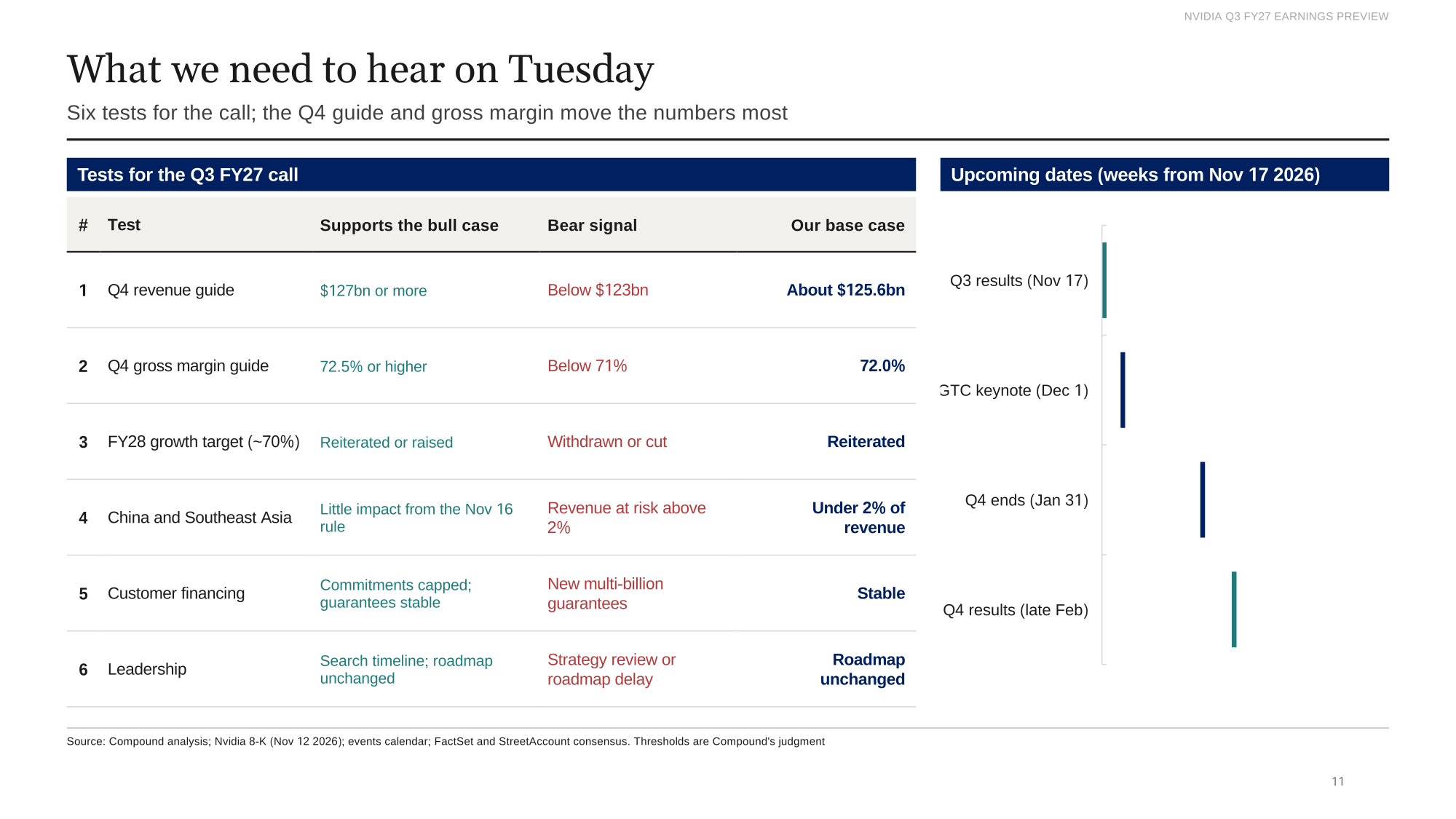
Six tests for the call, with what would support the bull and bear cases.
We will score this forecast against the reported numbers after the release.
 Nvidia Q3 FY27 earnings preview deck (PowerPoint)The 11-page preview: executive summary, forecast against consensus, revenue build, margins, Q4 guidance scenarios, the China bridge, the share price since October, cash flow, revenue quality and the checklist for the call, with editable charts and tables.Download · Free
 Nvidia Q3 FY27 earnings model (Excel)Quarterly model from Q1 FY26: segment build, non-GAAP and GAAP income statements, cash flow, balance sheet and working capital, Compound's Q3 and Q4 estimates against guidance and consensus, sensitivity tables, and the China and recurring revenue analysis, with formulas and sources.Download · Free
 Nvidia Q2 FY27 China revenue bridge (PDF one-pager)Reported revenue to an ex-China core and a Southeast Asia stress case, with commentary on each step and sources.Download · Free
More from Compound News

Finance AI Vendors Hold 18% of the Seat Market and 0.3% of Finance Payrolls
Finance AI vendors book about $9.9 billion a year: roughly 18% of a $54 billion seat-based market, but 0.3% of the $3.4 trillion finance pays its workers. Our BLS and BEA-based model puts the middle case at $143 billion, 6.9% penetrated.
Read article →
Legal AI has sold 10% to 13% of its seat market. Legal spend is $1.1 trillion
Legal AI vendors run at about $1.67 billion a year, 13% of a $12.6 billion seat-based market and 10% of a labor-value build. Against the $1.13 trillion spent on legal work outside China, it is 0.15%.
Read article →
OpenAI breaks up its robotics team for the second time, betting GPT-6 Astra can run robots
OpenAI moved its robotics researchers under research chief Mark Chen and its robot hardware staff under president Greg Brockman, Fortune reported Nov. 13. It is the company's second robotics breakup since 2020. OpenAI says robotics work continues and a humanoid demo is still targeted for 2027.
Read article →