NVIDIA has $304 billion of commitments due by January 2028. Can it pay?
NVIDIA's supply and capacity commitments reached $390 billion on Oct. 25, and $304 billion of its $518 billion in future commitments falls due by January 2028. Against FactSet consensus cash flow it can pay, but the January quarter is tight once buybacks are counted. We map who gets paid and the schedule Jensen Huang reportedly called an “avalanche.”

NVIDIA's supply and capacity commitments reached $390 billion on Oct. 25, up from $279 billion in July, mostly for multi-year memory, the company said in its Nov. 17 CFO commentary. Counting cloud contracts, data center leases, equity investments and capital spending, NVIDIA has $518 billion of future commitments. $82 billion is due in the 14 weeks to Jan. 31, 2027, and another $222 billion in fiscal 2028, which ends in January 2028.
In August, Jensen Huang told his finance team that the chip wafers and memory NVIDIA had committed to buy were coming at him like an “avalanche,” The Wall Street Journal reported, as quoted by Computing. Huang resigned Nov. 12. CFO Colette Kress is interim CEO, and the board said on the Nov. 17 earnings call that it does not intend to reinstate him.
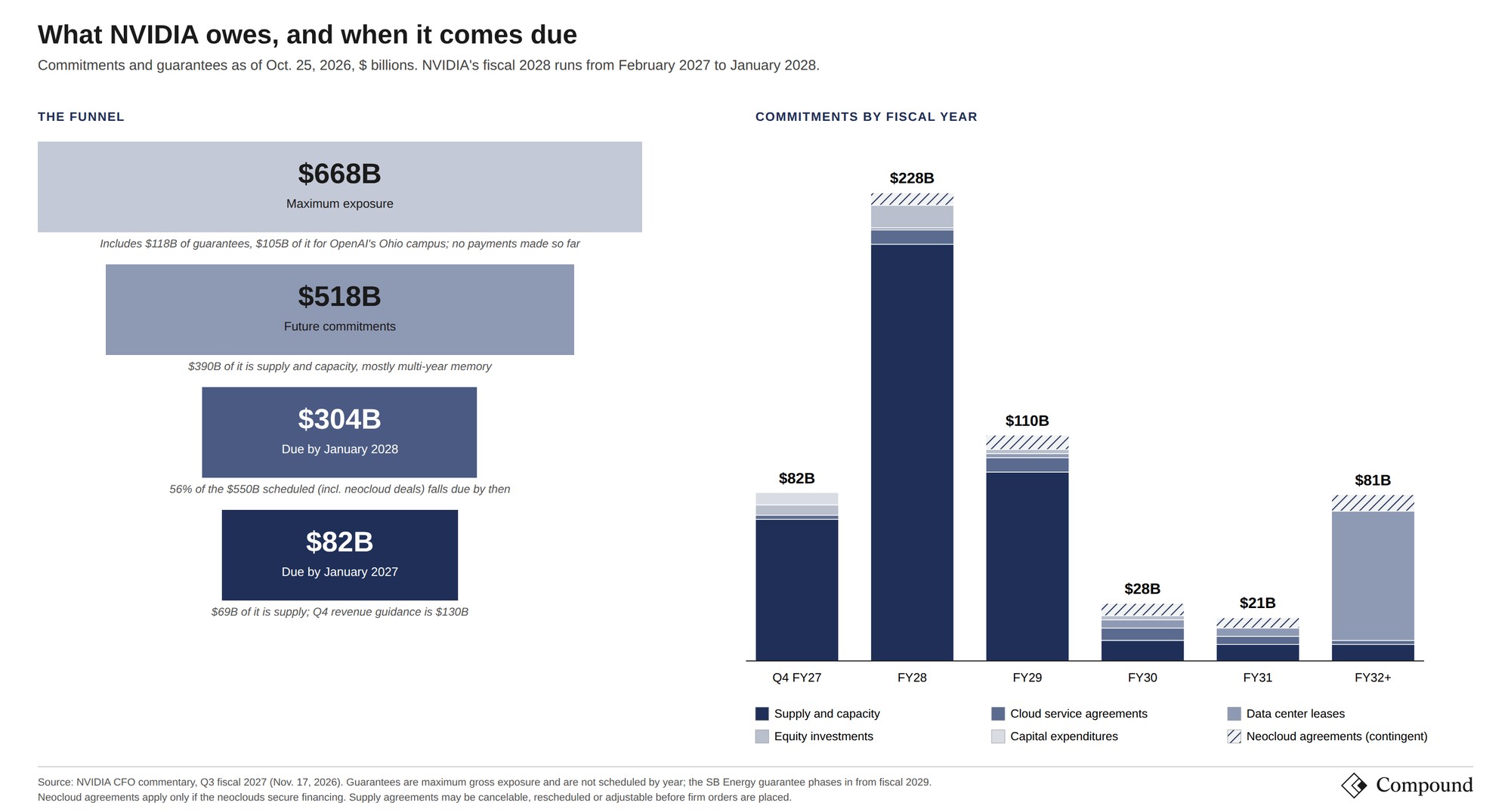
The payment schedule
The table below is NVIDIA's own schedule, in $ billions. Fiscal 2028 runs from February 2027 to January 2028.
| Fiscal year | Supply and capacity | Cloud, leases, equity, capex | Total commitments | Neocloud agreements (contingent) |
|---|---|---|---|---|
| Q4 FY27 (to Jan. 31, 2027) | 69 | 13 | 82 | 0 |
| FY28 | 203 | 19 | 222 | 6 |
| FY29 | 92 | 11 | 103 | 7 |
| FY30 | 10 | 12 | 22 | 6 |
| FY31 | 8 | 8 | 16 | 5 |
| FY32 and later | 8 | 65 | 73 | 8 |
| Total | 390 | 128 | 518 | 32 |
The fiscal 2028 supply line more than doubled in one quarter, from $87 billion in the July 10-Q to $203 billion. Of the $550 billion scheduled, including the contingent neocloud deals, 56% falls due by January 2028. The schedule leaves out $118 billion of guarantees. Up to $105 billion of that backs SB Energy's Ohio campus, which is leased to OpenAI, and its first phase takes effect in fiscal 2029. NVIDIA says it has made no payments under its guarantees.
Not every dollar is firm. NVIDIA says some supply agreements “may be cancelable, rescheduled, or adjustable” before it places firm orders. For scale, Q4 revenue guidance is $130 billion, plus or minus 3%. NVIDIA had $53.5 billion of cash and marketable securities on Oct. 25, and Q3 free cash flow was $43.8 billion.
Can NVIDIA pay it?
Against consensus, yes, with one tight quarter. Analysts expect $58.7 billion of free cash flow in the January quarter and $334.9 billion in fiscal 2028, according to the FactSet mean as of Nov. 18. Free cash flow is already net of what NVIDIA pays suppliers for the chips it sells. So the test is whether the commitments run ahead of what consensus sales will use.
Next quarter, they do. The $69 billion of supply commitments due by Jan. 31 is about 1.9 times the roughly $36 billion cost of goods implied by consensus sales of $126 billion at NVIDIA's guided 71% to 72% gross margin. In fiscal 2028, $203 billion is 1.06 times the roughly $191 billion implied. We treat the excess as cash tied up in inventory and prepayments and subtract the equity, cloud, lease and neocloud commitments. On that basis, free cash flow after commitments is about $19 billion in the January quarter and $298 billion in fiscal 2028.
Buybacks decide how tight it gets. NVIDIA plans to use its remaining $227.3 billion repurchase authorization through fiscal 2028. Spread evenly over five quarters, buybacks would cut cash and securities from $53.5 billion to about $27 billion by Jan. 31, before they rebuild to $143 billion by January 2028. The $118 billion of guarantees is left out of that path because they phase in from fiscal 2029, when consensus free cash flow is $487.5 billion. If every one of them were called in the January quarter, the position would fall to about -$91 billion.
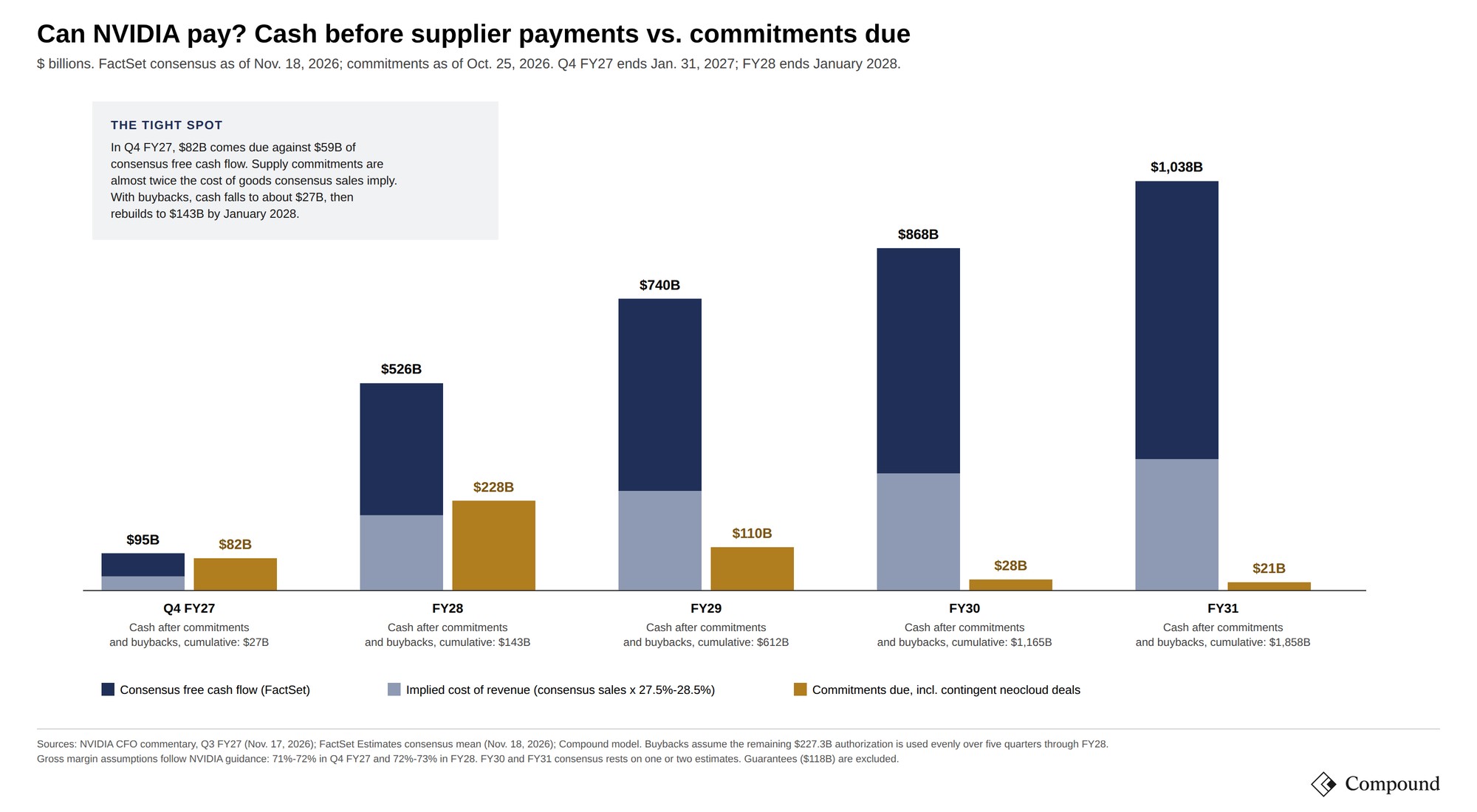
The cushion depends on consensus holding. In our model, a 30% shortfall against fiscal 2028 consensus revenue and free cash flow, with the full buyback, leaves NVIDIA about $43 billion short by January 2028. Without buybacks it would still hold about $184 billion. Compound's own Q4 FY27 model has revenue of $129.2 billion and free cash flow of $65.7 billion, above consensus. Consensus for fiscal 2030 and 2031 rests on one or two estimates.
Who gets paid
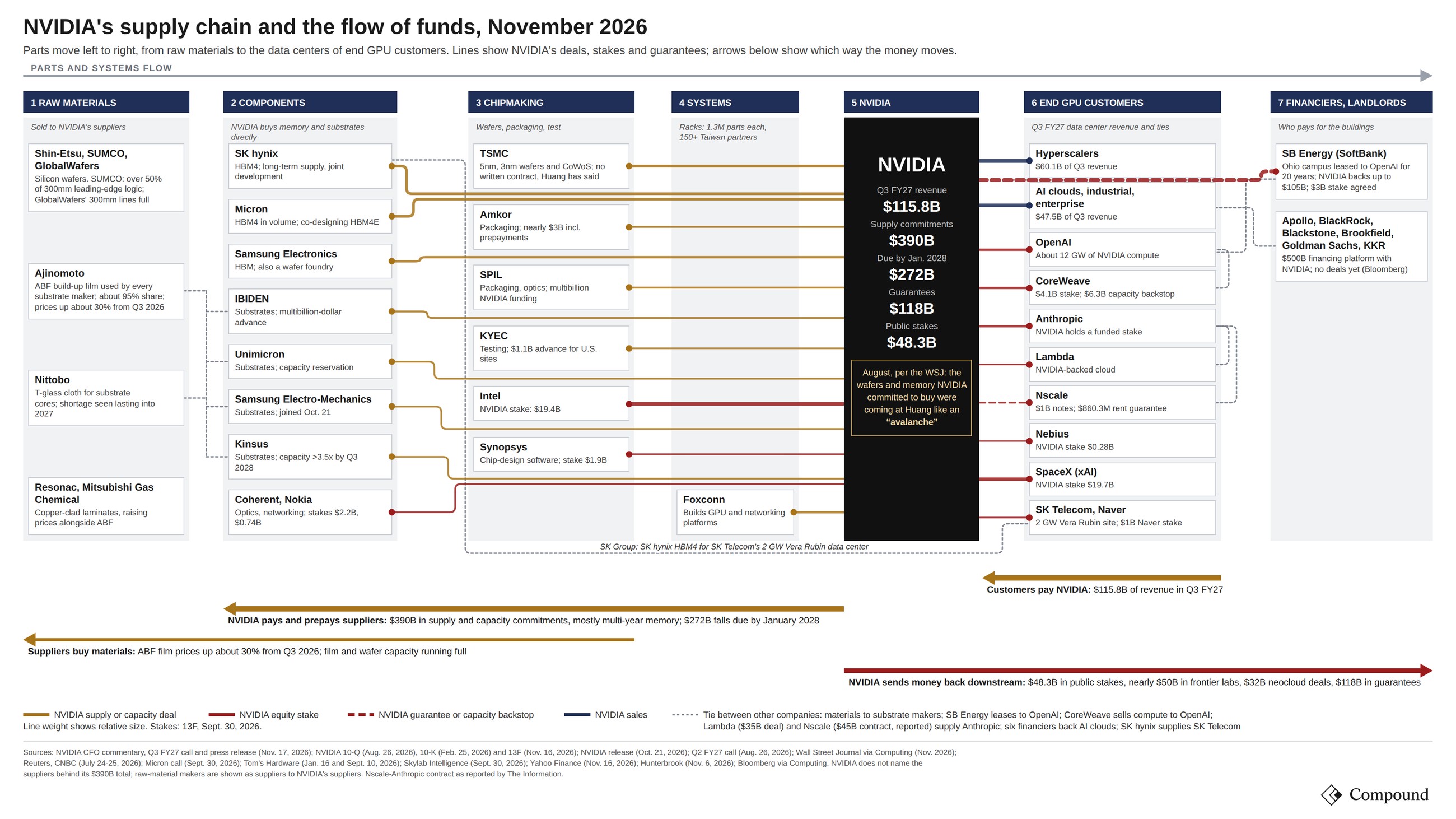
NVIDIA does not name the companies behind the $390 billion. Its 10-K names TSMC and Samsung as wafer foundries and SK hynix, Micron and Samsung as memory suppliers. Since July, it has disclosed these deals:
- Memory: a long-term HBM supply and co-development partnership with SK hynix, part of a $500 billion-plus SK Group initiative announced July 24. On Sept. 30 Micron said it is co-designing HBM4E with NVIDIA and has sold most of its 2027 HBM supply at higher prices.
- Substrates: a multibillion-dollar capacity advance to IBIDEN, a capacity reservation with Unimicron, and deals with Samsung Electro-Mechanics and Kinsus, announced Oct. 21 and Nov. 17.
- Packaging and test: nearly $3 billion of Amkor agreements including prepayments, multibillion-dollar funding for SPIL, and a $1.1 billion advance to KYEC for U.S. test sites.
- Wafers: Vera Rubin uses TSMC's 5nm, 3nm and CoWoS technologies. Huang has said NVIDIA never signed a contract with TSMC.
- Raw materials: every substrate maker uses build-up film from Ajinomoto, which has a reported 95% share and raised prices about 30% from the third quarter.
The “avalanche” meeting
The Journal reported that Huang called the August meeting because NVIDIA was in talks to guarantee billions of dollars for companies that could not afford its chips. At the meeting he said major cloud providers were moving to alternative chips, and he called Kress “a deer in the headlights.” According to Computing's account, Kress later cut NVIDIA's proposed OpenAI backstop from up to $250 billion for 8 GW to about $125 billion for 4.25 GW. NVIDIA's filing caps that guarantee at $105 billion.
In public, Huang said the opposite about memory. On Oct. 22 he told CNBC he does not expect an oversupply of memory by 2029: “You can always use more of it.” The supply commitments then rose another $111 billion in the quarter ended Oct. 25.
The memory makers have tightened their terms. Samsung said in July that prepayments are “a substantial part” of its long-term contracts. SK hynix says its DRAM and HBM capacity through 2029 is effectively sold out, Korea JoongAng Daily reported. Taiwan's Commercial Times reported Nov. 10 that NVIDIA wants to slow its chip orders (unconfirmed); a second Commercial Times article the same day said orders and capacity were unchanged.
Money that flows back to customers
NVIDIA's public stakes were worth $48.3 billion at Sept. 30, led by SpaceX at $19.7 billion and Intel at $19.4 billion. It has invested nearly $50 billion in frontier AI labs. OpenAI's existing and planned commitments add up to about 12 GW of NVIDIA compute. NVIDIA has also signed a $6.3 billion order to buy CoreWeave's unsold capacity through April 2032, Hunterbrook found. Bloomberg reported that the $500 billion financing platform NVIDIA set up with six asset managers in August has not produced any deals.
The model
Our model has two tabs. The Schedule tab lays out NVIDIA's commitments by fiscal year, the contingent neocloud deals, the guarantees and the funnel above. The Coverage tab tests the commitments against FactSet consensus revenue and free cash flow and against Compound's own Q4 model. Its sensitivity table covers revenue shortfalls and the pace of buybacks. Inputs are linked to their sources; yellow cells are our assumptions.
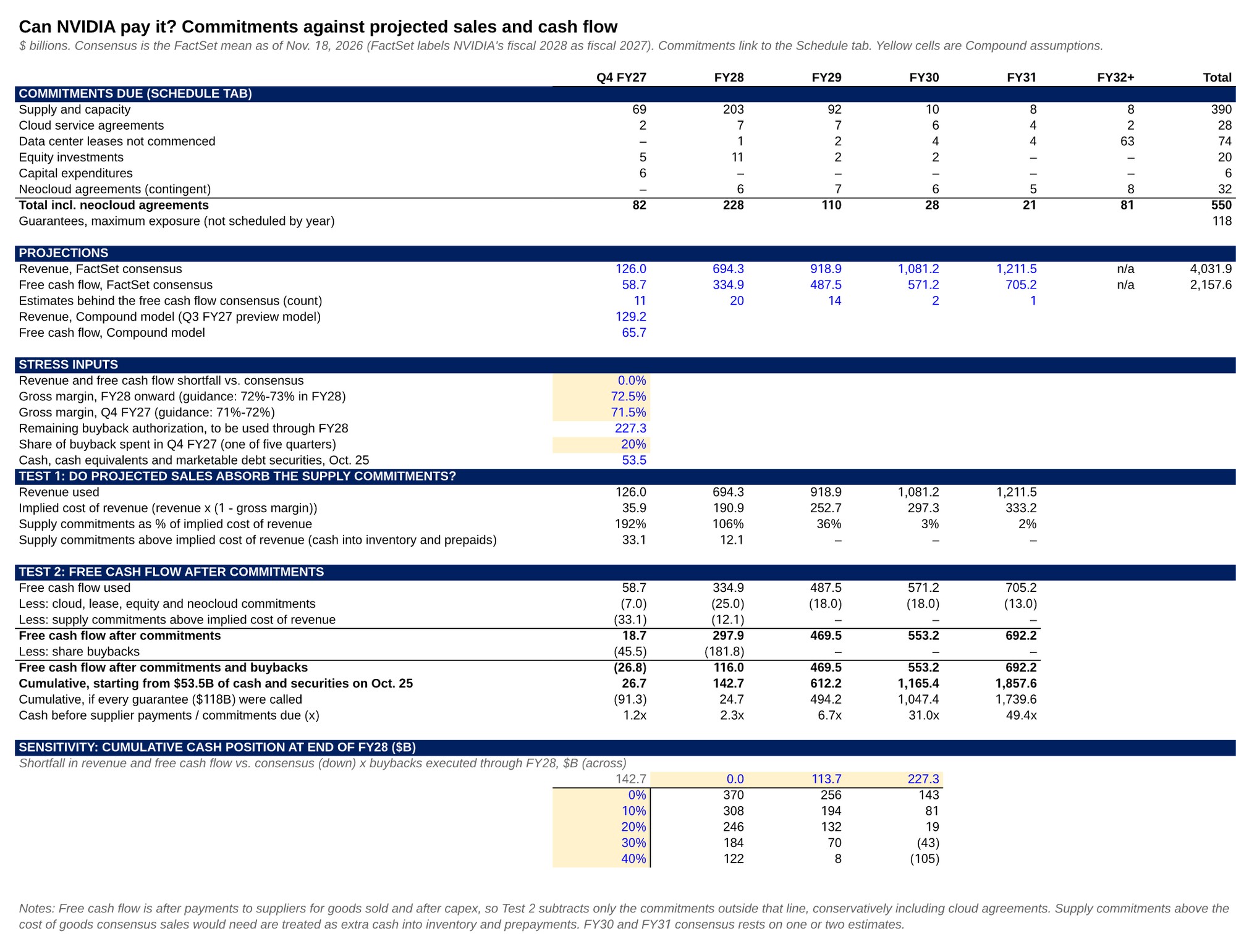
 NVIDIA commitments schedule (Excel)Two tabs: commitments by fiscal year and the payment funnel; and coverage against FactSet consensus cash flow, with a buyback and shortfall sensitivity table.Download · Free
What to watch
- Coming weeks: NVIDIA's Q3 10-Q, with the full commitments note.
- Consensus revisions: the FactSet free cash flow mean for fiscal 2028 was $334.9 billion on Nov. 18. A cut of 30% or more would leave NVIDIA short by January 2028 if it completes its buyback.
- Nov. 2026 to Jan. 31, 2027: $82 billion of commitments fall due, $69 billion of it supply. NVIDIA guides gross margin to 71% to 72%.
- February to April 2027: expanded Singapore testing starts high-volume production in February, and KYEC's U.S. test sites follow in April.
- Fiscal 2028 (February 2027 to January 2028): $222 billion of commitments fall due, $203 billion of it supply.
- Fiscal 2029: the first phase of the SB Energy guarantee takes effect.
- CEO search: the board has hired Heidrick & Struggles to find a permanent CEO.
More from Compound News
Compound forecasts Nvidia Q3 revenue of $112.1 billion, above the $109.0 billion consensus
Nvidia reports Tuesday, its first quarter since Jensen Huang resigned. Our model puts EPS at $2.58 against $2.48.
Read article →
Jensen Huang Moved 58.96 Million Nvidia Shares Into a Family Trust in March. The Date Was Set in 2016
Huang's March 20 Form 4 shows 58,962,602 Nvidia shares, worth $10.64 billion, passed from two 2016 annuity trusts into a family remainder trust on March 18, when the trusts' 10-year terms ended, 238 days before he resigned.
Read article →
Marvell Q3 Earnings Preview: $1.11 EPS vs $1.10 Consensus
Marvell reports Dec. 1. We expect a Q4 revenue guide of about $3.75 billion; the stock is down 40.9% since Oct. 28.
Read article →