The French fabric that limits how fast the US can build Patriot missiles
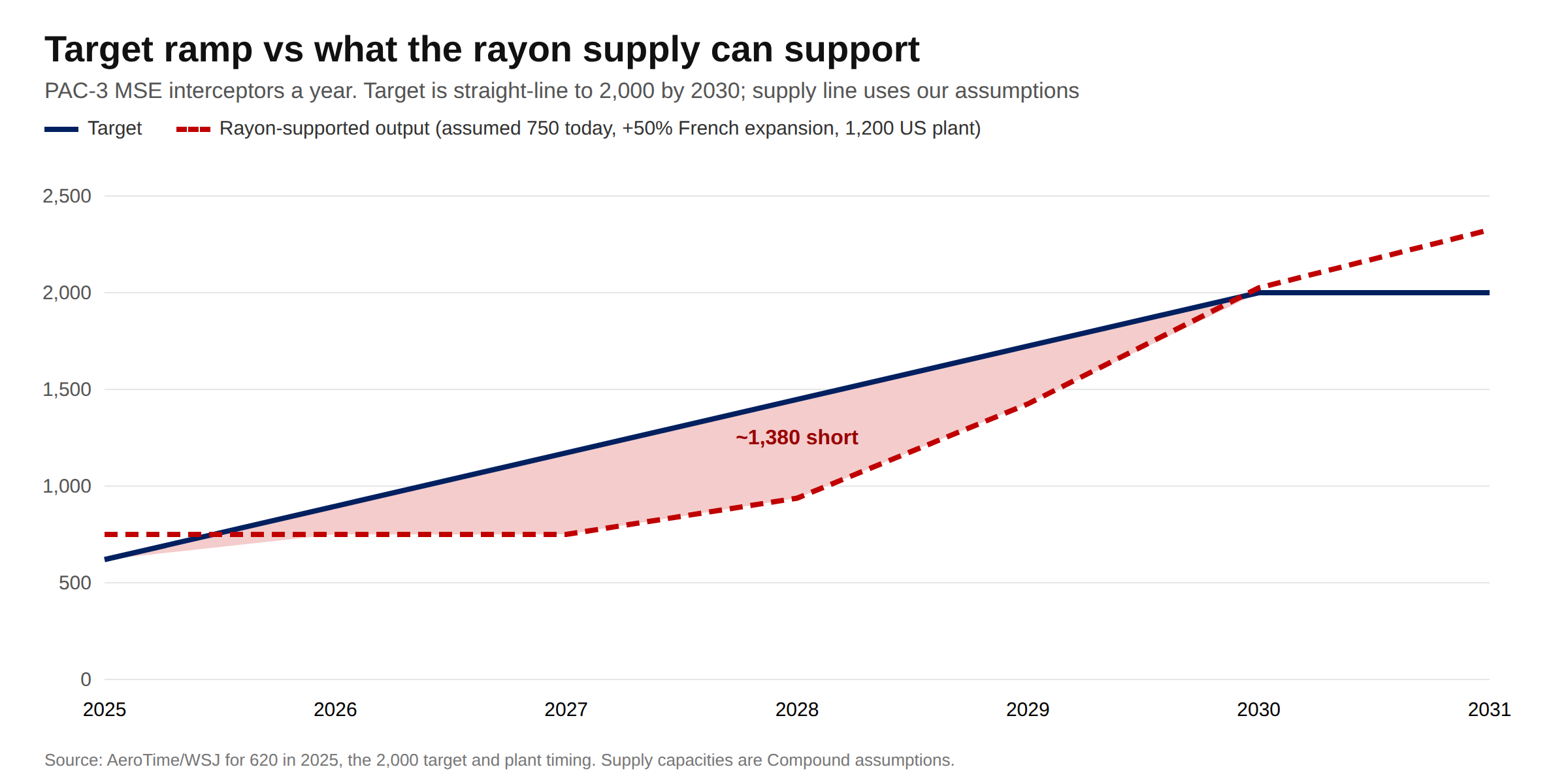
Every PAC-3 MSE rocket motor needs Raycarb, a carbonized rayon made only by ArianeGroup and processed only by Park Aerospace. New supply lands in 2028 and 2030, late in the ramp to 2,000 a year. Our model puts the shortfall near 1,380 missiles if today's supply supports 750 a year.
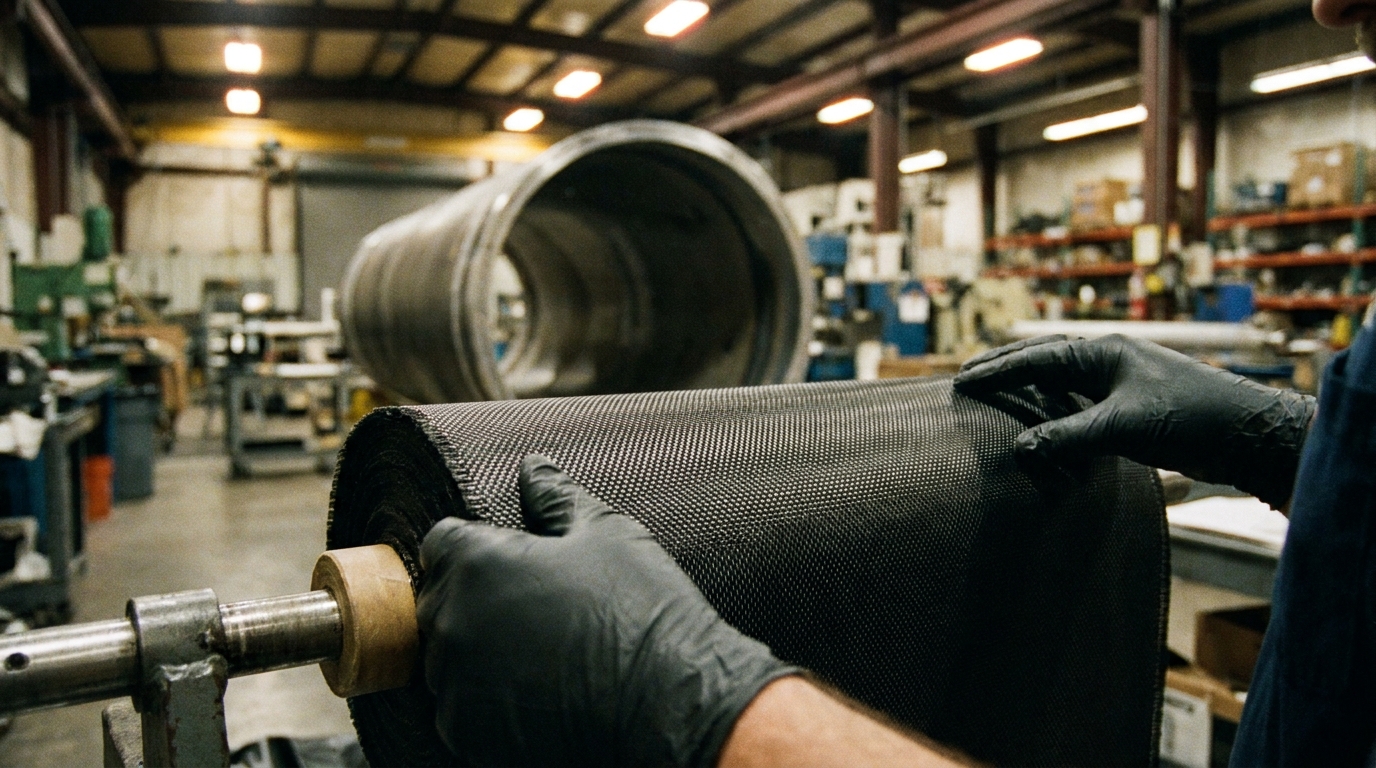
We mapped this supply chain and built the capacity model in Compound. Swap in your own assumptions to stress-test any defense ramp. Try Compound free, no credit card needed.
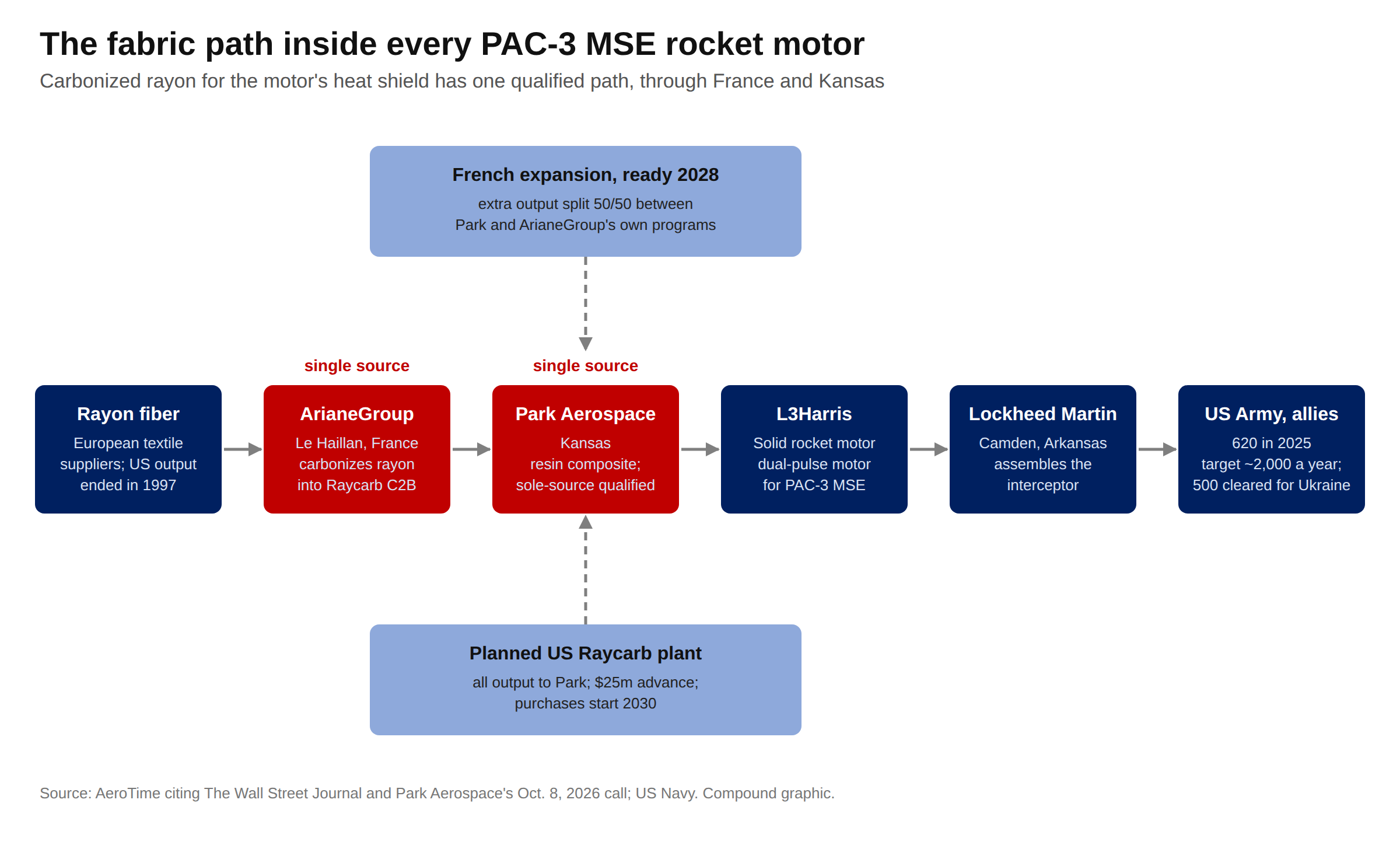
The Pentagon wants about 2,000 PAC-3 MSE interceptors a year, up from 620 delivered in 2025, and every one needs a French-made carbonized rayon fabric that has a single qualified path into the rocket motor, AeroTime reported on Wednesday, citing an investigation by The Wall Street Journal.
The fabric, Raycarb C2B, is made by ArianeGroup near Bordeaux and processed by Kansas-based Park Aerospace into a heat-resistant composite for the motor. Park CEO Brian Shore told investors on Oct. 8 that Park is sole-source qualified on the PAC-3 MSE solid rocket motor for that material, and that the French expansion alone cannot support 2,000 missiles a year.
Timing problem
The two fixes arrive late in the ramp. ArianeGroup's French expansion is due in 2028, and its extra output is split equally between Park and ArianeGroup's own programs. Park's planned US plant would reserve all output for Park, with its $25 million advance deducted from fabric purchases starting in 2030, the same year the Army wants to reach the tripled rate. ArianeGroup agreed to pull that schedule forward six months.
US rayon fiber production stopped in 1997, the Navy has said, and domestic replacements funded in 2025 still need to be qualified, which can take years.
Shortfall model
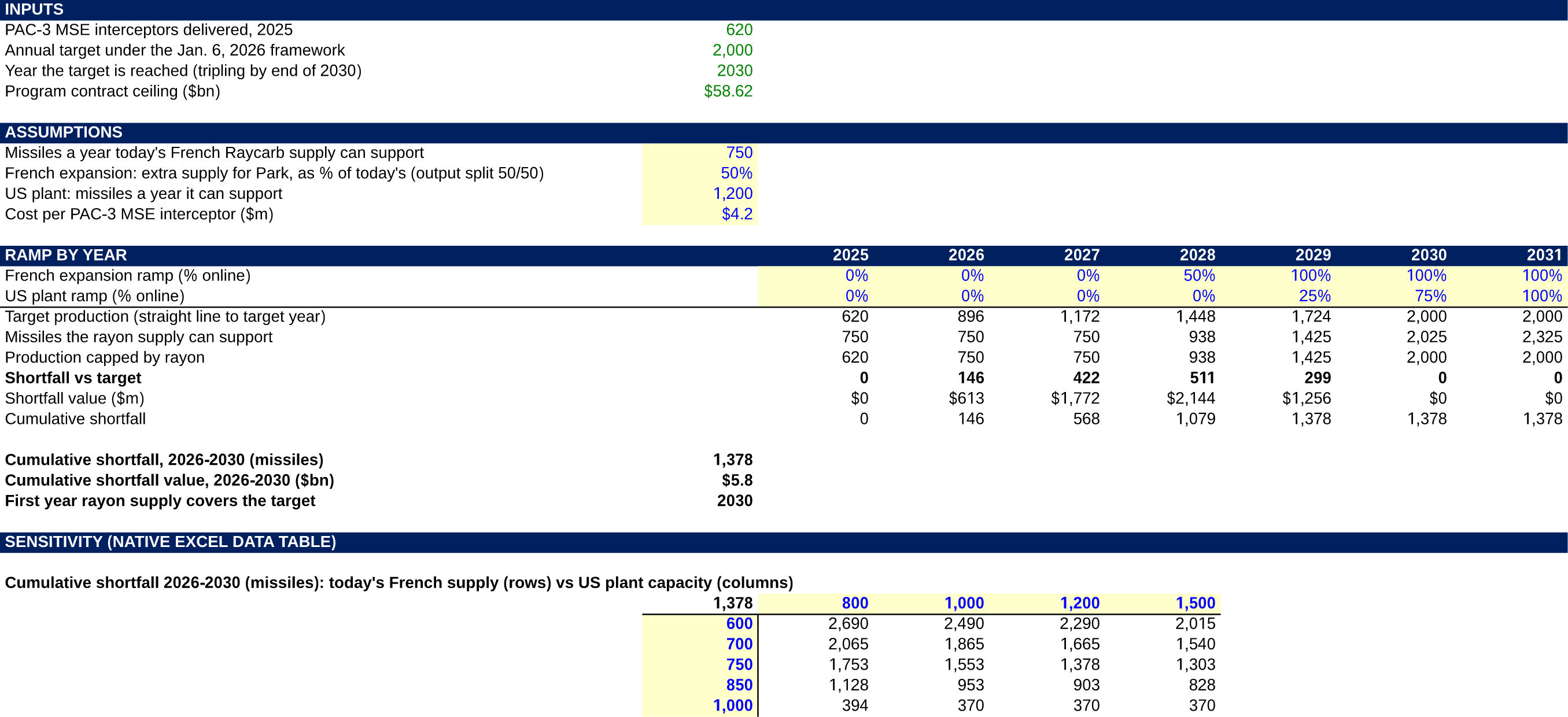
How many missiles the current fabric supply can support is not public, so we made it an input. If today's Raycarb supports about 750 missiles a year, the French expansion adds 50% for Park and the US plant supports 1,200, our model puts output about 1,380 interceptors below a straight-line path to 2,000 over 2026 to 2029. At an assumed $4.2 million each, that is about $5.8 billion of deliveries pushed back.
The gap closes in 2030 in every case we ran. Its size depends mostly on today's supply: at 600 missiles a year the cumulative gap is 2,290; at 1,000 it is 370. Supply covers the target only when the US plant ramps, which matches Shore's view that European supply plus the US plant can support 2,000 a year.
Demand is not waiting. The Center for Strategic and International Studies estimated on Nov. 10 that the US fired about two-thirds of its prewar Patriot interceptors against Iranian ballistic missiles, and the State Department cleared a possible sale of 500 PAC-3 MSEs to Ukraine in October. The Army's July contract modification lifted the program's ceiling to $58.62 billion.
Download the model
 PAC-3 MSE rayon capacity model (Excel)Target ramp against rayon-supported output by year, with the shortfall in missiles and dollars, editable supply assumptions and a native Excel data table.Download · Free
What to watch
- By Dec. 31: whether Park and ArianeGroup finalize the US plant agreement, as they expected on Oct. 8.
- Park Aerospace's next earnings call, for any update on Raycarb volumes.
- 2028: the French expansion start, the first new fabric on the program.
More from Compound News

NVIDIA has $304 billion of commitments due by January 2028. Can it pay?
NVIDIA's supply and capacity commitments reached $390 billion on Oct. 25, and $304 billion of its $518 billion in future commitments falls due by January 2028. Against FactSet consensus cash flow it can pay, but the January quarter is tight once buybacks are counted. We map who gets paid and the schedule Jensen Huang reportedly called an “avalanche.”
Read article →
Tankers burn in Hormuz again. What oil could cost if the strait shuts
Iranian state media reported three tankers on fire in the eastern Strait of Hormuz on Wednesday (unconfirmed), and the Houthis claimed strikes on Saudi sites. Brent settled at $91.95. Re-anchored to that price, our model puts Brent near $106 in a sustained mine campaign and $125 if Gulf losses return to spring levels.
Read article →
ByteDance would rent OpenAI models from Microsoft as its chip route narrows
ByteDance is in talks to spend about $500 million more on Azure for OpenAI models, as banks paused a $480 million Nvidia chip loan tied to it. Our model puts renting at about 5.5 times the per-token cost of owning the chips.
Read article →